Tràm Chim National Park
"The boatman cut the engine, pointed at two tall grey shapes on the far bank, and whispered the word for crane like it was a secret he was not sure he should share."
Most of the Mekong Delta I had seen by this point was a delta of people — floating markets, brick kilns, fruit orchards, the relentless productive hum of one of the most farmed landscapes on earth. Tràm Chim, up in Đồng Tháp province near the Cambodian border, is the delta with the people taken out: a vast protected remnant of the Plain of Reeds, the seasonally flooded grassland that once covered enormous stretches of the region before the dykes and rice paddies arrived. It is what the delta was, preserved as a reminder of what almost all of it has stopped being.
Into the Plain of Reeds
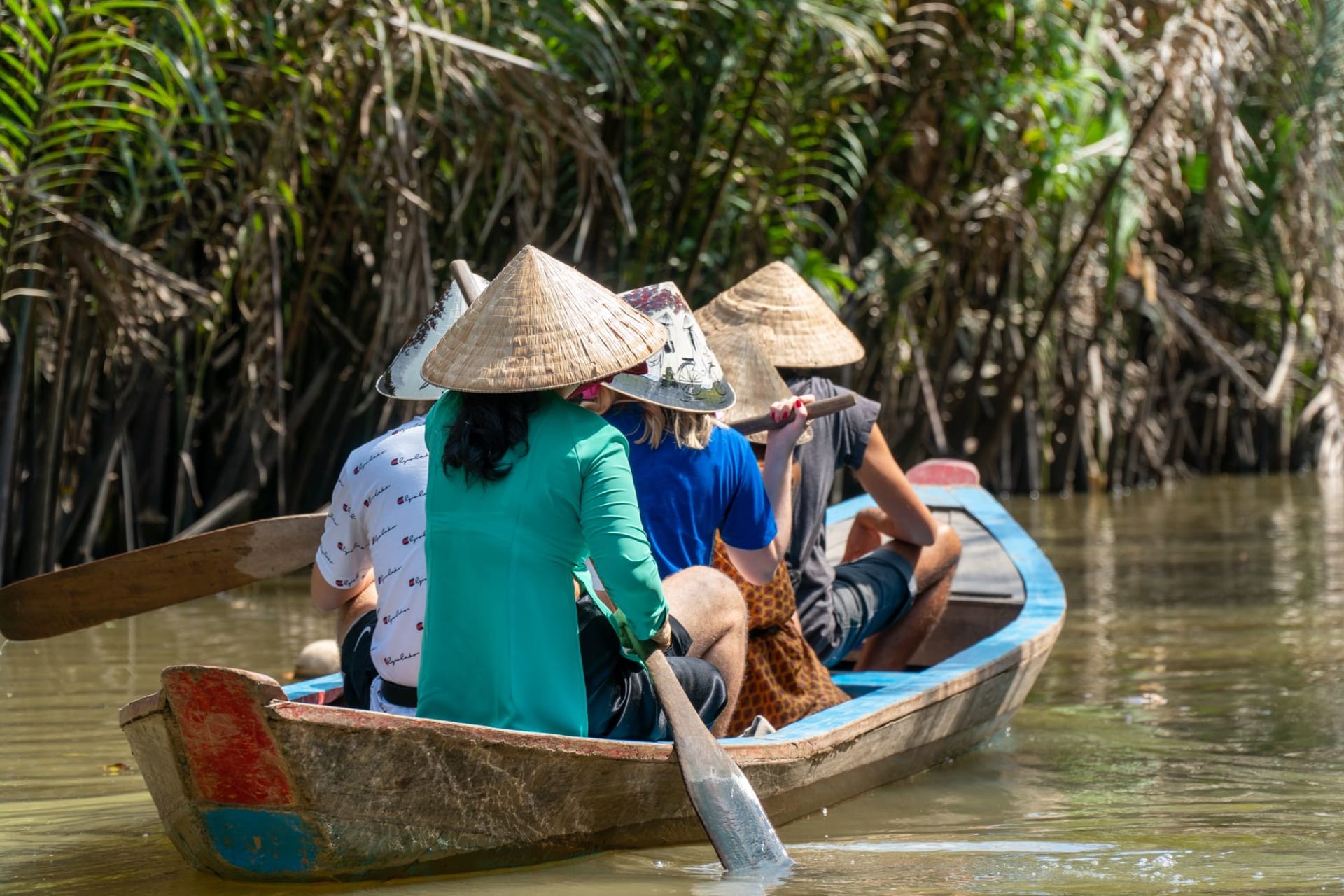
We hired a long wooden boat at the park headquarters — Lia, me, and a quiet boatman named Tâm who had, I gathered, been doing this for most of his adult life. The shallow craft slid out through channels cut between walls of reeds taller than the boat, opening every few minutes onto flooded melaleuca forest and then onto sheets of open water carpeted with lotus and water lily and a floating vegetable the Vietnamese harvest and eat. Tâm navigated entirely by landmarks invisible to me, occasionally cutting the engine so we could hear the place: a continuous layered racket of birds that I had no hope of identifying and he named without looking up.

Tràm Chim is, above all, a bird park — over two hundred species, including a long list of the threatened and the spectacular — but the animal it is famous for is the eastern sarus crane, the tallest flying bird in the world, a metre and a half of grey and crimson that arrives in the dry season to feed on the tubers in the drained grassland. Their numbers have collapsed across Southeast Asia, and the cranes’ return to Tràm Chim each year is treated locally as something between a harvest and a homecoming. Tâm had not seen them yet this season. He talked about them the way people talk about old friends who have been slow to call.
What the dry season reveals
We did not see cranes — we were a few weeks early, Tâm thought, and he was apologetic in a way that suggested he took it personally. But we saw painted storks standing in the shallows like committee members, purple swamphens stalking the lily pads, and a sky that at one point simply filled with egrets lifting off a roost in a single white sheet. The light at dawn over flooded grassland is a particular thing — low and gold and absolutely flat, no hills to interrupt it — and the reflections doubled everything until the horizon stopped meaning anything.

What stayed with me was less any single sighting than the simple fact of the place existing — a working argument, in the middle of the most intensively cultivated delta in Asia, that some of it should be allowed to stay wet and unruly and full of birds. Tâm, easing us back toward the headquarters as the heat came up, said the cranes would be along in a few weeks. I believed him. I have half a mind to go back and check.
When to go
The dry season, roughly December through April, is when the water recedes, the grassland feeds the birds, and the sarus cranes are most likely to be present — late in that window is your best crane chance. Go at first light; the birds are active, the heat is bearable, and the dawn light over the water is the entire point. Boat trips are arranged at the park entrance, and a guide who can name what you are looking at is well worth the small extra cost.