Châu Đốc
"The closer you get to Cambodia, the more Vietnam surprises you with what it contains."
The Cambodia border is twelve kilometers from Châu Đốc and you feel it before you see it. The architecture shifts: more concrete mosques, more Arabic script on shopfronts, more women in hijabs on motorbikes. The Chăm Muslim community here has been living on the Vietnamese side of what is now an international border for centuries, and they have made the town into something that doesn’t fit neatly into any version of Vietnam I’d encountered before. I crossed on a motorbike from Long Xuyên and arrived at dusk, the light falling at that particular low angle that makes the river look like hammered copper.
The Chăm quarter sits across the water on a thin slip of land reached by ferry. The main mosque is white and surprisingly modest from the outside, but the interior is cool and carpeted in green and has the particular stillness of a room where people genuinely pray. The community here is distinct from the Chăm of the central coast — different dialect, different practice, different history — and Châu Đốc is one of the only places in the delta where you can eat a meal that has nothing to do with Vietnamese cuisine. I had a dish of mutton with a spiced coconut broth and flatbread cooked on a curved iron plate, eaten on a plastic mat at a family’s house at the edge of the quarter.

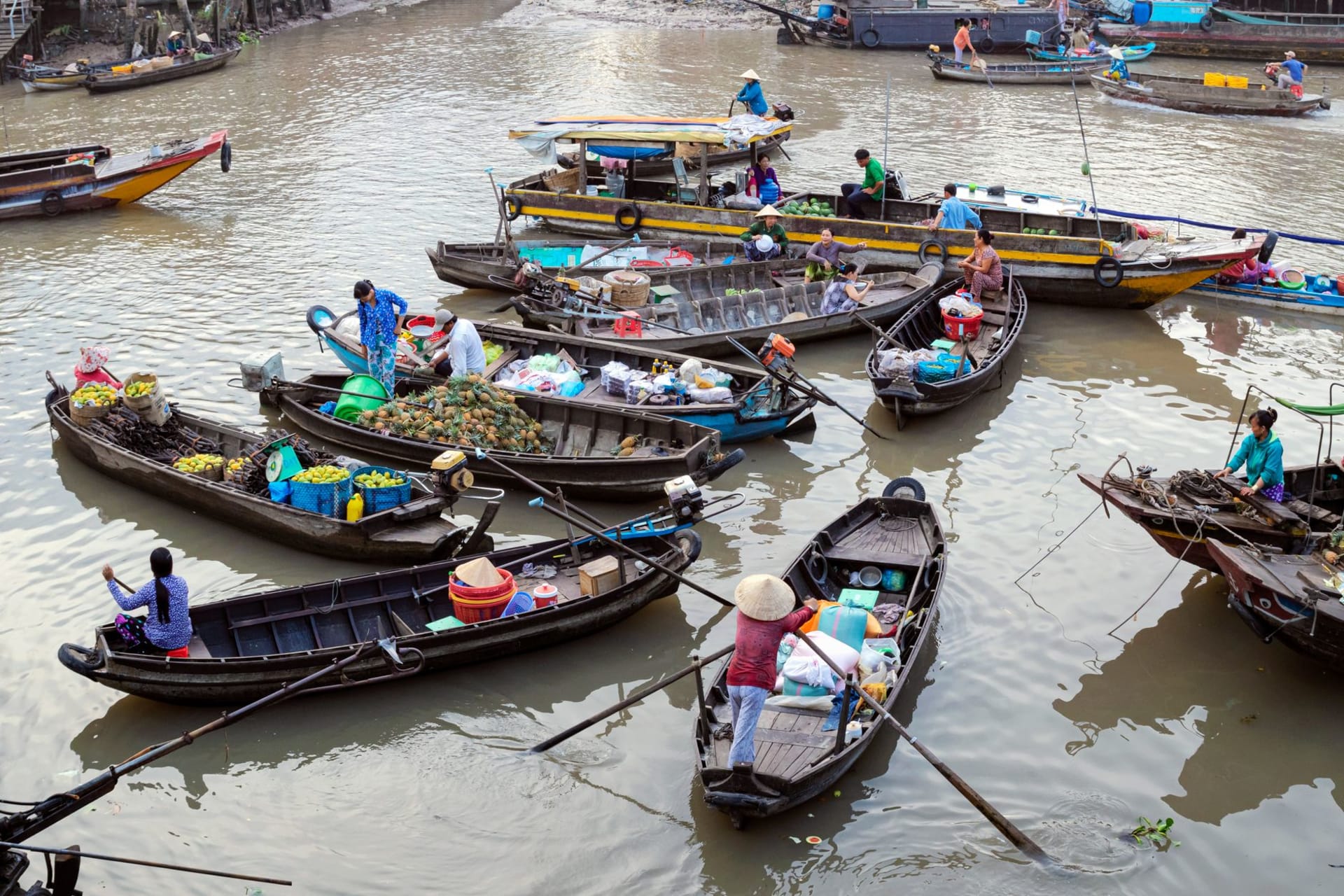
Below the river surface, suspended in large submerged cages beneath the floating houses of the fishing community, hundreds of thousands of pangasius catfish are growing. You can walk out on the planks of these floating villages and look down through gaps in the wood and see the water churning with fish. It’s an industrial aquaculture operation presented in the most domestic possible setting — families cooking dinner, children doing homework, televisions on, and beneath the floor, dinner for the rest of Vietnam. The smell of fish sauce fermenting in large clay urns on some of the boats adds another layer to the sensory situation.
Sam Mountain rises abruptly from the flat alluvial plain five kilometers from town — an anomaly of limestone surrounded by rice paddies. The road spirals around it in loops, passing temples, pagodas, and shrines at every turn. The top gives you Cambodia: flat, green, hazy, extending north and west to the horizon. I climbed it at six in the morning before the heat set in and had the view mostly to myself. A pair of monks were making offerings at the summit shrine, and from somewhere below, invisible in the mist, a rooster was making itself heard.

The noodle soup specific to Châu Đốc — bún cá — uses fish instead of pork, with a clear broth flavored with mắm, the region’s pungent fermented fish paste. It’s an acquired taste that I acquired immediately. It’s available at noodle stalls from five in the morning.
When to go: November to April, dry season. The Sam Mountain Festival in February or March draws enormous crowds but is genuinely extraordinary — a celebration with processions, offerings, and the mountain packed with pilgrims from across the delta.