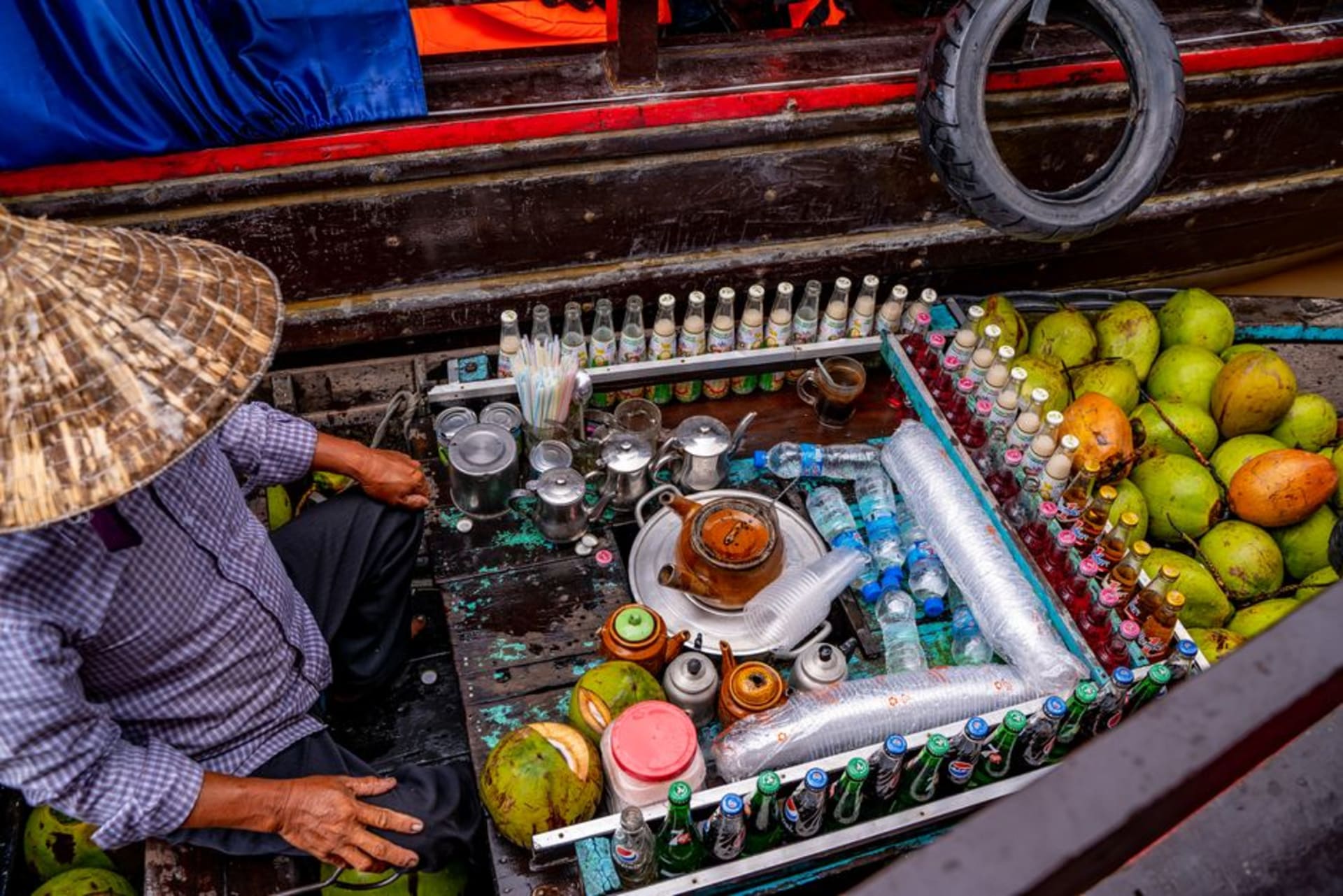
A wholesale river market where fruit vendors hang samples from tall poles, older and quieter than the delta's famous tourist markets.
We got to the dock in Cai Be before six, still dark enough that the boatman used a flashlight to check the knots on our little wooden boat. Lia had set an alarm the night before that I complained about, and then didn’t complain about the moment we pushed off into the Tien Giang branch of the Mekong and the water turned the color of pewter under a sky that hadn’t decided what it was doing yet. Within ten minutes we were among them: vendor boats, low and wide, each one with a tall bamboo pole lashed near the bow, and hanging from every pole a sample of whatever was for sale below deck. A pole with a pineapple speared on top meant pineapples. Green squash meant squash. Someone had rigged three different vegetables to one pole, and I still don’t know what that meant, but I liked trying to guess.
This isn’t a market built for people like us. That’s what struck me the most. It’s a wholesale trading point that’s been running for generations, moving fruit, rice, and vegetables in from the orchards around Cai Be district long before anyone thought to bring tourists out to watch it happen. Cai Rang, further south, has leaned into the boat-tour crowd; Cai Be still felt like it was mostly ignoring us, which I found oddly comforting. Our boatman nosed us in close to a barge stacked with dragon fruit so a woman could hand Lia one straight off the pile, waving away the coins Lia tried to offer. I don’t think she needed our business. I think she just liked that we were curious.
As the light came up properly, the twin towers of Cai Be Catholic Church appeared over the riverbank, French colonial and slightly incongruous against all that tropical green and brown water, and our boatman explained, with the patience of someone who’s answered the question a hundred times, that it had stood there watching the river trade for a very long time. We didn’t go ashore for it that morning, just drifted past slow enough to take it in, the bells not yet ringing.

From the market we cut into the narrower canals toward Tan Phong island, the boat suddenly small and the palm cover thick overhead, until we stopped at a coconut candy workshop where a woman was stirring a copper pot of caramelizing coconut paste with a wooden paddle nearly as tall as she was. We watched her cut and wrap it by hand, ate a piece still warm, and bought a bag we finished before we got back to the mainland. A little further on, at a rice-paper stall, someone showed Lia how to ladle the batter thin across a steaming cloth drum, and she made one so lopsided the woman laughed and made her try again.
When to go: Aim for early morning, any time of year — that’s when the vendor boats are out in force. If you can pick your season, the dry months from December to April keep the river calmer and the crossing to the islands a lot more comfortable.