Uxmal
"Uxmal rewards patience. Come after three, when the tour buses are leaving, and the stone starts to glow."
I rented a car in Mérida specifically because the bus schedules for the Puuc Route do not accommodate the kind of slow late-afternoon visit that Uxmal actually requires. Driving south through the low limestone hills, the scrub growing shorter and the road dipping and rising through a landscape that looks modest and slightly monotonous until you understand that this is what the Maya of the Terminal Classic period were working with — no rivers, no lakes, poor soil, an annual rainy season and a long dry one — and that everything here was built through the management of rainwater collected in underground cisterns called chultunes. The sophistication of Uxmal is inseparable from the problem it was solving.
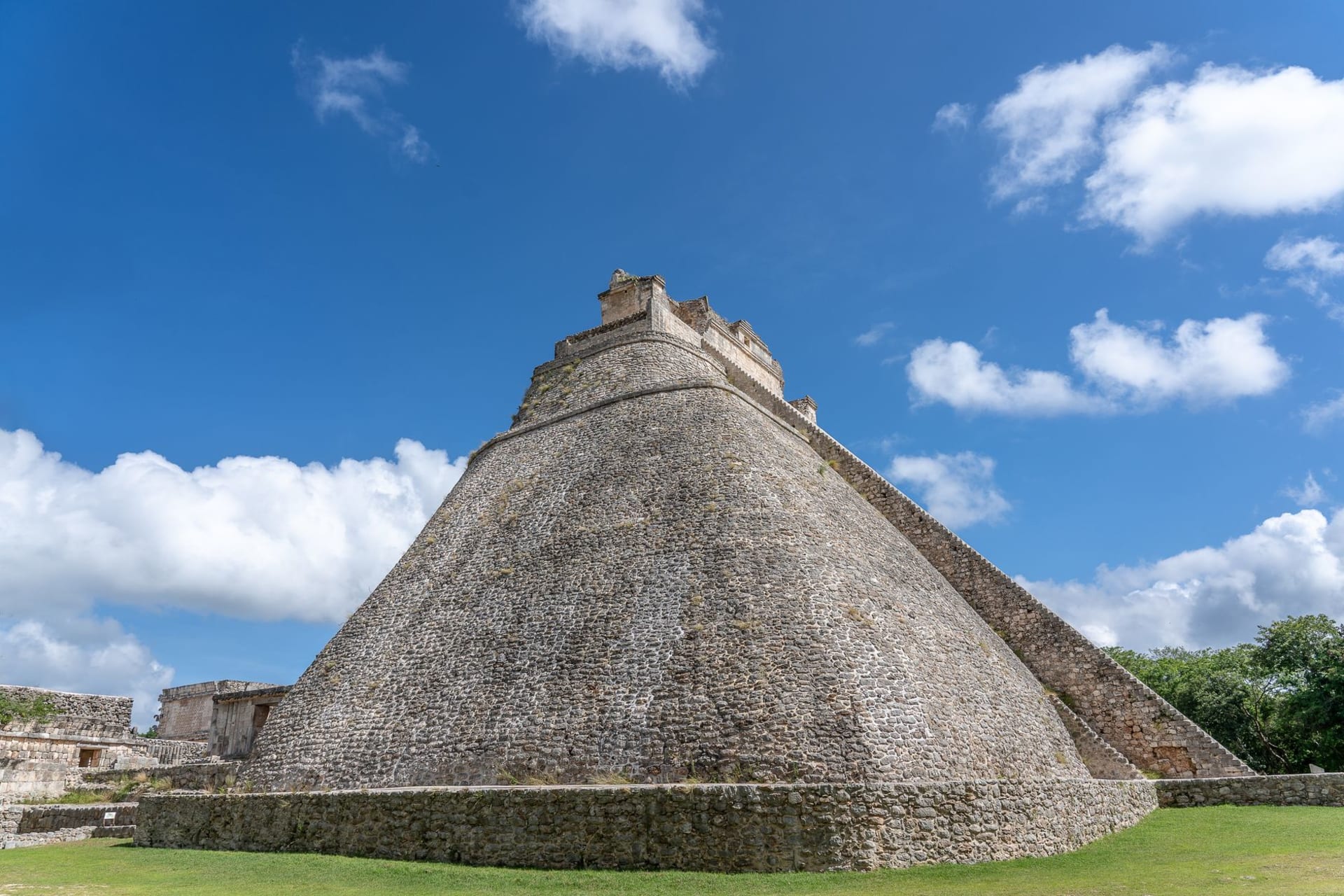
The Pyramid of the Magician is the structure that defines Uxmal from a distance, and it earns the attention. Its base is elliptical rather than square — the only major pyramid in the Maya world built on an oval plan — and it rises steeply enough that the upper temple seems almost to overhang the visitor standing below. The story attached to it, that it was built in a single night by a dwarf magician, is the kind of origin myth that makes perfect sense once you stand in front of the thing: its geometry is unusual enough to suggest something non-standard was happening here, a builder or an architecture commission that refused the conventional solution. The five-temple sequence embedded within it — one built into each other over successive construction periods — was only understood through careful excavation, and viewing the restored exterior you are looking at centuries of accumulated ambition in a single form.

The Nunnery Quadrangle is where Uxmal’s architectural program is most fully legible. Four long buildings frame a central courtyard, and the upper facades of each carry carved stone mosaic friezes that are among the most intricate I’ve seen in the Maya world — lattice panels, serpent bodies, masks of Chaac the rain deity with his characteristic hooked nose, repeated and layered and interspersed in rhythms that are clearly decorative but equally clearly carrying iconographic content. The Spanish named it the Nunnery because the rooms reminded them of a convent; the Maya name and purpose remain debated. What is not debated is that whoever built this understood proportion deeply — the courtyard is slightly trapezoidal rather than perfectly rectangular, a subtle adjustment that makes it read as correct when it would not read as correct if it were actually square.
The Governor’s Palace, on a raised terrace above the Nunnery, is often described as the finest building in the pre-Columbian Americas and I have heard no convincing argument against this. Its facade runs one hundred meters and every centimeter of the upper register is covered in carved stone mosaic. It also aligns precisely with the southernmost rising point of Venus on the horizon, a planet the Maya tracked with devotional intensity. There is a moment in the late afternoon when the sun hits the Governor’s Palace at an oblique angle and the carved stone begins to look as if it is generating light rather than reflecting it.

The nightly sound and light show is kitsch and I recommend it anyway. The narration is overwrought, the colored lights transform the pyramids into something between a rave and a casino, and yet the sheer scale of what is being illuminated is undeniable. More practically, it means the lodges on-site — the Hacienda Uxmal and the Lodge at Uxmal — serve dinner to a captive audience of people who have already given the day their full attention and are ready to eat well and sleep.
When to go: November through March for bearable heat. The site opens at eight and the tour buses from Mérida arrive around ten. Arrive at opening, explore the Nunnery Quadrangle and the Pyramid of the Magician in the morning cool, then find shade during the midday heat. Come back out at three for the afternoon light on the Governor’s Palace.