A dusty river town on the Niger where Ali Farka Touré's desert blues still seems to hum in the walls and the water.
I’ll admit it plainly: I got to Niafunké because of a record. Long before Lia and I ever thought seriously about Mali, I had Niafunké on repeat somewhere in my twenties — that hypnotic, one-take, generator-powered album Ali Farka Touré recorded right here in 1999 with a mobile studio dragged in against the odds. So when we finally worked out a route along the Niger toward Timbuktu, I told Lia there was no way we were passing this town by. She teased me the whole drive in about “finally meeting my imaginary friend.” Fair enough.
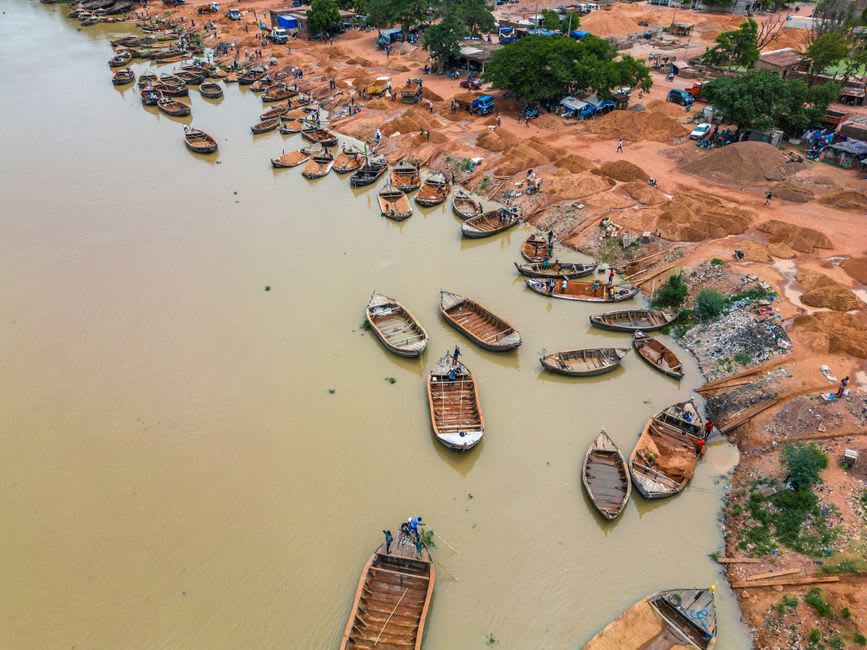
What struck me first wasn’t the music at all, though — it was how completely the town belongs to the river. Niafunké sits right on the Niger, and everything here still runs on its rhythm: when the water rises, when it recedes, when the fields get planted. Locals explained flood-recession farming to us like it was the most obvious thing in the world, which of course it is if you’ve lived by this river your whole life — you wait for the flood to retreat and plant straight into the soaked, fertile soil it leaves behind. We watched men working a strip of riverbank in the late afternoon light, and I remember thinking how little that scene owed to anything modern.
Touré wasn’t just a musician who happened to live here — he was elected mayor in 2004, and people we talked to still bring him up unprompted, crediting him with real, tangible things: roads, water systems, projects that actually got built because he pushed for them with whatever leverage his fame gave him. That’s not a footnote you find on a wall plaque; it’s just how people here talk about him, matter-of-factly, between sentences about the harvest or the ferry schedule. I didn’t get to see a studio or a shrine — there isn’t one in any touristy sense — but standing in the dusty main street, guitar riffs from that album kept looping in my head anyway.
We didn’t linger more than a couple of days — this stretch of the Niger has historically been a route north toward Timbuktu and Lake Faguibine, and that’s the direction pulling at everyone passing through, us included. But I’m glad we stopped. Niafunké isn’t a place with a checklist of sights; it’s a place you feel more than you photograph, and I left with a strange sense of having paid a small, overdue debt to an album that shaped a good chunk of my musical taste.
When to go: Aim for the cooler dry season between November and February — the heat off the Sahel eases just enough to make wandering the riverbank and the town’s sandy streets genuinely pleasant rather than punishing.
Keep exploring
More from Mali
 mali
mali Ségou
A former empire capital on the Niger where indigo-stained hands still work the cloth and the river festival fills the water with color each February.
Explore mali
mali Siby
A Mandé village sixty kilometers from Bamako where a natural stone arch frames the valley and the hills hold the memory of an empire's founding.
Explore mali
mali Sikasso
Mali's green southern capital, where the ruined earthen ramparts of a 19th-century kingdom encircle a hill swallowed by mango trees.
Explore mali
mali Timbuktu
The city that became a myth before the world stopped visiting — manuscripts, mosques, and sand advancing on three sides.
Explore mali
mali Bamako
Mali's capital sprawls along the Niger like a city that grew up beside its river and never quite forgot it.
Explore mali
mali Bandiagara Escarpment
A rust-colored cliff face where Dogon villages cling to the rock and Tellem granaries sit impossibly high in crevices no one can explain.
Explore