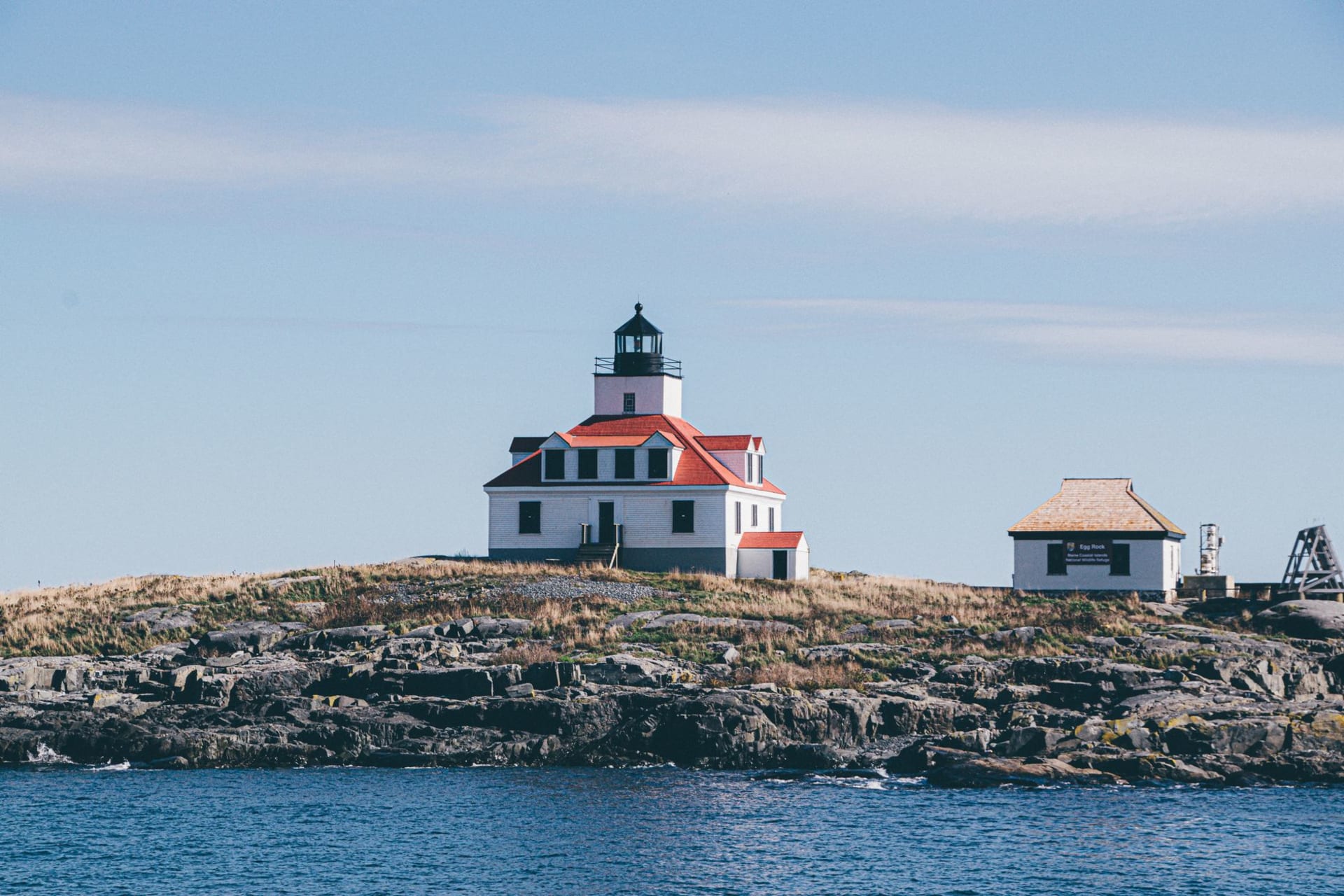
Deer Isle & Stonington
"Stonington has the feeling of a place that has decided, firmly, not to become anything other than what it is."
There is a suspension bridge that connects Deer Isle to the mainland, and crossing it feels more significant than bridges usually do. The road narrows on the other side. The spruce trees crowd closer. There are fewer houses, then fewer still, and then you are in a landscape that has the quality of having been left mostly alone — not preserved, not curated, just left. Deer Isle is a place where the economy has always been the sea, and the sea has always been unpredictable, and the people who stayed are the ones who found a way to work with that unpredictability rather than against it. The ones who couldn’t find a way left a long time ago, and what remains is a kind of distilled version of coastal Maine — beautiful in ways that have nothing to do with tourism and everything to do with the unadorned work of survival in a cold place.
Stonington, at the island’s southern tip, is as far down the peninsula as the road goes, and it is the realest fishing village I encountered in all of Maine. This is not sentiment or nostalgia. There are still more than a hundred lobsterboats working out of Stonington harbor, which makes it one of the most active lobster ports on the entire coast. When I arrived at six in the morning — I had been warned to come early — the harbor was already in motion: boats leaving in twos and threes, the sound of diesel engines rolling flat across the water, the smell of bait and salt and something oceanic that I don’t have a word for. By seven, most of them were gone. The water was quiet. A herring gull stood on a lobster trap and looked at me with supreme indifference.

The Haystack Mountain School of Crafts sits on the island’s eastern shore, on a hillside that drops in wooden terraces to the ocean. It is one of the most respected craft schools in North America — textiles, ceramics, blacksmithing, printmaking — and in summer its faculty and students inhabit the campus in a way that makes the whole island feel slightly more conscious of beautiful things. The buildings themselves, designed by Edward Larrabee Barnes in the 1960s, step down the slope on cedar stilts, their weathered wood the color of the surrounding rock, the ocean visible through the spaces between. I wandered through an open studio afternoon and watched a woman throwing a pot that had something in its form I had not seen before — a shape that seemed to be about the particular quality of winter light in this specific geography.
On the northwest corner of the island, the village of Deer Isle proper has a road that leads to a quarry where the granite for many famous American monuments was cut — the base of the Statue of Liberty came from here. The pit fills with cold blue-green water now, the walls still bearing the marks of the drill holes, and it sits quietly in the woods without any particular fanfare, the way important things sometimes do in Maine.

The fog is not always there, but when it is — and it comes often, in the night, lying thick over everything until mid-morning — the island takes on a quality that is neither eerie nor romantic in any postcard sense but simply dense, serious, and extraordinarily still. Standing at the water’s edge in that fog, with the sound of a boat’s engine somewhere out in the harbor but the boat itself invisible, you understand why the people who live here speak about the place the way they do: not with nostalgia, but with a kind of factual love.
When to go: Late June and September are ideal — the summer crowds are absent and the harbor is at full operational intensity. Avoid July and August on weekends if you want to experience the island as it is rather than as a destination. The Haystack open studios usually fall in mid-June and mid-July.