Camden
"Where else do the mountains fall directly into the sea? Camden has always felt like geography showing off."
Camden is the town that the rest of Maine’s coast seems to have been rehearsing for. The harbor curves into a protected cove at the foot of Camden Hills, and when you see the arrangement for the first time — the schooner masts rising above the waterfront, the hills forested all the way to the ridgeline behind, the bay opening south past the Curtis Island lighthouse toward a horizon full of islands — you understand immediately why this place has been painted, photographed, and rhapsodized beyond any defensible proportion. It is simply one of those arrangements of land and water and light that the eye cannot pass over without stopping.
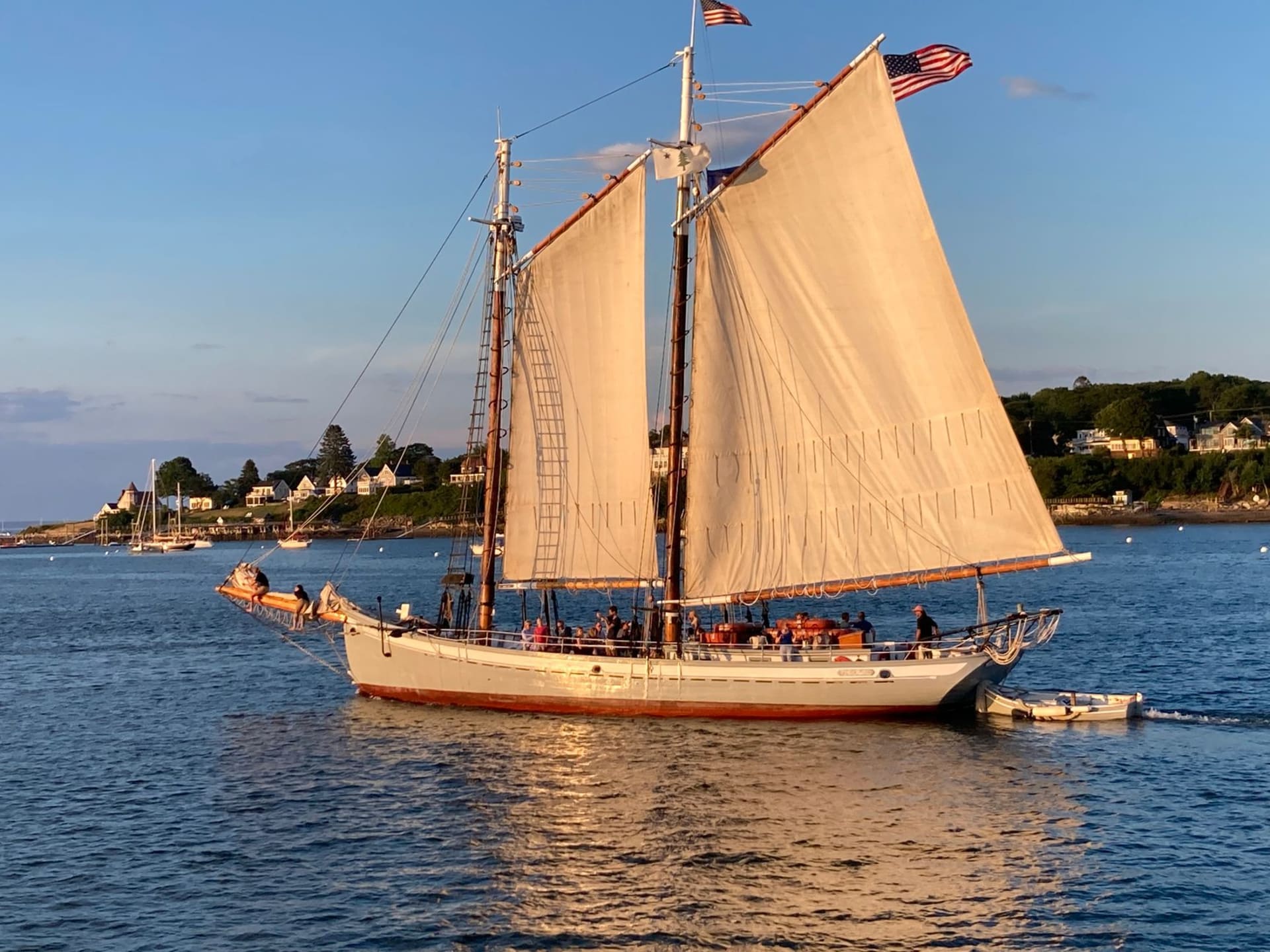
The schooners are a particular kind of anachronism that works. Camden is one of the last active windjammer ports in America: traditional wooden schooners that take passengers on multi-day sailing voyages up and down the Penobscot Bay coast. In peak summer the harbor holds half a dozen of them, their hulls painted black or dark green, their masts tall enough to be a landmark from the Camden Hills summit two miles away. I did not sail on one — the trips run three to seven days and I hadn’t planned ahead — but I watched one depart on a Wednesday morning with a full complement of passengers in rain jackets, the skipper calling something to someone on the dock, the sails going up in sections, the whole wooden structure leaning slowly into the wind and moving. It is one of those sights that makes the present tense feel slightly incongruous.

Camden Hills State Park begins practically at the edge of town — within walking distance of the harbor if you are inclined — and the summit of Mount Battie is accessible either by trail or, in an arrangement that somehow seems right for this place, by a paved auto road. The view from the top looks south over the entire Penobscot Bay archipelago: Vinalhaven, North Haven, the Penobscot Peninsula, the hills of Blue Hill across the water, and on clear days the faint silhouettes of islands further out. Edna St. Vincent Millay wrote her first major poem — “Renascence” — after climbing this hill as a teenager in the early twentieth century, and I found myself trying to see it the way a teenage girl in 1912 would have seen it, with no other buildings visible and the whole bay wild and unobstructed. The poem begins: All I could see from where I stood / Was three long mountains and a wood. That view hasn’t entirely changed.
The town itself is prosperous and knows it, and the knowing is sometimes audible. The restaurants are good but priced for the sailing crowd. The galleries are numerous. There are shops selling Maine sea glass jewelry and beeswax candles and the kind of hand-thrown pottery that signals a certain income demographic. I am not ungrateful for any of it. What I actually recommend is bypassing most of it in favor of the public landing at the head of the harbor, where the working fishermen still come in, and sitting on the dock with a coffee while the bay does its thing in the morning.

October is when Camden reveals something else: the hills behind the town go through a color change that peaks around the second or third week of the month, and the combination of blazing maple and birch with the deep blue of the bay below is, by any measure, exceptional. The leaf-peeper crowds are real, but they thin rapidly on weekdays, and the light in October — long, amber, coming in at a low angle — makes the harbor look like something from an Edward Hopper painting, all shadow and quiet water.
When to go: June for the harbor at its least crowded and the hills at their greenest. Mid-September through mid-October for the fall color, which here includes the bay as a backdrop. The windjammers sail May through October; booking far in advance is necessary for July and August.