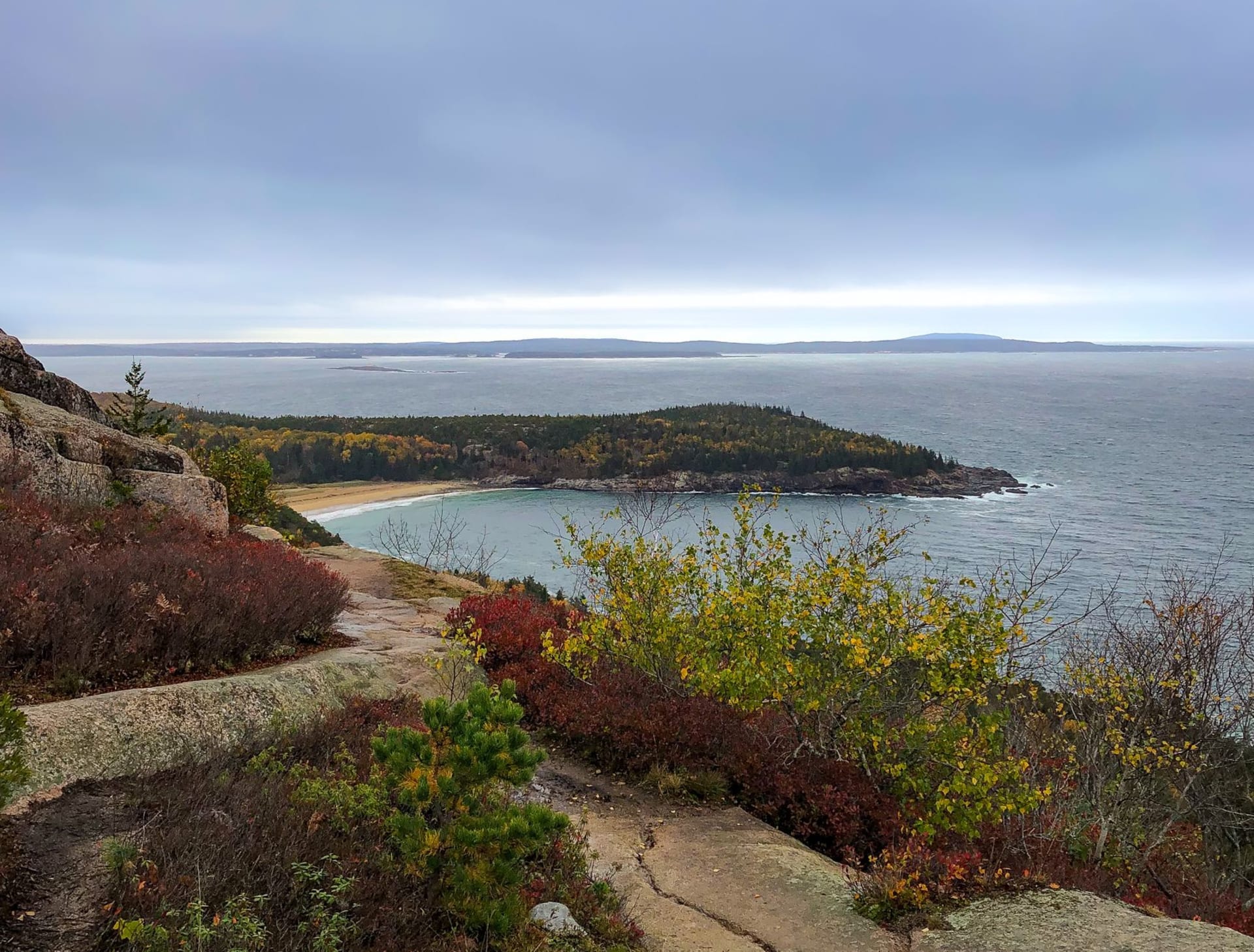
Acadia National Park
"Cadillac Mountain at dawn — standing in the first light on the eastern seaboard, feeling unreasonably small."
I drove up Cadillac Mountain before four in the morning, following the switchbacks in the dark with nothing but my headlights and the occasional reflective eyes of something I never identified beside the road. At the summit parking lot, about forty other people had already had the same idea. We stood in our jackets on the bare summit granite, facing east, not talking much, waiting. The horizon paled by degrees — cream, then pink, then the specific orange that occurs in exactly that form exactly once a day, then the edge of the sun, and suddenly there was light on everything: the islands below, the Porcupine Islands in Frenchman Bay, the distant blue line of the Maine coast stretching away in both directions. Cadillac Mountain is the highest point on the eastern seaboard north of Rio de Janeiro, and at this hour it is, literally, one of the first places in the continental United States to receive sunlight. That information feels abstract until you are standing there in the cold, watching it happen, and then it is one of the most straightforward experiences of awe I have ever had.
The park covers most of Mount Desert Island and a handful of offshore islands, and it is more varied than any single photograph suggests. The carriage roads are the most underwritten part of the story. John D. Rockefeller Jr. commissioned them in the early twentieth century, insisting they be motor-free, and they are still that — fifty-seven miles of crushed gravel roads curving through birch and spruce forests, over stone arch bridges, to viewpoints above the ocean. I borrowed a bicycle in Bar Harbor and spent a full day on them, eating a sandwich at a bridge over a stream, getting briefly lost in a way that felt deliberate, encountering nobody for stretches long enough to notice the sound of the forest: the particular silence that is never quite silence.

The Shore Path at Bar Harbor, which hugs the rocky coast below the town’s Victorian cottages, is where the geology becomes impossible to ignore. Mount Desert Island was carved by glaciers, and everywhere you look the evidence is there: smooth, rounded granite faces scored by striations, pink and gray boulders deposited with the casual indifference of a very slow moving force. At Thunder Hole, a narrow sea channel in the rock, the right combination of swell and tide produces a sound that is not thunder but close enough that you flinch the first time — the water compressing into the slot and releasing with a boom that you feel in your chest. Children love it. So did I.
Jordan Pond sits at the center of the park, its water so clear and cold that the bottom is visible at considerable depth. The Jordan Pond House, a restaurant that has existed in some form since the late nineteenth century, serves popovers — eggy, hollow, enormously puffed rolls that emerge from the oven like small balloons — with strawberry jam and butter on the lawn overlooking the water and the South Bubble mountain. It is one of those things that sound too twee to be worth doing and then turn out to be exactly perfect.

Bar Harbor itself, the town that serves as the park’s gateway, is more touristed than the rest of the island deserves. In high summer its main street is thick with people in Acadia sweatshirts clutching ice cream. But go early, or go in June, or go in October when the crowds are gone and the birches on the carriage roads have turned — and the town becomes again what it was: a quiet place at the edge of a great park, looking out toward a bay that runs its colors through every shade of the Atlantic depending on the weather.
When to go: June is the sweet spot — crowds are thin, the park is lush, and the days are long enough to do everything twice. September and early October bring fall color and cool clarity but the crowds return on weekends. Avoid the last two weeks of July and all of August on the summit road unless you enjoy waiting in lines at altitude.