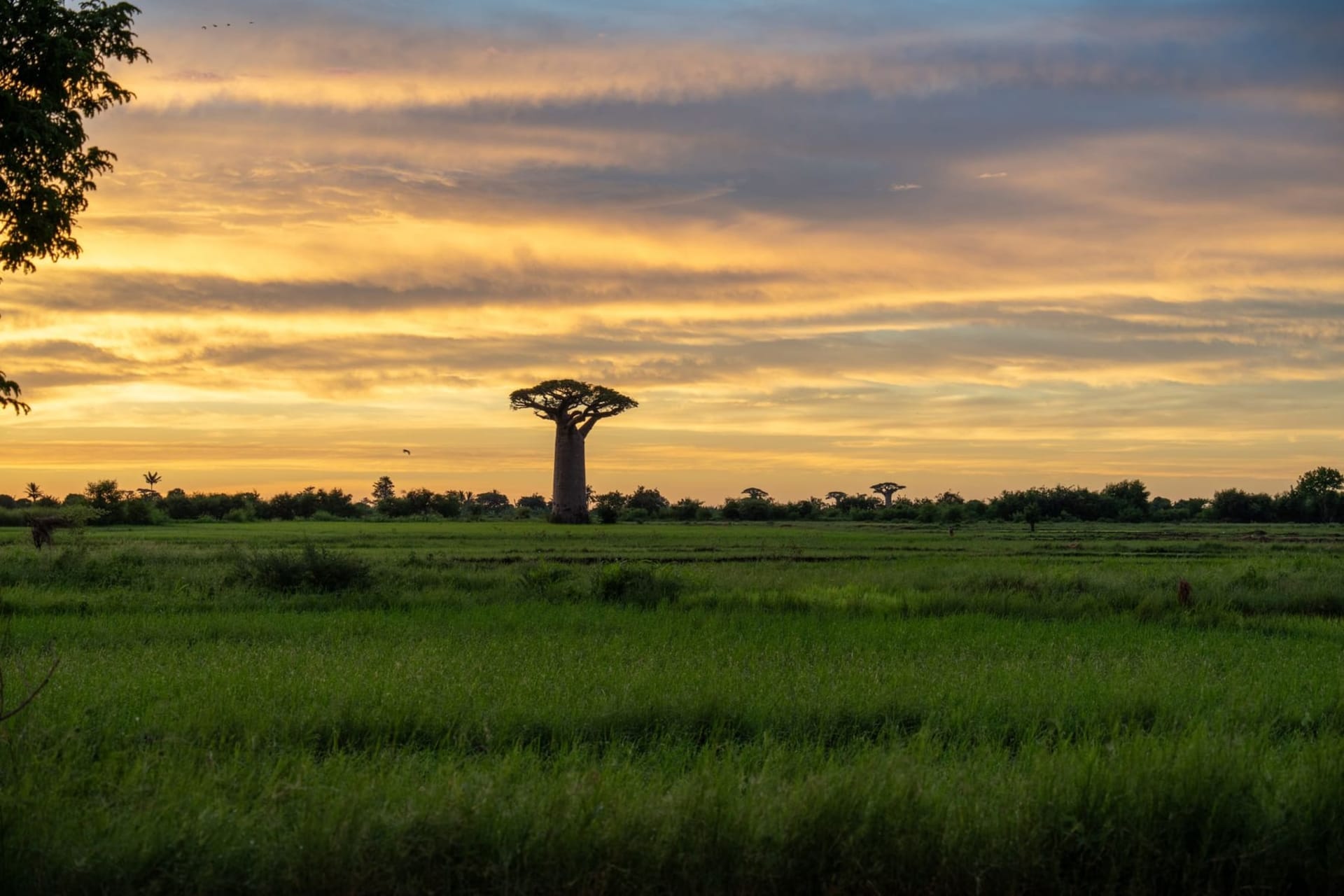
Ancient baobab trees 800 years old lining a laterite road at sunset — Madagascar's most iconic image.
The road to Morondava is a slow undoing. Hours on a rutted track through dry scrubland, red dust coating everything — the seats, my forearms, the back of Lia’s neck — and then, without warning, the trees appear. Not gradually. All at once. Six, eight, a dozen of them, rising from the flat earth like something a child drew before they understood scale.
The Road Itself
The Avenue du Baobab is not a park or a reserve. It is a working laterite road between the villages of Belo sur Tsiribihina and Morondava, used daily by zebu carts and motorcycles and women balancing loads on their heads. The baobabs — Adansonia grandidieri, endemic to Madagascar — stand on either side with no fanfare. No entrance fee when we arrived. No fence. A man selling slices of coconut from a cooler sat in the shadow of a trunk that was already centuries old when the first Merina kingdoms rose in the highlands.
That indifference to grandeur is what undid me.
I pressed my palm against the bark. It was warm from the afternoon sun, faintly corrugated, and wider than my arm span by a factor I couldn’t calculate. The tree holds water inside that trunk — thousands of liters — which is why the bark feels almost taut, like skin over something living and pressurized.
The Hour Before Sunset
We arrived at four in the afternoon, which the man with the coconuts confirmed, in French, was exactly right. By five the light had changed from white to amber to a deep copper that made the laterite road glow like cooling iron. Lia sat on a low rock and stopped talking. That almost never happens.
What I hadn’t anticipated was the smell. Dry grass, warm earth, something faintly fermented from the standing water in a rice paddy just off the road. It wasn’t picturesque. It was agricultural, dusty, lived-in — and it made the whole scene more real than any photograph had prepared me for.
The surprise came at dusk: a pair of giant fruit bats crossed overhead, slow and deliberate, their wingspan absurd against the dimming sky. Local kids laughed at whatever expression crossed my face. They see this every evening.
Getting There
Morondava is accessible by domestic flight from Antananarivo or by road from the north. The Avenue itself is roughly seven kilometers from town — tuk-tuks and taxis make the run for a few thousand ariary. Hiring a guide is worthwhile less for information than for navigation; the unmarked turnoffs will defeat you at dusk.
When to go: The dry season runs from April through October, with July and August offering the clearest skies and the most dramatic sunset light. Avoid the rainy season between December and March — the laterite road floods and the trees disappear into low cloud.