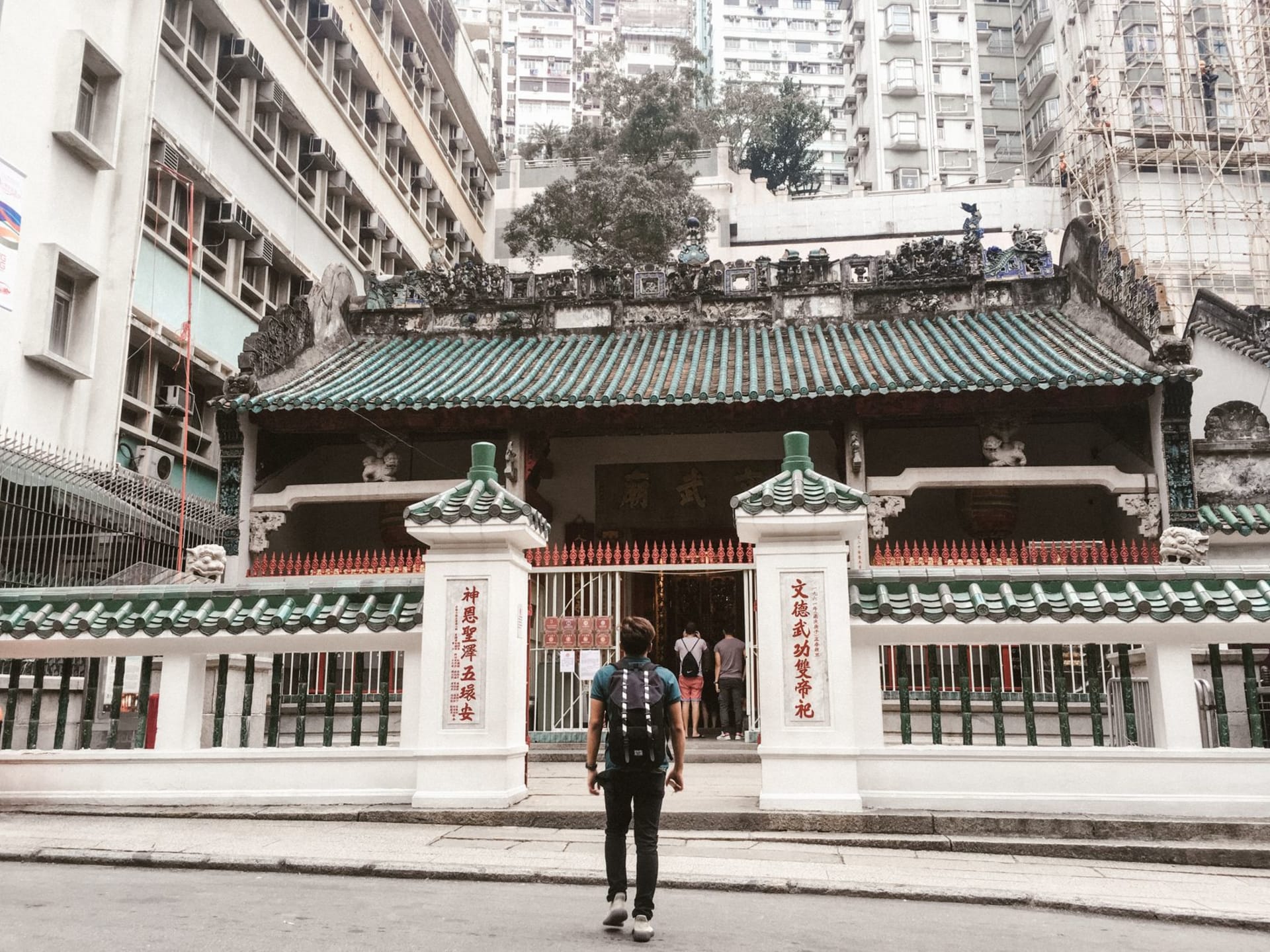
A-Ma Temple
"Macau is named after a goddess. The Portuguese asked the locals what this place was called and they said: temple of A-Ma."
The Portuguese arrived on the southwestern tip of the Macau peninsula in the early sixteenth century and asked the people they found there what this place was called. The people, presumably indicating the temple behind them, said something like “A-Ma Gao” — Bay of A-Ma, the sea goddess whose shrine stood here. The Portuguese heard “Macau.” The name of the entire territory, for four centuries and counting, is a mishearing of a reference to this temple.
A-Ma Temple sits at the waterfront of the Inner Harbour, wedged between the hillside and the old fishing quay. It was built in 1488, which predates the Portuguese arrival by about three decades, and dedicated to Mazu — the goddess of the sea, protector of fishermen, one of the most widely worshipped figures in southern Chinese coastal culture. The temple is still an active place of worship. This is the first thing to understand about it: it is not a museum piece. When I arrived on an ordinary Tuesday morning, half a dozen women were burning paper offerings at the courtyard furnace, a man in his seventies was kneeling before the main altar, and the air was so thick with incense smoke that my eyes watered before I’d crossed the threshold.

The temple complex is built into the hillside rather than on flat ground, which means it ascends in a series of levels, each chamber or pavilion higher than the last. You move through it by climbing stone steps cut into the rock face, passing shrines decorated with red and gold in the Chinese tradition, the walls dense with calligraphy and carved stone relief. There are several distinct pavilions — one dedicated to A-Ma, one to Guan Yin, one to Guan Di — each with its own atmosphere, its own particular smell of incense, its own regulars who seem to have a preferred altar and a preferred time.
The highest point of the complex has a pavilion with a stone carving of a sailing junk cut into the rock face — supposedly a memorial to the boat that carried A-Ma to this shore, or perhaps a votive offering from fishermen grateful for a safe return. Sitting up there on a carved stone bench, looking out through a gap in the old walls toward the Inner Harbour, I could see the ferry terminal a kilometer away, the new Macau-Hong Kong bridge beyond it, the cargo ships at anchor in the channel. Four hundred and fifty years of maritime history, visible through the same gap, from the same spot.

The neighborhood around the temple — the Barra district — is one of the quieter parts of Macau’s historic peninsula. Old shophouses, a few small restaurants, the smell of salt fish drying in the sun. The Macau Maritime Museum is directly across the street from the temple entrance, and while it is modest in scale, it contextualizes everything about this waterfront and this city as a trading post that grew up around the sea.
When to go: Morning is best — the light comes from the east and illuminates the rock carvings, and the regular worshippers are most active before noon. The temple is busiest on the first and fifteenth of each lunar month and on the festival of Mazu (23rd day of the third lunar month). Dress conservatively and move quietly.