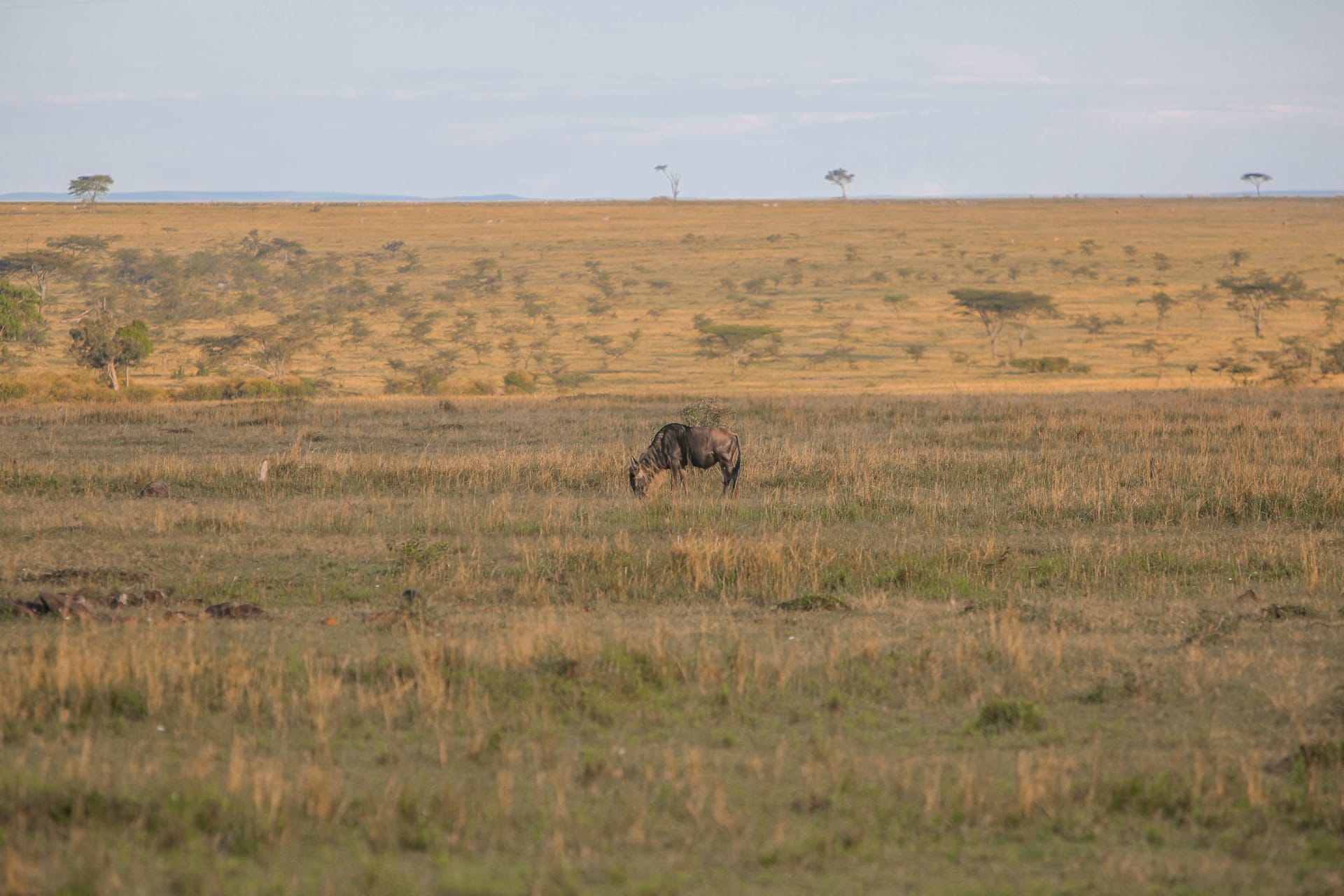
You wait at the river longer than you expect to. That’s the first thing nobody tells you. The wildebeest gather in their thousands on the northern bank — a shifting, lowing mass of muscle and anxiety — and they don’t move. They stare at the water. Some of them wade in a meter and then bolt back, spooking the whole herd into a stampede away from the bank, only to circle back twenty minutes later and start the whole deliberation again. Samuel, my driver, said he’d seen herds wait three days at a crossing point before finally committing. So we parked on the embankment above the water and we waited too, engine off, drinking lukewarm coffee from a flask, and I found myself genuinely unable to do anything except watch.
The Mara River moves with the confidence of something very old and very indifferent. It’s the color of milky tea — tannin-brown, swirling, carrying red laterite soil down from the highlands. The banks are thick with sedge grass and crooked fig trees, and in the shallows the hippos park themselves like grey boulders, their ears rotating like satellite dishes. I could smell the river before we reached it that first morning: something rich and vegetal and slightly rotten, the smell of water that does a lot of work.

When the crossing finally happened — not that morning, but the following one, just after seven — it was nothing like the footage I’d seen. The footage makes it look choreographed. In person it was pure chaos. One wildebeest went in, then fifty, then suddenly the whole bank dissolved into water and noise and the smell of something sharp and animal. The crocodiles moved with a laziness that seemed obscene given what was happening. They didn’t thrash or chase — they simply intercepted, with a patience that felt almost administrative. Most animals made it across. A few didn’t. The ones that crossed shook themselves on the southern bank and immediately began to graze, as if they hadn’t just survived something.

In the dry months, outside migration season, the river pulls in different wildlife. Elephants come down to drink at dusk, standing chest-deep and using their trunks like siphons. Leopards drape themselves in the riverside figs. The hippos make their nocturnal journey upstream, grunting in the darkness in a way that sounds, at three in the morning, alarmingly like something trying to break into your tent. The river never empties of life. It just changes what it’s showing you.
When to go: July through October for the Great Migration crossings — but understand that the timing is entirely up to the wildebeest. Come with patience and no fixed expectations. Outside migration season, November and February are excellent for the resident wildlife and dramatically fewer vehicles on the banks.