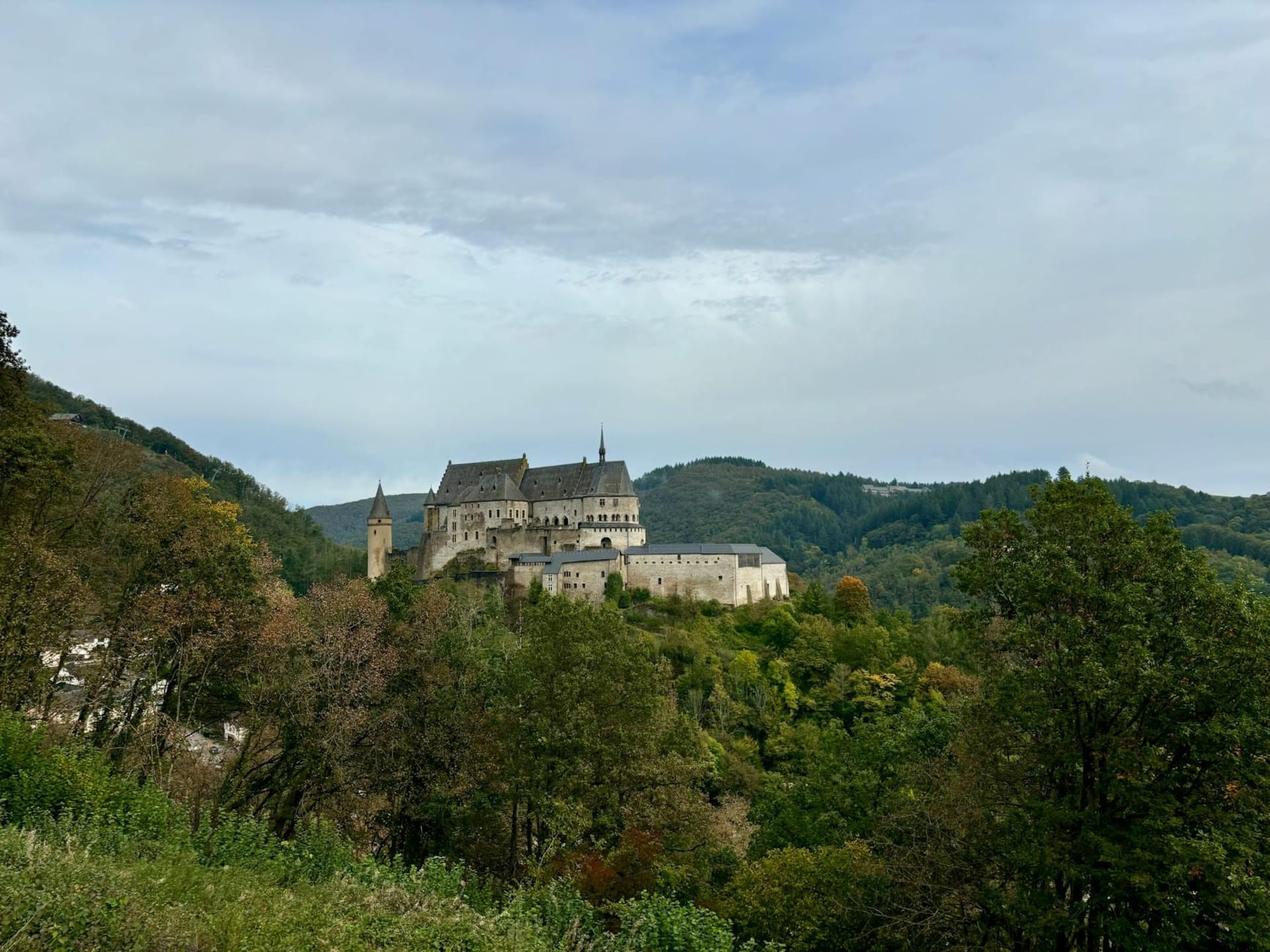
Vianden
"Vianden is the castle town that larger countries would have put on their money."
A medieval castle-topped village straight from a fairytale, tucked into the Our river valley on Luxembourg's border with Germany.
I had low expectations for Vianden — Luxembourg is a small country, and I’d assumed its medieval showpiece would feel like a managed ruin, cleaned up and roped off for coach groups. Instead, walking down the Grand-Rue on a Thursday morning in October, I found a village that seemed entirely unconcerned with performing for visitors. Butchers were unloading meat. A woman in her seventies was scrubbing her doorstep. The castle above us looked like it had been placed there by a novelist, not a tourism board.
The Castle That Earned Its Silhouette
The Château de Vianden sits at an elevation that seems slightly too dramatic to be real. From the Our river bank, the whole composition — water, bridge, steeple, ramparts — reads like something painted on a lacquered box. But the castle isn’t just a backdrop. It was the ancestral seat of the House of Orange-Nassau, which puts it in the same genealogy as the Dutch royal family, and the interior reflects that lineage: frescoed halls, a Romanesque chapel that dates to the eleventh century, and a Gothic great hall where the winter light enters in long cold bars through arched windows.
Victor Hugo spent time in Vianden — he was exiled from France under Napoleon III and came here repeatedly between 1862 and 1865. There’s a small house-museum on the rue de la Gare where he stayed. I wasn’t expecting much from it, but Lia pulled me inside on a whim, and we ended up staying forty minutes. His handwritten notes cover the walls alongside sketches he made of the valley. He wrote letters from this house about the silence. I understood exactly what he meant.
The Hour Before Lunch
The Our river marks the German border at the edge of town. Along its bank, past the small hydroelectric pump station — an odd but somehow charming piece of infrastructure — there’s a walking path that turns quiet fast. We followed it north until the village noise disappeared entirely, just water over stones and the occasional rustle of something in the beech leaves overhead. The smell in that corridor, wet rock and late-autumn fungus, stayed with me longer than anything I ate.
We had lunch at a terrace overlooking the river: a thick bean and smoked pork soup, the kind that arrives without ceremony and earns its keep through sheer density. The bread came from somewhere close. I didn’t ask where. Some things are better assumed.
When to go: Late September through early November is ideal — the crowds have thinned, the valley foliage turns amber and rust, and the light on the castle walls in the late afternoon has a quality that the summer haze never quite allows. Avoid July and August if solitude matters to you.