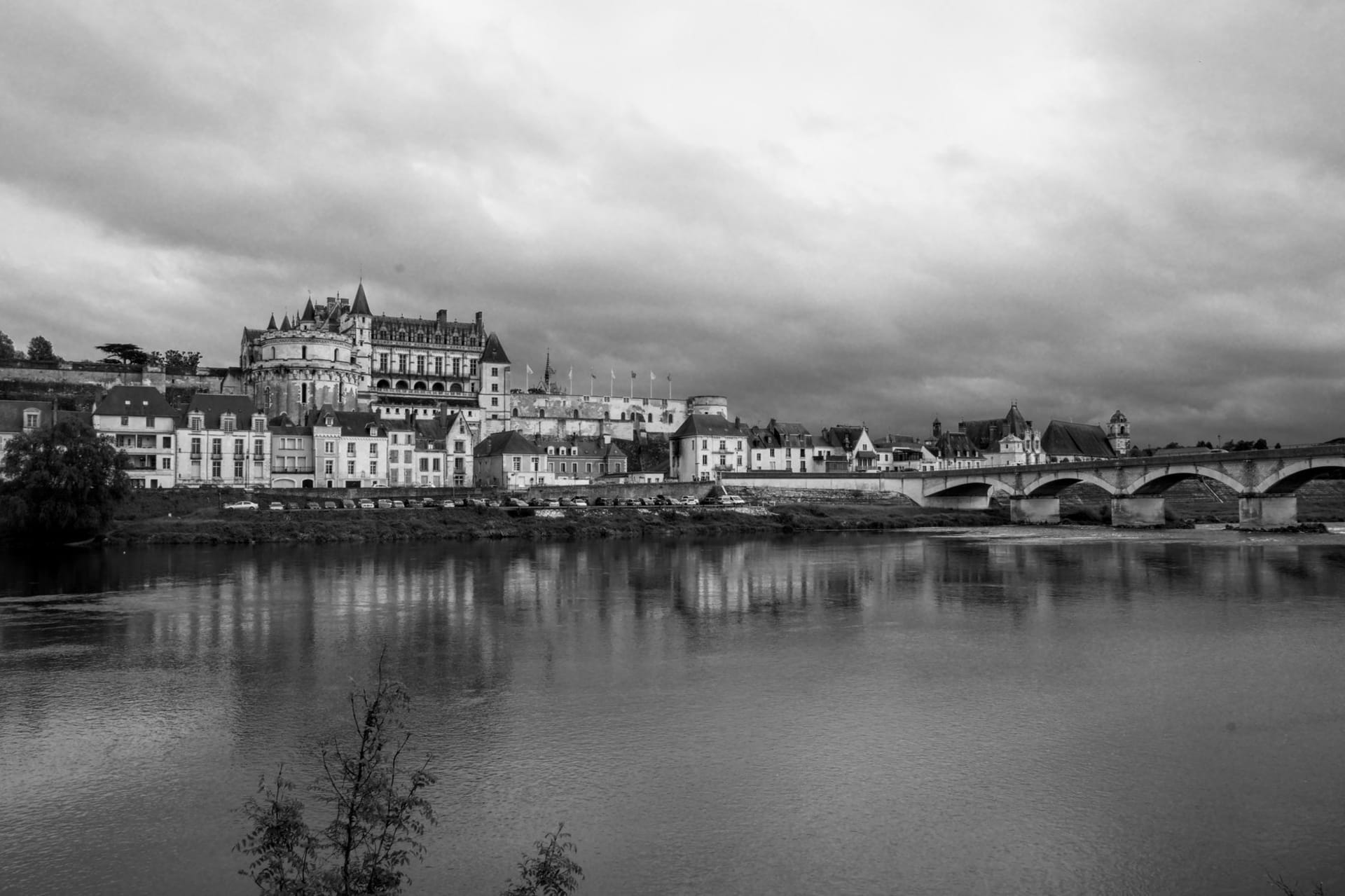
Amboise
"François I invited Leonardo here for the company. The river probably sealed the deal."
I arrived in Amboise on a bicycle, coming south along the Loire à Vélo from Blois with the wind behind me and the smell of mud and warm water rising from the river. The town announced itself slowly — first a clutch of white limestone rooftops, then the twin towers of the Château Royal appearing above the cliff edge, and finally the whole thing: a medieval fortress perched on its promontory above the Loire, with the town gathered at its feet like a congregation. I locked the bike to a bollard near the bridge and stood there for a long moment doing nothing useful except looking.
The Château Royal is where Charles VIII died after hitting his head on a doorframe — an ending that somehow feels appropriate for a palace this theatrical — and where François I brought the Italian Renaissance to France in the form of artists, architects, and one very old Florentine genius. The château itself is enormous and mostly empty in the way that royal residences become empty once the royals have moved on, but the views from the terrace above the Loire are worth every stair. The flat river, the poplar-lined islands, the Touraine plain stretching south — in September light it is the kind of view that explains itself.

But the place I kept returning to was Clos Lucé, a small manor house a short walk from the château where Leonardo da Vinci spent his last three years, from 1516 until his death in 1519. François I gave it to him, along with a generous pension and the title of “First Painter, Engineer and Architect to the King,” which seems like an appropriately royal way of asking your favorite genius to move nearby. The house is intimate and slightly worn in the way of places that have been loved for a very long time. Leonardo’s bedroom, his studio, the small chapel he used — preserved without over-restoration, which means you can still feel the particular quality of light through those low windows without everything feeling like a stage set. In the garden, the museum has installed full-scale models of his machines — a tank, a flying contraption, a hydraulic saw — and whether they read as moving or faintly ridiculous depends entirely on your mood.

The town market runs on Friday mornings under the covered hall near the river. Old men sell cheese from wooden carts. A woman arranges ropes of garlic. There is a stall with five types of goat cheese and a handwritten sign explaining the milk comes from a farm visible from the road. I bought a round of crottin and a bottle of Vouvray at the cave coopérative across the street and ate both on a bench by the Loire while a heron stood absolutely motionless on a sandbar fifteen meters away, which is the correct way to spend a Friday morning in the Loire Valley.
When to go: September is Amboise at its best — summer crowds have thinned, the light is amber and oblique, and the market fills with early harvest produce. May runs a close second, quieter still and with the gardens theatrical. Avoid July and August unless you enjoy queuing with four coaches of school groups at the Clos Lucé ticket window.