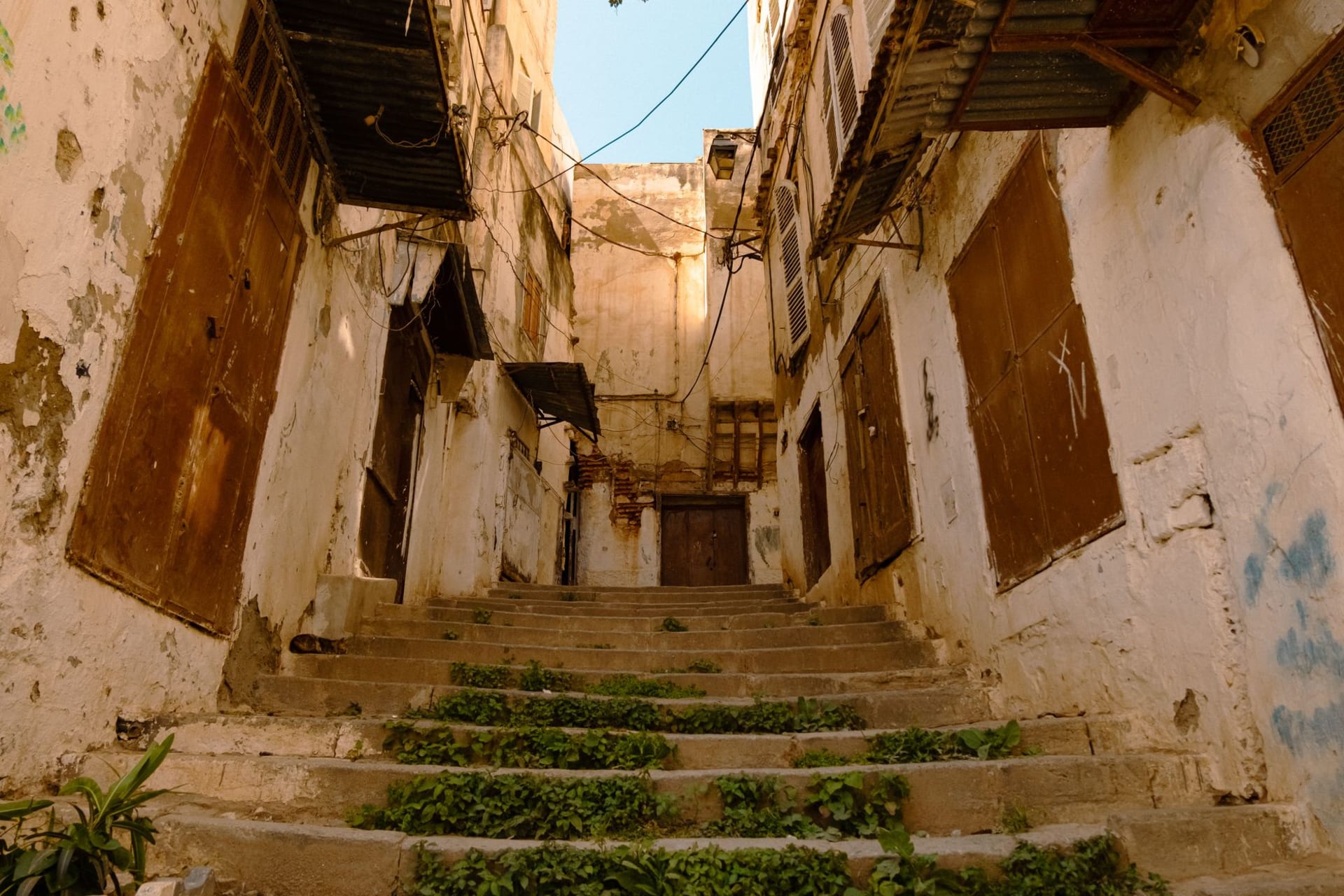
Tripoli Old City
"A Roman arch in the middle of traffic, holding up nothing but the sky and four centuries of accumulated nerve."
The Arch of Marcus Aurelius was the first thing I recognized in Tripoli — a marble triumphal arch from the second century, standing in the middle of what functions as a roundabout in the old city, cars threading past it with the casual disregard of people who have grown up alongside something extraordinary. I had been expecting to feel the usual tourist remove, that sense of looking at history through glass. Instead, I stood on the street while a truck idled three meters from a Roman column and felt the strangeness of time collapsing — not dramatically, but quietly, the way it does when you realize a thing has simply always been here, and the city built itself around it over two thousand years, and now neither the arch nor the traffic finds the other remarkable.

The medina of Tripoli is smaller than Tunis or Marrakesh, and more layered. The Ottomans built here for four centuries, leaving mosques with fine geometric tilework — the Gurgi Mosque has the most beautiful interior I found in Libya, its every surface covered in Andalusian-influenced tiles and carved plasterwork — and a caravanserai that now houses secondhand goods, and the Qasr al-Hamra, the Red Castle, a fortress-museum complex on the waterfront that contains, in its various rooms, Byzantine mosaics, Roman statuary, and horseshoe arches of such proportional perfection that I kept walking back through them to check they were as good as I remembered. From the roof terrace you look out over the harbor and the newer city beyond, and the scale of time compressed into one view is quietly vertiginous. The souk smells of rosewater and cumin and something I could not identify for half a day before tracing it to Libyan frankincense sold in small pellets from sacks — a resinous, slightly burnt smell that clings to cloth and memory equally.

The food stalls along the souk’s interior corridors were selling shakshuka made with preserved lemon, and pastries filled with dates and orange blossom, and small cups of Libyan coffee thick with cardamom and ginger that hit the bloodstream like a quiet emergency. I ate standing up, leaning against a tiled pillar, watching the foot traffic move through a covered alley whose ceiling had been replaced at least three different times in three different eras by the visual evidence. The Italian quarter, built during colonial occupation in the early twentieth century, adds yet another layer. Wide boulevards, a cathedral now converted to a mosque that retains its dome and campanile, apartment buildings with the rational optimism of Fascist-era architecture. It sits uncomfortably next to the medina and the Roman arch and the Ottoman mosques, but that discomfort is honest — it reflects what actually happened here, which was not comfortable. Walking the full circuit of the old city in an afternoon, you move through something like an argument between five civilizations, conducted in stone.
When to go: October through March. Summer in Tripoli is hot and humid from the Mediterranean. The medina’s covered alleyways offer refuge but the city is more pleasant to explore in cooler months. Friday mornings are quiet and contemplative; the souk comes fully alive from Saturday through Thursday, reaching its most chaotic and satisfying state in the late morning hours.