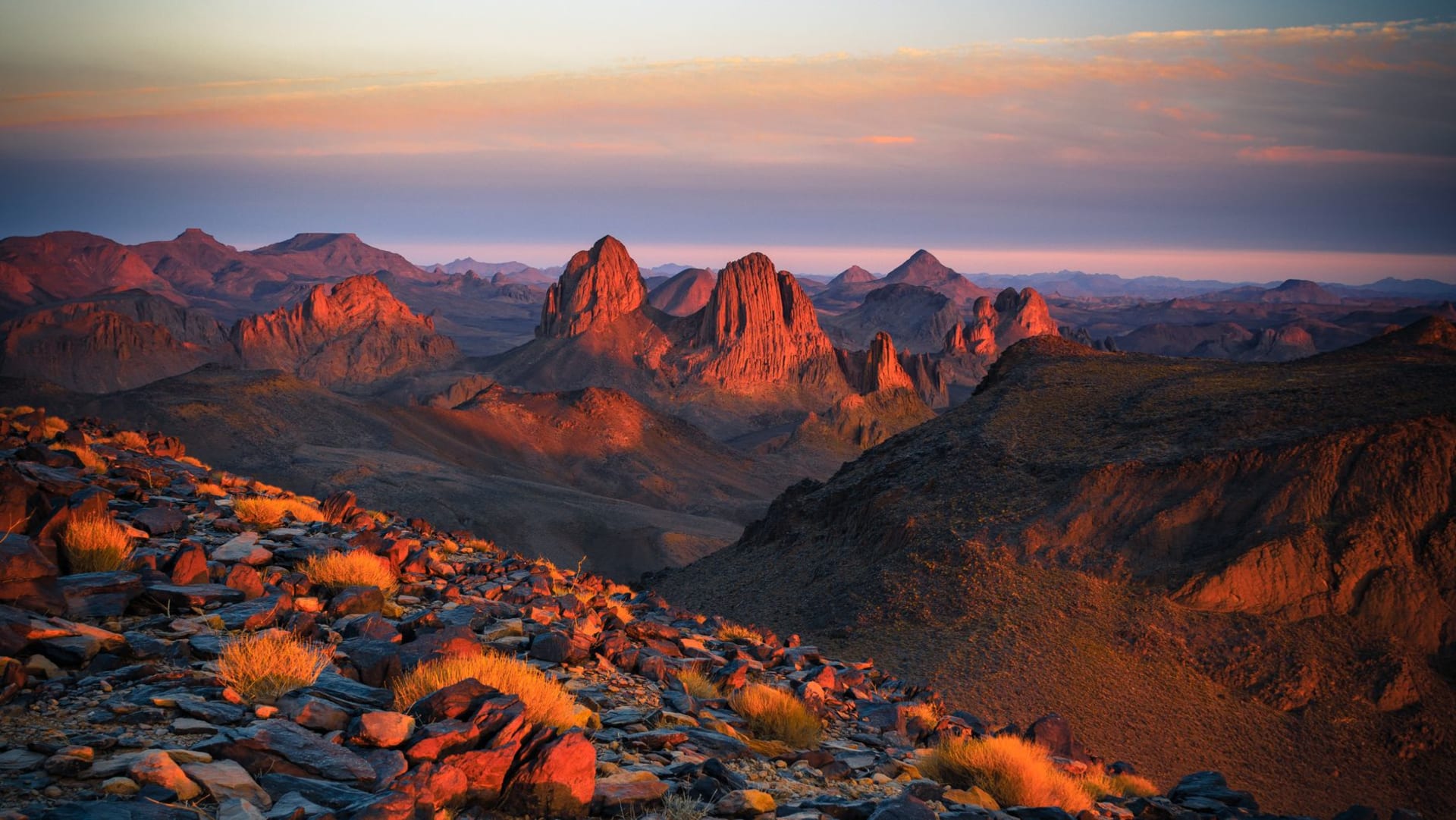
Akakus Mountains
"Someone painted a giraffe here eight thousand years ago. There are no giraffes in Libya anymore. That is the whole story."
The paintings were not where I expected them. I had been walking with a Tuareg guide named Mukhtar along a dry riverbed — a wadi — between orange sandstone cliffs in the Akakus Mountains in southwestern Libya, about four hours by Land Cruiser from the nearest town, and I was looking at the walls as landscape: layered rock, wind erosion, the deep shadow of an overhanging ledge. Then Mukhtar stopped and said nothing and pointed, and I looked more carefully at the rock face and saw, at eye level, a line of animals.
Cattle. Painted in ochre and white, their horns swept back in the distinctive style of ancient Saharan rock art, walking in a line that followed the natural grain of the rock. I put my face close to the wall and the paint was bright in a way that surprised me — not vivid as in newly made, but unfaded, protected from rain and UV by the overhang above them for eight thousand years. The paintings at this site are approximately six to eight thousand years old. They predate ancient Egypt. They were made when the Sahara was a savanna — wet enough to support cattle, elephants, hippopotamuses, giraffes — all of which appear in the rock art of the Akakus. There are no giraffes in Libya now. There have been no giraffes here for millennia. Looking at one painted on a cliff face in the middle of the modern Sahara is an experience with no clean category: it is grief and archaeology and wonder and disorientation arriving simultaneously, with no instruction about which to feel first.

The Akakus range is a UNESCO World Heritage Site and one of the world’s great concentrations of prehistoric rock art. The paintings and engravings span twelve thousand years of human presence in the area — from the earliest marks made by hunter-gatherers at the end of the last ice age, through pastoral scenes from the Neolithic Green Sahara, through images of horses and then camels as the climate dried. It is the longest visual record of a climate catastrophe I know of: you can watch, panel by panel, the water disappearing and the people adapting until the cattle are gone and only camels remain. The last few panels before the camel era show horses in landscapes that are already beginning to thin, the vegetation sparser in the painted context, as if the artists were recording what they could see happening.
We camped that night in a bowl between cliffs, the fire small and the stars consequential. Mukhtar brewed tea over the coals in the long, careful Tuareg process — heating the pot, rinsing, filling, waiting, pouring from height to create the foam — and told me in French, which he spoke with considerable precision, that his family had been guiding people to the rock art sites for three generations. His grandfather learned which panels were accessible on camelback. His father learned on the first Land Cruisers. He learned by studying photographs on the internet and then verifying them in person. “The paintings don’t change,” he said. “The way people find them does.” He poured a second round of tea and the fire made small sounds and the sandstone cliffs were dark shapes against the stars and somewhere below the horizon the modern world continued without us.

When to go: November through February. The Akakus in summer is among the hottest places on earth — temperatures can exceed 55°C. The drive from Ghat takes four to six hours on rough desert tracks and requires a 4WD and a guide. November offers perfect temperatures, clear desert air, and the rock art surfaces at their most legible in the low-angle winter light, which rakes across the engravings and makes the reliefs visible that flat summer light would bleach out entirely.