Sapo National Park
"The forest here doesn't care whether you find it beautiful or terrifying. It simply continues."
We left Greenville before sunrise in a dugout canoe with an outboard that coughed and caught and eventually settled into a reliable rhythm on the Sinoe River. The ranger sat in the bow watching the bank, and I sat amidships watching everything — the river surface steaming faintly in the pre-dawn air, the trees closing overhead as we moved upriver, the shapes of things just visible in the dark water. A grey heron lifted from a sandbar and disappeared into the forest before I could track where it went. I had the feeling, arriving into Sapo this way, of being admitted somewhere rather than merely arriving.
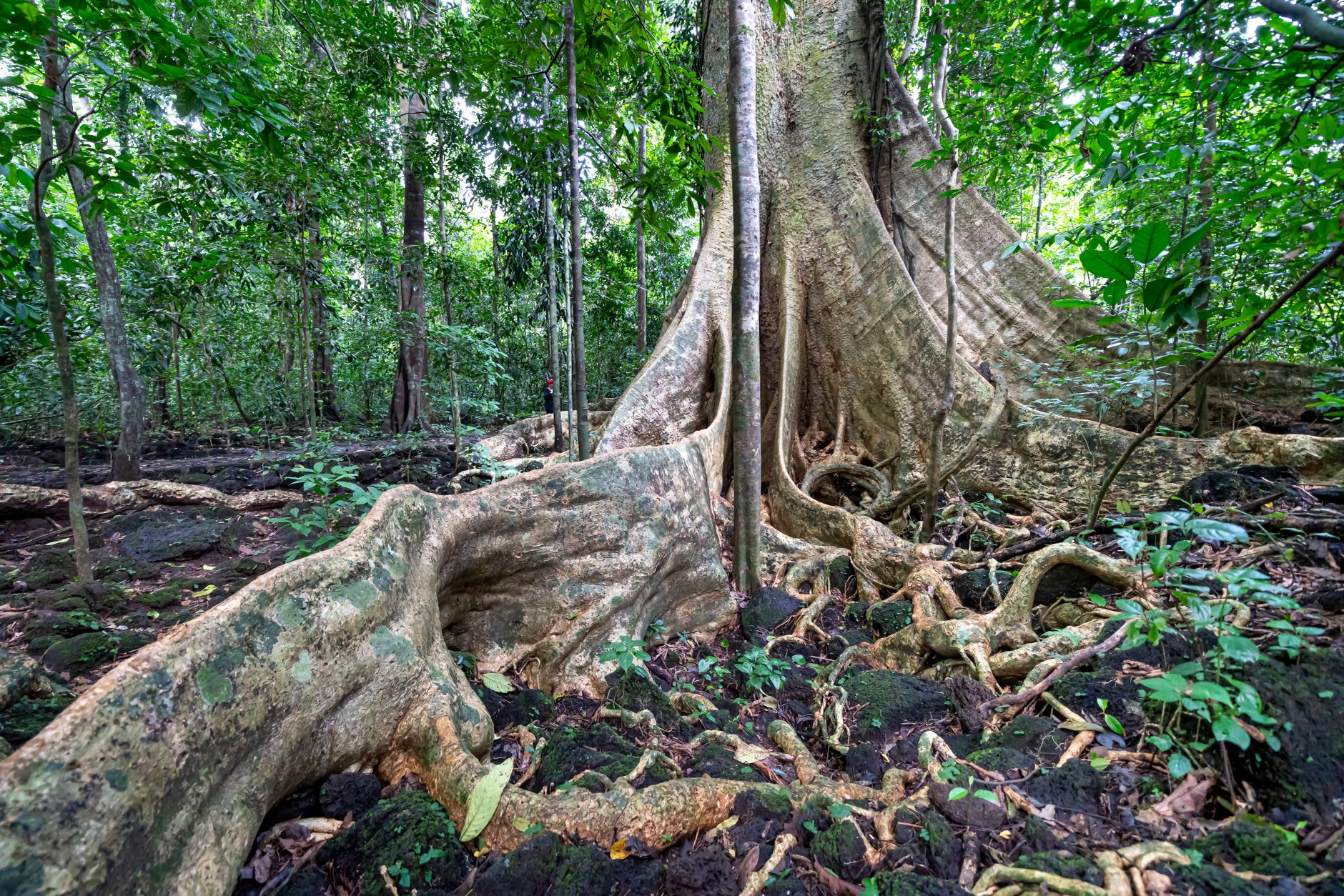
Sapo National Park covers nearly 1,800 square kilometers of primary rainforest in southeastern Liberia — the largest protected forest in West Africa and the anchor of the Upper Guinean forest biosphere that extends into Sierra Leone and Guinea. There are no paved roads inside the park. There are no lodges. What exists are research stations, ranger posts, a handful of forest trails that require a guide who knows them, and the forest itself, which has been doing what it does for approximately the same length of time that would embarrass any human attempt at chronology. The trees here are enormous. I know this is not a precise description, but standing at the base of a forest giant whose canopy you cannot see and whose trunk you cannot encircle with four people, precision feels beside the point.

The wildlife is there — pygmy hippos in the rivers, forest elephants moving through the deep interior, chimpanzee troops in the upper canopy, hundreds of bird species including the white-breasted guinea fowl and the rare Liberian mongoose. But Sapo is not a park that performs its wildlife for you. The animals exist at their own scale and rhythm, and seeing them requires patience and silence and some luck. What I remember most distinctly is sound rather than sight: the dawn chorus that begins around four-thirty and builds to a density that feels physical; the crack of something large moving through undergrowth that we never saw; the steady drip of condensation from leaves that creates a sound like soft continuous rain even on dry mornings. The forest is never quiet, but the sounds are its own and feel private.
The rangers are the other revelation. Many are from communities that have lived adjacent to this forest for generations — they know it in the way that comes from something older than ecology textbooks. Walking with a ranger named Varney on the second day, he stopped twice to show me things I would have walked past: a pygmy hippo print pressed into river mud, and then, on a bend in the trail, a cluster of orchids growing on a branch at eye level that he identified by a Kpelle name I couldn’t write down quickly enough. He carried a walking stick and moved through the forest faster than seemed possible. I moved at approximately half his speed and was sweating entirely through my shirt.
Sapo is not a comfortable destination. The humidity is constant and intense. The logistics of getting there — from Greenville by river, or by an extremely rough road to the research station — require planning and cannot be arranged at the last minute. The accommodation is basic and the food is simple. None of this is the point. The point is to spend time in a forest that is one of the last examples of what this entire region looked like before two centuries of extraction, and to understand, somewhere below the level of conscious thought, what has been lost elsewhere and why it matters that this remains.
When to go: December through March is the reliable window — dry-season conditions make river travel easier and forest trails navigable. Organize access through the Liberia Forest Development Authority in Monrovia or through community-based guides in Greenville well in advance; the park cannot absorb unplanned visitors and the logistics require lead time.