
Kilpisjärvi
"Three countries. Not a soul. A stone marker in the snow at the point where the maps run out."
To get to Kilpisjärvi you must want to. It sits at the northwestern tip of Finland — a finger of territory that extends between Norway and Sweden toward the Arctic Ocean — and the road that leads there winds through a landscape of such austere grandeur that the journey itself becomes the event. I drove from Muonio, five hours north, the road climbing gradually into open fell where the treeline falls away entirely and the horizon extends in every direction to distant ridges of grey rock and snow.
The village of Kilpisjärvi is tiny — a few hundred permanent residents, a national park centre, some accommodation huddled against the cold. But it sits at the edge of the Saana fell (1,029 metres), on the shore of Lake Kilpisjärvi, and across that lake you can see directly into Norway. The lake mirrors the fell in its name and in winter, frozen, the two merge into a white unity that is hard to look away from. I arrived in late February when the days were finally beginning to lengthen and the sun crept above the fell ridges for the first time after months of polar night. It came up orange and low and lit the fell face in a colour I have no precise name for — ochre moving toward copper, with the shadows below it running blue.
The tripoint — the point where Finland, Sweden, and Norway meet — is accessible on foot or ski across the frozen lake. In winter it is a seven-kilometre round trip on ice, marked by a small stone monument that has accumulated offerings from visitors: ski poles, coins, photographs from people who came and needed to leave something. I walked it alone on a windless morning, pulling a sled with a thermos of coffee, and arrived at the monument in a silence so complete it felt genuinely sacred. I stayed thirty minutes and saw no one.
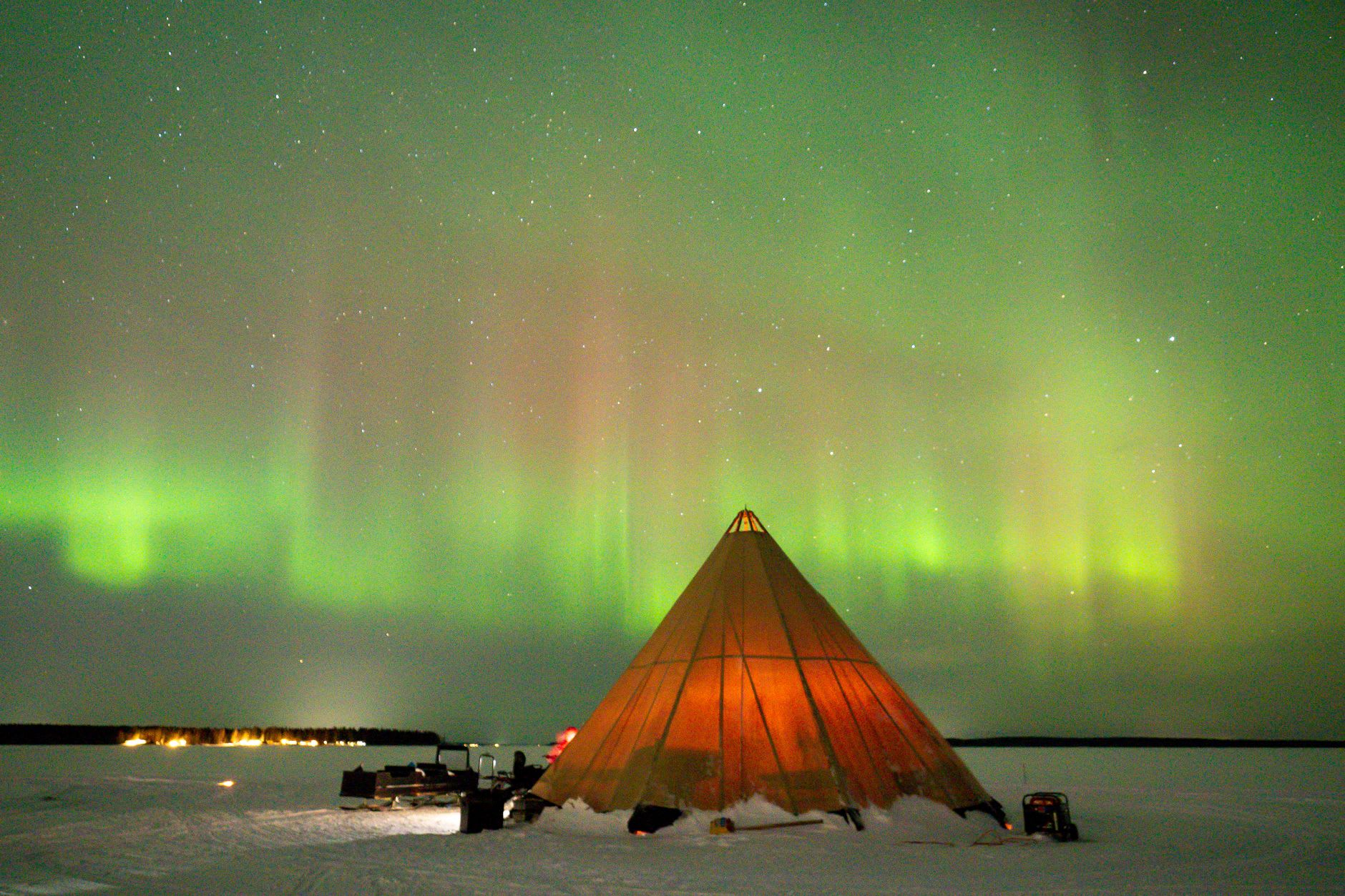
The fell views from the trail up Saana are among the most dramatic in Finland: you gain four hundred metres of elevation and the panorama opens over three countries simultaneously. I watched the aurora from up there one night, lying on my back in the snow with the world spread out in every direction, and had one of those experiences that simply does not fit into language — the kind you bring home with you and cannot share.
When to go: February and March offer the best combination of returning light and full winter conditions. August is excellent for trekking under the midnight sun, when the Three-Country Cairn Trail draws serious hikers. Avoid the road in November if possible — it is serviceable but the conditions are unreliable and the light is at its most punishing.