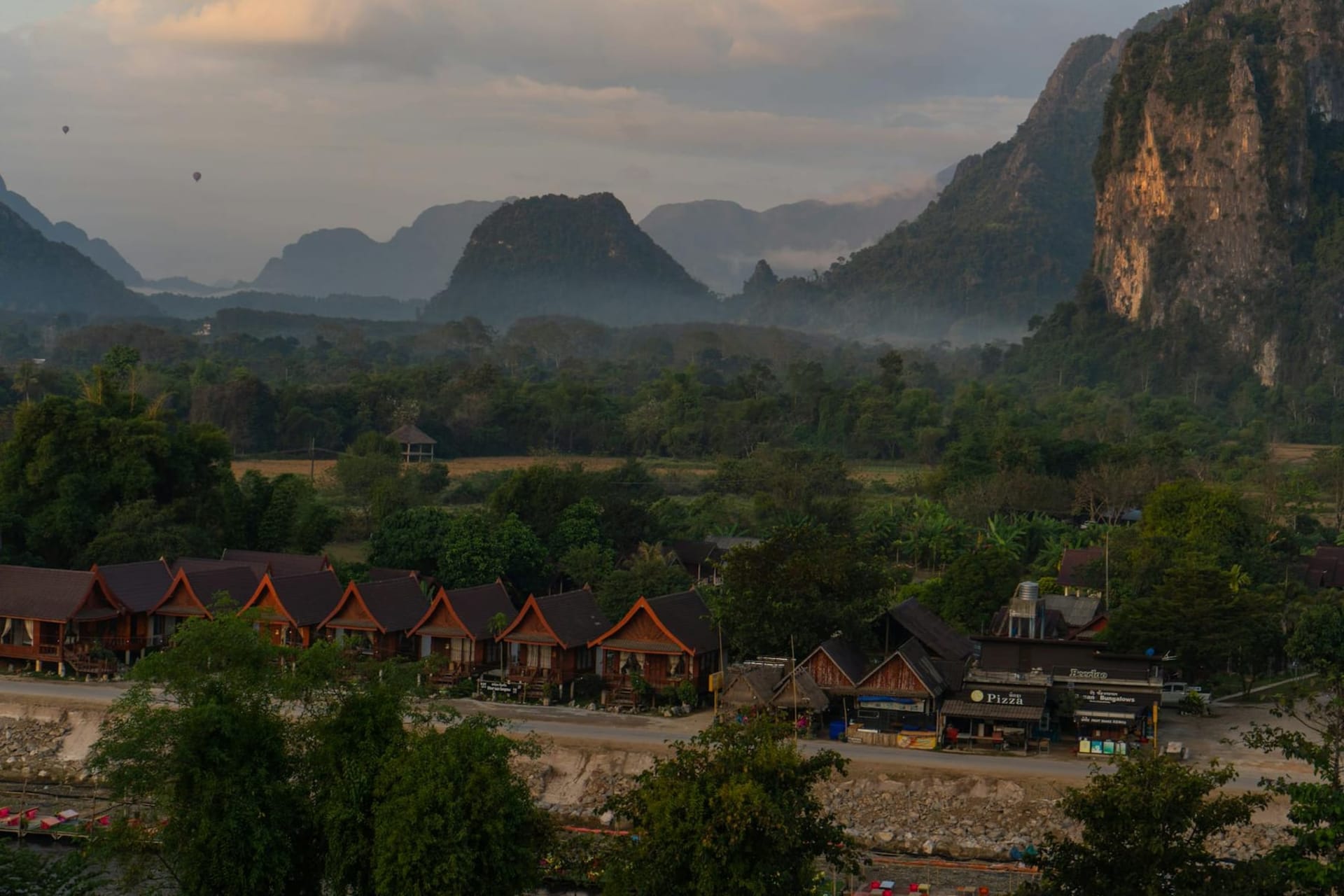
Vang Vieng
"Vang Vieng earned a bad reputation and then quietly grew up into the landscape it always deserved."
Karst peaks above a lazy river, where hot-air balloons drift past at sunrise and caves echo inside.
The first thing I saw from the bus window was a wall of rock — not a slope, not a ridge, but a vertical limestone cliff simply appearing out of rice paddies, sudden and unreasonable. Lia pressed her face to the glass. Neither of us said anything. There was nothing useful to say.
Vang Vieng sits along the Nam Song River in central Laos, hemmed in on every side by karst formations that belong more to a painter’s imagination than a geography textbook. For years, the town existed in two registers at once: the lurid one (buckets of whisky, inner tubes, a backpacker economy built on oblivion) and the quieter one that the limestone always knew was there, patient and indifferent to reputations.
The River at Dawn
I set an alarm for 5:30 and walked down to the riverbank alone, past the still-shuttered noodle stalls on Rue Luang Prabang. The air smelled of river mud and woodsmoke. Across the water, the karst peaks were dissolving slowly out of darkness, and a single balloon — orange and gold — was climbing the far cliff face, impossibly slow, as though it had nowhere it needed to be.
I ate khao piak sen, the thick rice noodle soup that is Vang Vieng’s real morning staple, at a plastic table with a cracked leg. The broth was deep and slightly sweet, with a knob of fresh ginger I kept finding with my teeth. The balloon was gone by the time I looked up.
Inside Tham Chang
The cave entrance is just south of town, up a concrete staircase that grows slicker as you climb. Tham Chang is old enough to have served as a refuge during nineteenth-century raids, and inside, the scale undoes you. Water drips from a ceiling you cannot see. The formations are lit in colors that would embarrass a nightclub, and yet — walking deeper, where the tour groups thin out and the colored bulbs give way to weak flashlights — something genuine opens up. A darkness that predates electricity by a very long time.
I hadn’t expected the cold. Or the sound the river makes when you hear it through forty meters of rock — a low, continuous murmur, like the mountain is thinking.
An Unexpected Afternoon
What surprised me most was an afternoon I hadn’t planned at all: a borrowed bicycle, a wrong turn past a banana plantation, and a small village where children were playing takraw beside a monastery wall. No guesthouses, no menus translated into French. Just late light turning the paddies the color of new copper, and a dog asleep across the path who refused to move for either of us.
That, more than any sunrise balloon or Instagram karst, was Vang Vieng keeping its quieter promise.
When to go: November through February brings dry, clear skies and cool mornings ideal for ballooning and cave walks; the wet season (June–October) turns the river brown and the landscape extravagantly green, which has its own argument.