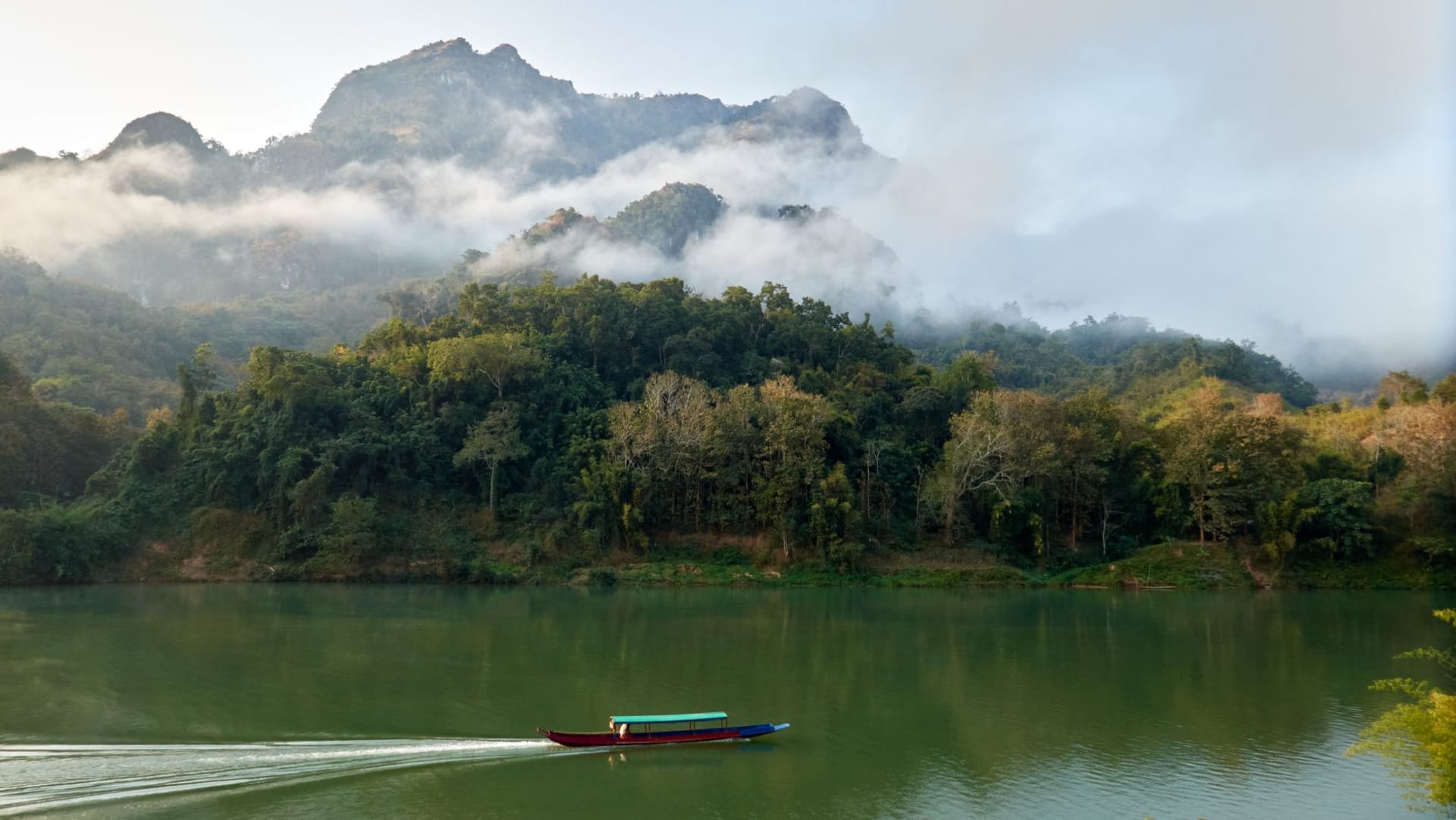
Kong Lor
"The guide switched off his headlamp and the dark was so complete I couldn't tell if my eyes were open."
The boat engine cut out inside the cave and the guide switched off his headlamp. The darkness was absolute — no gradations, no shapes, just complete black and the sound of water moving somewhere near the hull. Lia reached for my arm. Neither of us said anything for about thirty seconds, which felt long enough to become slightly unnerving and exactly right.
Kong Lor is a river cave in Khammouane Province that runs for seven kilometers through a single limestone karst mountain. You enter it by longboat, crouching under stalactite formations in the first low chamber, then opening into vaults so vast the headlamps barely scratch the ceiling. The river — the Nam Hin Boun — flows through the mountain and exits the other side, where a pocket valley of rice fields and karst towers waits, quiet and completely incongruous. It takes two to three hours by boat to cross and return, and almost nothing about that experience is easy to describe without sounding hyperbolic.
Getting There
The logistics of reaching Kong Lor are part of its appeal. From Thakhek, the closest city of any size, most travelers ride the Loop — a motorbike circuit that cuts through karst country past blue lagoons, roadside noodle stands, and empty two-lane roads with the kind of scenery that makes you slow down unprompted. We took the longer route, threading deeper into the province through thinning forest. The road eventually narrows to a single lane, and Ban Kong Lor village materializes just before the cave entrance. The guesthouses are basic in ways that feel earned rather than charming. You eat what’s being cooked, which on our night was a fish soup so sour and bright it woke up my whole face.
The River Underground
The boatmen know the river by sound and muscle memory. They pole through shallow sections and gun the throttle where the water deepens, and you sit low in the narrow hull watching formations pass overhead: curtains of calcite, columns built over ten thousand years, shapes that look like melted wax frozen mid-drip. The scale is genuinely hard to absorb. At the widest point, the ceiling disappears entirely into darkness and you’re floating in what feels like a subterranean cathedral with no walls.
The air smells of minerals and wet stone — clean and cold, entirely distinct from the humidity outside. When the guide kills the lamp to let you feel the nothing of it, you hear the water and your own breath and not much else. I found it briefly frightening in a way I hadn’t anticipated and immediately wanted to stay longer.
The Valley Between
Halfway through, the cave exhales into open air — a hidden valley between karst walls, rice paddies bright green against grey stone, a handful of houses visible through bamboo. Local Phu Tai villagers use this passage routinely to reach markets on the other side of the mountain. Our guide stopped here, brewed tea on a small gas burner balanced in the bow, and handed cups back without ceremony. We drank floating in the middle of a mountain, which is either absurd or perfect depending on how you’re feeling.
The Return Trip
The return journey feels different from the entry. You know the scale now and can read the formations as landmarks — the curtain chamber, the column cluster, the narrowing before the exit. When the light appears ahead, grey and then gold, there’s something almost reluctant about moving toward it. I sat on the riverbank afterward doing nothing for a while, which was the right thing to do.
When to go: February through April offers dry conditions and clear water at its most navigable. October and November are also excellent once the rains recede. Avoid June through September — the river rises unpredictably during monsoon and the cave closes when water levels become dangerous.