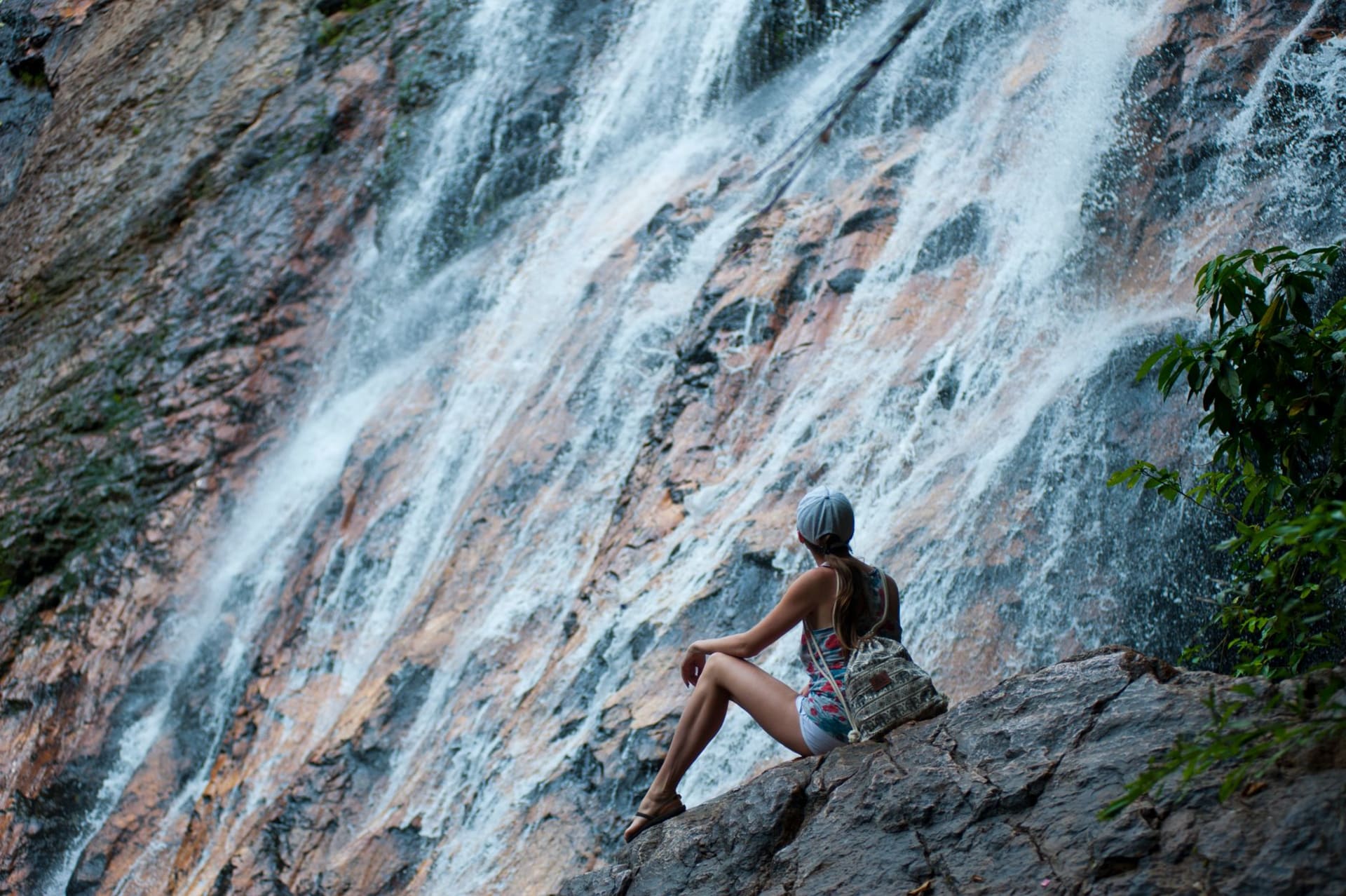
Temurun Waterfall
"The road to Temurun is the kind that makes you feel like you've earned the waterfall before you even see it."
The road to Temurun Waterfall is the kind of thing Google Maps describes as “navigable” in the way that a real estate listing describes a property as having “character.” This is a narrow track through jungle that runs off the main road between Datai Bay and the north coast, and for about three of its four kilometers it is a perfectly fine single-lane road through trees. Then it is not. There is a section of exposed root and eroded gravel where the jungle closes in on both sides, the canopy drops to head height, and your scooter suggests with increasing urgency that you reconsider your life choices. I did not reconsider. I walked the scooter the last hundred meters, which was the right call.
All of this is absolutely worth it. Temurun is the tallest waterfall in Langkawi — water falling perhaps 200 meters down a dark rock face, in three stages, into a pool at the base that is deep and cold and almost entirely undisturbed. On the morning I arrived, there was nobody else there. I sat on a rock at the pool’s edge for nearly an hour, which is the closest thing to genuine solitude I have experienced on Langkawi, and the sound of the falls was so complete that it crowded out every other thought.

The pool is swimmable — I did swim, though the cold of it was initially something that required a short internal negotiation — and the rock at the base provides perfect flat surfaces to spread a towel, dry off in the occasional beam of sunlight that makes it through the canopy, and eat whatever you thought to bring. I had not thought to bring anything, which was a consistent mistake of that particular trip. What I had was water, which turned out to be enough.
The vegetation around the falls is the kind that makes you want to know the names of things. Enormous tree ferns, some of them taller than I am, grow between the boulders at the pool’s edge. The rock face behind the waterfall itself is colonized by mosses and algae in a dozen shades of green, and the spray has created a microclimate that keeps everything permanently damp and hypergreen. A paradise flycatcher — a bird I had seen in a photograph before but never in the wild — spent ten minutes in the trees above the pool while I was sitting there, its ridiculously long tail streaming behind it as it moved from branch to branch. I had not brought binoculars either.

Getting back out is the same road in reverse, which is to say: walk the scooter over the root section, then ride, then arrive at the main road with your arms tired from the handlebars and your clothes damp from the spray and your general mood significantly improved. Stop at the small warung at the junction — a shed with a plastic table and a woman who sells teh tarik and roti canai from what appears to be a single-burner stove — and debrief with tea.
When to go: The waterfall runs year-round but is at maximum volume from October through February when the northeast monsoon brings heavy rainfall to the north coast. Visit in the morning before any cloud cover develops. The road condition is best in dry weather — after heavy rain, the final section becomes genuinely treacherous. Wear shoes with grip. No sandals. This is the one place on Langkawi where footwear matters.