Irkutsk
"The Decembrists were sent here to be punished and ended up building one of the most elegant cities in Russia. Exile has a complicated legacy."
Every Trans-Siberian journey has a city where the train stops long enough to actually breathe, and for most people that city is Irkutsk. I arrived on a grey February morning after four days on the train, feeling approximately as fresh as laundry that had been left in the machine overnight, and the city surprised me immediately. I had been expecting a Soviet industrial hub — grey blocks, wide boulevards, the utilitarian grimness that Siberia is supposed to produce. What I found instead was a city of ornate wooden houses, an elegant riverfront, and a café culture that would not be out of place in a mid-sized European town.
The wooden architecture is the thing everyone mentions about Irkutsk and the reason everyone mentions it is that it genuinely stops you in the street. The carved wooden shutters and window surrounds here reach a level of decorative ambition that defies the climate and the material and the logic of a place where it gets to minus thirty. Entire blocks in the 130 Kvartal district have been restored, their facades showing off the full vocabulary of Siberian wooden ornament — geometric fretwork, carved flowers, painted sunbursts, lace-like patterns that look like they belong on fabric rather than timber. Walking through on a cold morning, breath condensing in front of you, it feels like being inside a fairy tale that somehow survived industrialization.

The Decembrist story hangs over Irkutsk with particular weight. After the failed 1825 uprising against the Tsar, hundreds of aristocratic revolutionaries were sentenced to hard labor and exile in Siberia. Many ended up in Irkutsk, where their wives followed them voluntarily — a journey of several months by horse-drawn cart across the steppe, giving up their titles and property to do so. The result was an influx of educated, cultured people who built libraries, opened schools, organized amateur theatre, and generally made Irkutsk considerably more sophisticated than its location warranted. The Volkonsky House museum, home to Princess Maria Volkonskaya who followed her exiled husband here, preserves the drawing rooms and parlors of that unlikely social world with something close to reverence.
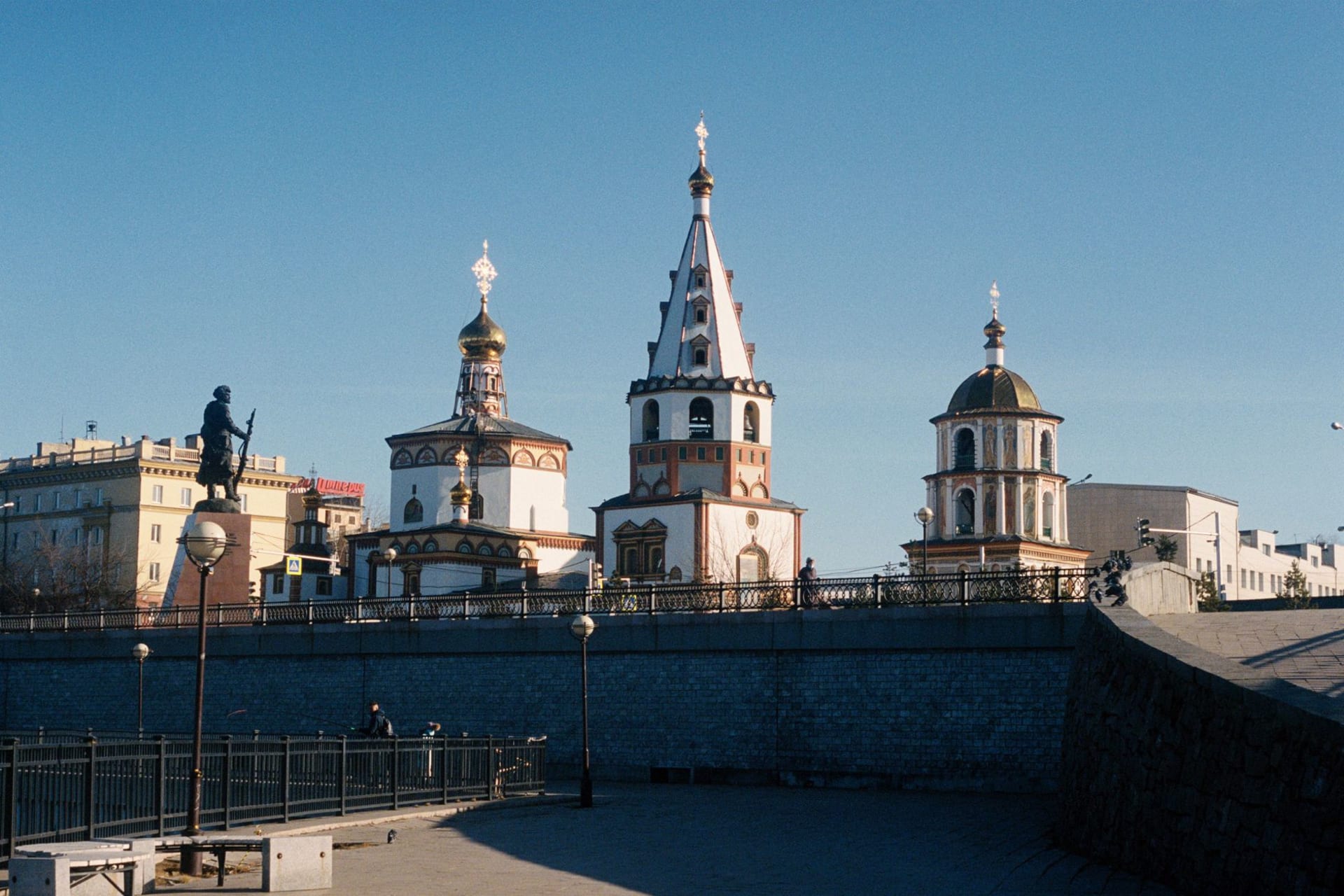
The Angara River runs through the city, and in winter it stays partially unfrozen — the water too fast and deep to freeze solid — while ice forms in elaborate sculptural shapes along the banks. In the evenings I would walk along the embankment as the temperature dropped and watch the steam rise off the moving water. The university students skating on a rink below the cathedral, the smell of pirozhki from a kiosk by the bridge, the sound of church bells through cold air: Irkutsk has a texture that requires time to absorb. Most travelers give it a day before rushing to the lake. That seems like a mistake.

For food, the stolovaya — Soviet-style cafeterias that have outlasted the Soviet Union — serve dense, nourishing plates of borscht and pelmeni and kotlety for almost nothing. Beside them, newer restaurants around the 130 Kvartal serve a food-conscious Irkutsk that has discovered natural wine and Buryat fusion and proper coffee. I ate both, sometimes on the same day. The pelmeni at the stolovaya at lunchtime were better than anything at the design restaurant three streets away that charged four times the price. That is Irkutsk: layer after layer of things that shouldn’t coexist and somehow do.
When to go: Year-round, but winter (December through February) gives you the full atmospheric weight — the wooden houses under snow, the river steaming, the fur coats, the sense that you are genuinely far from anywhere familiar. Summer brings long days, open-air markets, and the convenience of getting to Baikal by boat as well as by road. The city is always better as more than a single overnight.