Asia
Lake Baikal
"I walked on a lake and looked straight down into thirty meters of nothing."
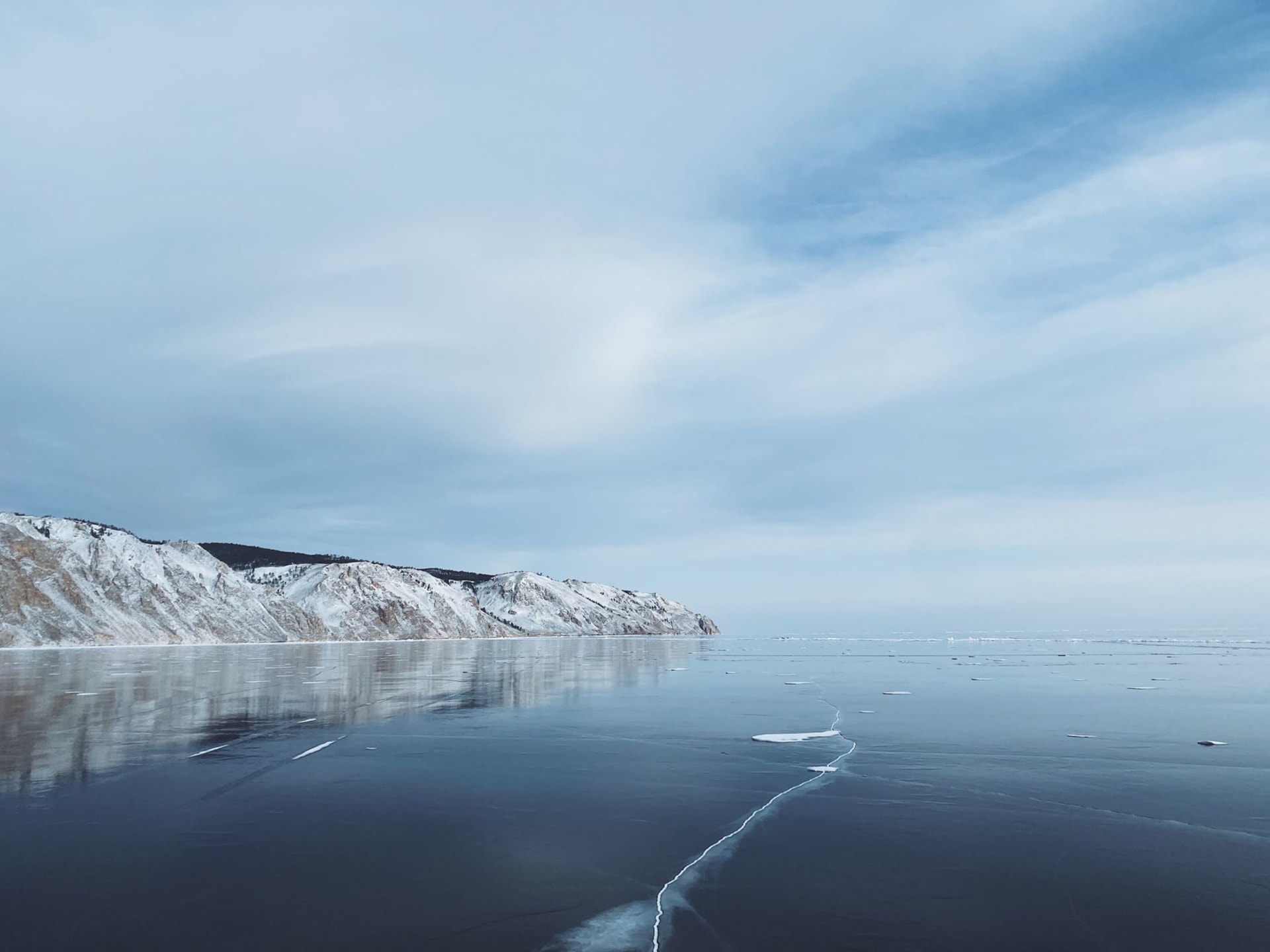
I arrived at Baikal in February, which everyone told me was either a brilliant idea or a sign of poor judgment. The train from Irkutsk drops you off in Listvyanka, a village of wooden houses and fish-smoking shacks on the lake’s southern shore, and nothing prepares you for the first moment you step onto the ice. It doesn’t look like a lake. It looks like a planet — 636 kilometers of frozen water disappearing into a horizon you can’t see the end of. And underneath your boots, the ice is not white. It’s blue-green and transparent, cracked in long diagonal fractures that catch the winter light like stained glass. You can see straight down. The fish are down there somewhere, thirty meters below you, living inside the deepest lake on Earth.
The thing Baikal does to you is hard to explain rationally. The Buryat people who have lived on its shores for centuries call it the Sacred Sea, which at first sounds like mysticism and then, after a day or two, sounds like accurate description. The water is so pure you can drink it straight from the lake — I did, cupping it through a crack in the ice with my hands so cold they’d stopped feeling like hands. In summer, the water stays cold enough to shock you senseless even in July. The nerpa seals, a freshwater species found nowhere else on the planet, surface through ice holes and blink at you with their enormous dark eyes as if they’re the ones confused by your presence. Omul, a white fish endemic to Baikal, appears on every menu in every form — hot-smoked, cold-smoked, dried, grilled over charcoal on the shoreline. I ate it every day for a week and never got tired of it.
When to go: February and March for the ice — that’s when it’s thick enough to walk on, the cracks are photographically dramatic, and the famous ice bubbles (methane frozen mid-rise) are visible. June and July bring warm temperatures and kayaking on open water, but the real devotees go in winter. Avoid late April when the ice is melting but hasn’t gone: you can’t walk on it, you can’t boat across it, and it is beautiful in the way that useless things sometimes are.
What most guides get wrong: They frame Baikal as a side trip from Irkutsk, worth two or three days. That’s not wrong exactly — it’s just a failure of imagination. Baikal isn’t a lake you tick off. It’s a place that requires you to sit with it, to walk further out onto the ice than feels sensible, to eat omul at a picnic table in minus fifteen and understand why people choose to live in Siberia. Give it at least five days. A week is better. The Trans-Siberian Railway can wait.