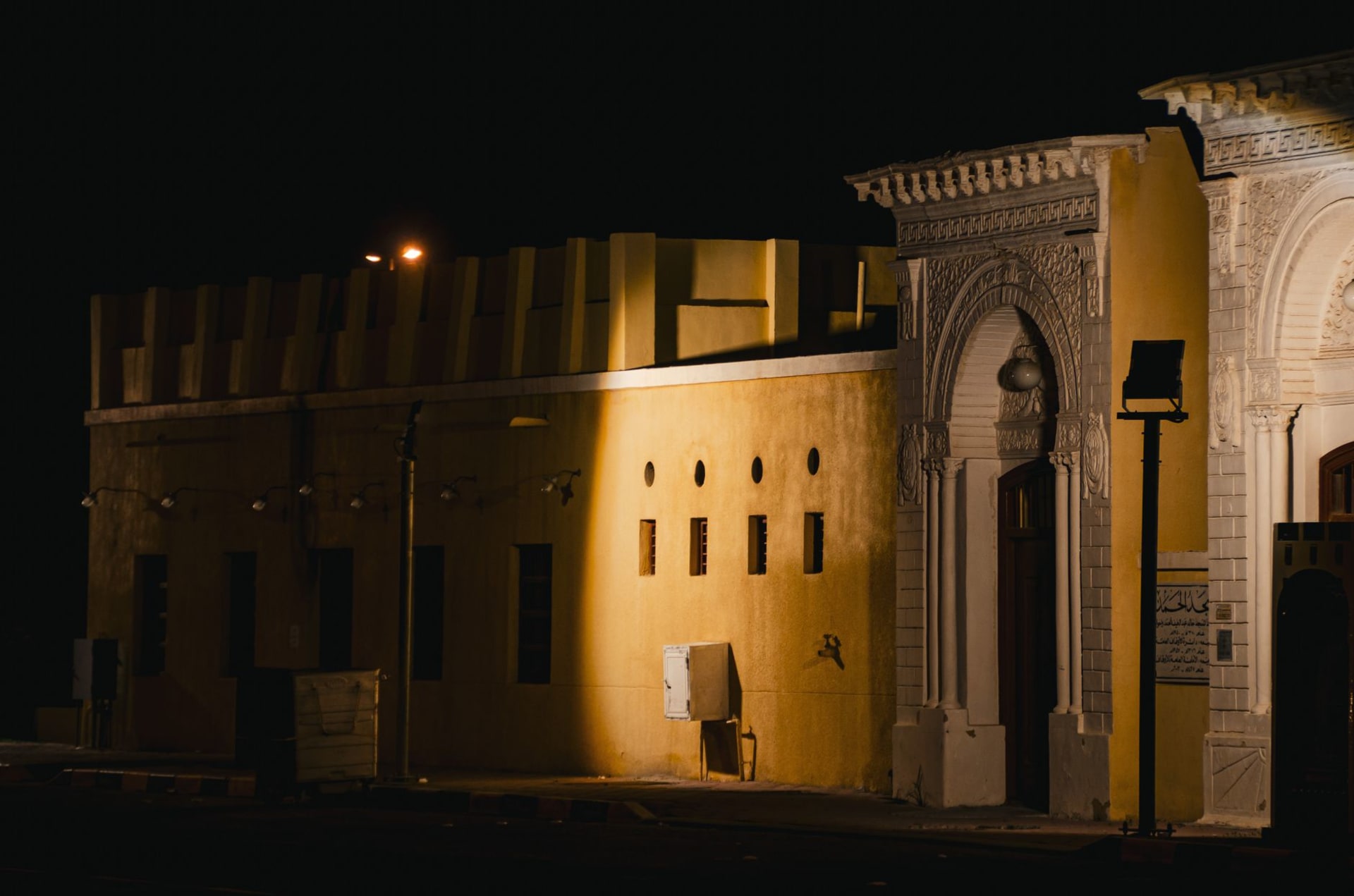
Al-Ahmadi
"It takes a moment to remember you are in Kuwait and not some forgotten English garden suburb."
I almost drove past Al-Ahmadi without turning off, because nothing about the approach road prepares you for what the town actually looks like. I was expecting more Kuwait City — the towers, the construction cranes, the familiar Gulf ambition toward vertical scale. What I got was a roundabout with a flower bed and a street lined with frangipani trees, and beyond it, bungalows. Real bungalows, low-slung and British in their proportions, with front gardens and clotheslines and the kind of quiet that you only get when a neighborhood was designed with space between things rather than maximum density. I stopped the car and sat there for a moment trying to recalibrate.

Al-Ahmadi was built from scratch in the early 1950s by the Kuwait Oil Company — a joint British-American venture — as a company town for its expatriate workforce. The planners, working with the confidence of postwar British colonial urbanism, laid it out with a logic that has nothing to do with how anything else in Kuwait was organized: streets on a grid, parks at regular intervals, a golf course, a cinema, a social club. The grass was kept green by desalinated water and the willingness of KOC to pay for it, which it did for decades because the oil underneath justified any expense. The result is a neighborhood that feels like it was lifted from the English Home Counties and set down in the middle of a desert, slightly shocked by the relocation but managing.
The Oil Museum on the edge of town has enough archival photographs and equipment to make a morning of it — photographs of the original wells, the faces of the workers, the slow transformation of the landscape from empty sand to one of the most productive oilfields in human history. I spent an hour in there before driving south to the ridge that overlooks the fields themselves. From that vantage point, you can see the pump jacks working in their slow hydraulic rhythm across a horizon that extends further than seems possible. There is a smell to the air up there, faint but unmistakable — not unpleasant, exactly, but clarifying in the sense that it reminds you what all this is actually for. The quiet streets and the English roses are nice. But this is the reason the streets exist.

The golf course still operates, though the membership today skews toward the remaining expatriate community rather than the British engineers who first played it. The social club has a pool. The old cinema, which showed English-language films to homesick workers in the 1950s and 1960s, is closed now. Walking the residential streets in the late afternoon — the frangipani dropping its flowers onto the tarmac, sprinklers running in the gardens — there is something both melancholy and precise about the place. It was built for a specific purpose, by a specific idea about how industry and domesticity should be arranged, and that idea has outlasted most of the people who designed it.
When to go: November through March when the temperature makes the outdoor spaces usable. The Oil Museum is open most days — phone ahead as hours vary. Driving the surrounding oil fields requires no special access but keep to the public roads; the pump jacks look better from a distance in any case. Pair with a visit to Fahaheel further south for a fuller picture of Kuwait’s southern coast.