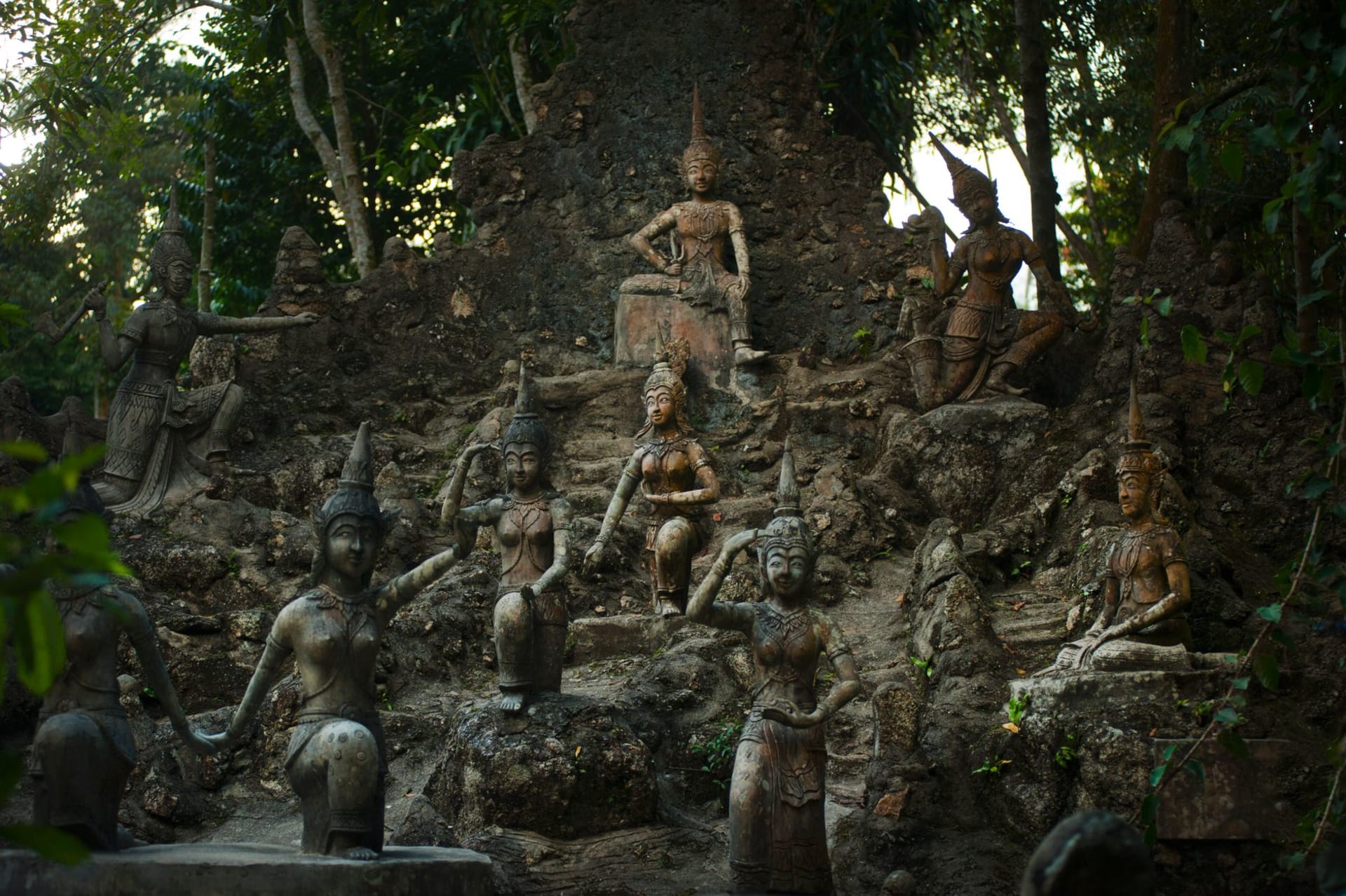
Secret Buddha Garden
"The road up was so steep our rented jeep stalled twice, and Lia announced she would walk the rest on principle — then the jungle opened onto a hillside full of stone strangers."
Most of Koh Samui happens at sea level — the beaches, the bars, the airport, the relentless ribbon of resorts. The Secret Buddha Garden is the island’s correction to all that, hidden high in the granite interior above Lamai, and reaching it is genuinely an ordeal. The track up the Pom mountain is a brutal sequence of near-vertical concrete ramps and washed-out switchbacks that defeats most rental scooters and a good number of cars. We hired a battered 4x4 with a driver in the end, after our own jeep stalled twice and Lia threatened to get out and walk on principle. The driver took the worst hairpins at a crawl, grinning, clearly enjoying our nerves.
A farmer’s strange life work
The garden — locally called Magic Garden or Tar Nim — is the creation of one man, Nim Thongsuk, a durian and rambutan farmer who began building it in 1976 when he was already in his seventies. Over the rest of his long life he installed dozens of statues across his steep hillside orchard: Buddhas in various poses, Thai deities, animals, and a remarkable set of human figures modeled on his own family and neighbors, frozen mid-gesture among the boulders and ferns. He worked the slope until he died in his nineties, and his descendants still maintain it. There is something deeply personal about the place that no temple complex ever achieves — these are not commissioned masterpieces but the patient handiwork of an old man arranging his own private cosmos.

The statues are scattered down a hillside threaded with a small clear stream that drops in little falls between the figures, so you follow a rough path among them with the water always nearby. Some are weathered grey, furred with moss; others have been repainted in bright colors. There is a statue of Nim himself, seated and contemplative, looking out over the work of his life. The whole thing is small — you can walk it in half an hour — but the setting does the heavy lifting: dense jungle, granite boulders the size of houses, and the constant sound of water.
The view that makes the road worth it
The garden sits high enough that the jungle opens in places onto enormous views — east across the forested interior to the coast and the sea beyond, the resorts reduced to white specks far below. We sat on a boulder near the top with the driver’s flask of sweet Thai coffee and watched a sea eagle ride the thermals over the valley. Up here the island’s heat eases, the air moves, and the relentless commercial energy of the coast feels like another country.
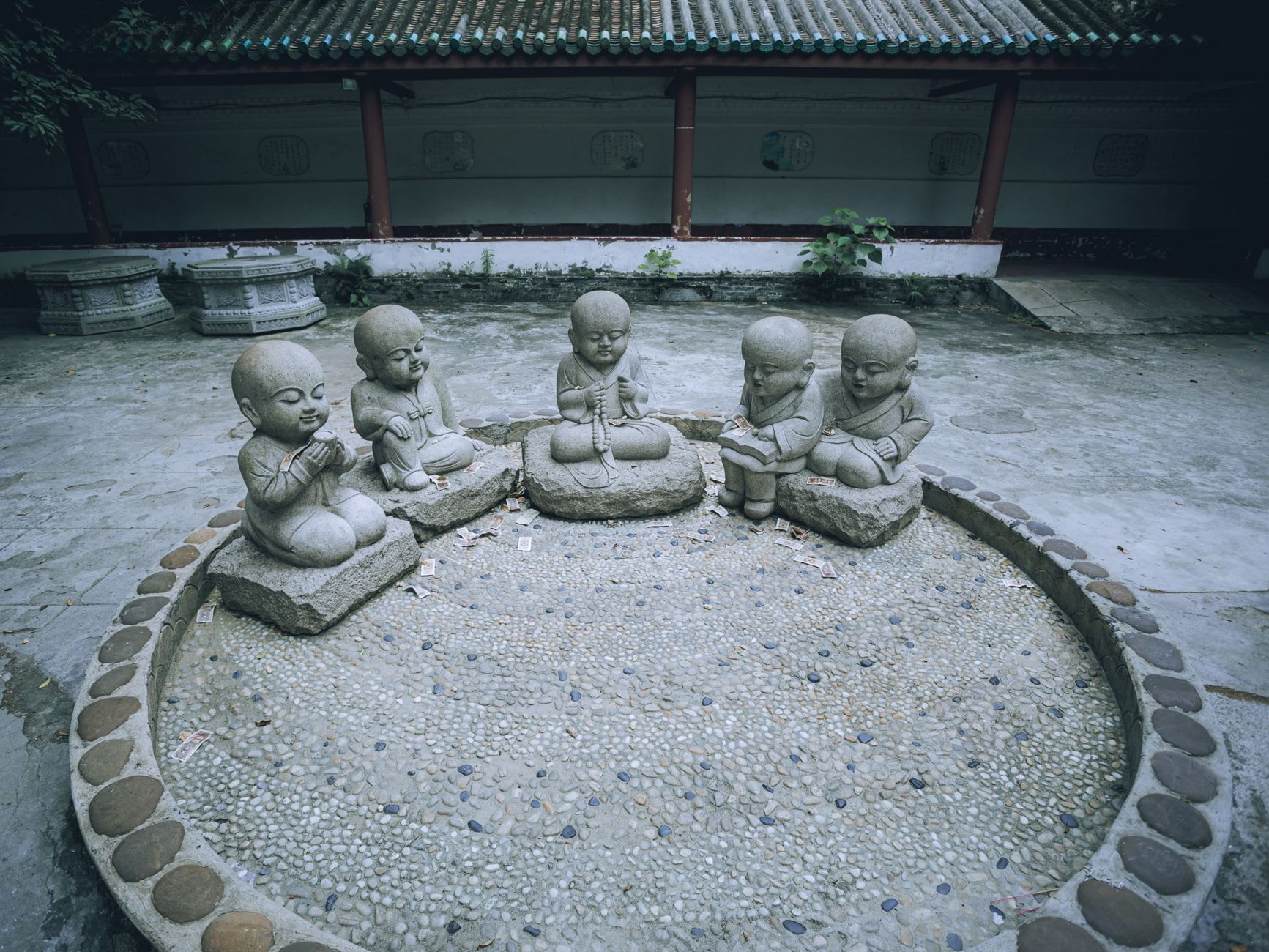
I will be honest that the garden itself is modest, and people expecting a grand attraction sometimes leave underwhelmed. That is the wrong frame. It is one man’s eccentric devotion, kept alive by his family, in a spectacular setting, and the difficulty of getting there filters out the merely curious. We were two of about six visitors the whole time we were up there. On an island as developed as Samui, that alone felt like a small miracle.
When to go: February through April for the driest roads — the steep concrete track becomes genuinely dangerous after heavy rain, and the wet season from October to December regularly closes it to all but the most capable vehicles. Go early in the day; afternoons bring both heat and cloud over the high interior.