Lamai Beach
"Lamai is where Chaweng's younger sibling ended up — just different enough from the original to have worked out better."
Lamai sits about six kilometres south of Chaweng along the east coast, and the two beaches are often compared as if choosing between them is the primary decision of any Koh Samui trip. Having stayed at both, the comparison is partly fair and mostly misleading. Lamai has a similar arc of white sand and warm turquoise water. It has beachfront bars, rental shops, restaurants with pictures on the menu. What it does not have is Chaweng’s relentlessness — the way that beach generates noise and traffic and commercial energy as if these were structural requirements. Lamai sits easier in itself. The road behind the beach has space between the buildings. The beach itself has space between the umbrellas. This sounds like a minor thing until you have been on Chaweng for two days.
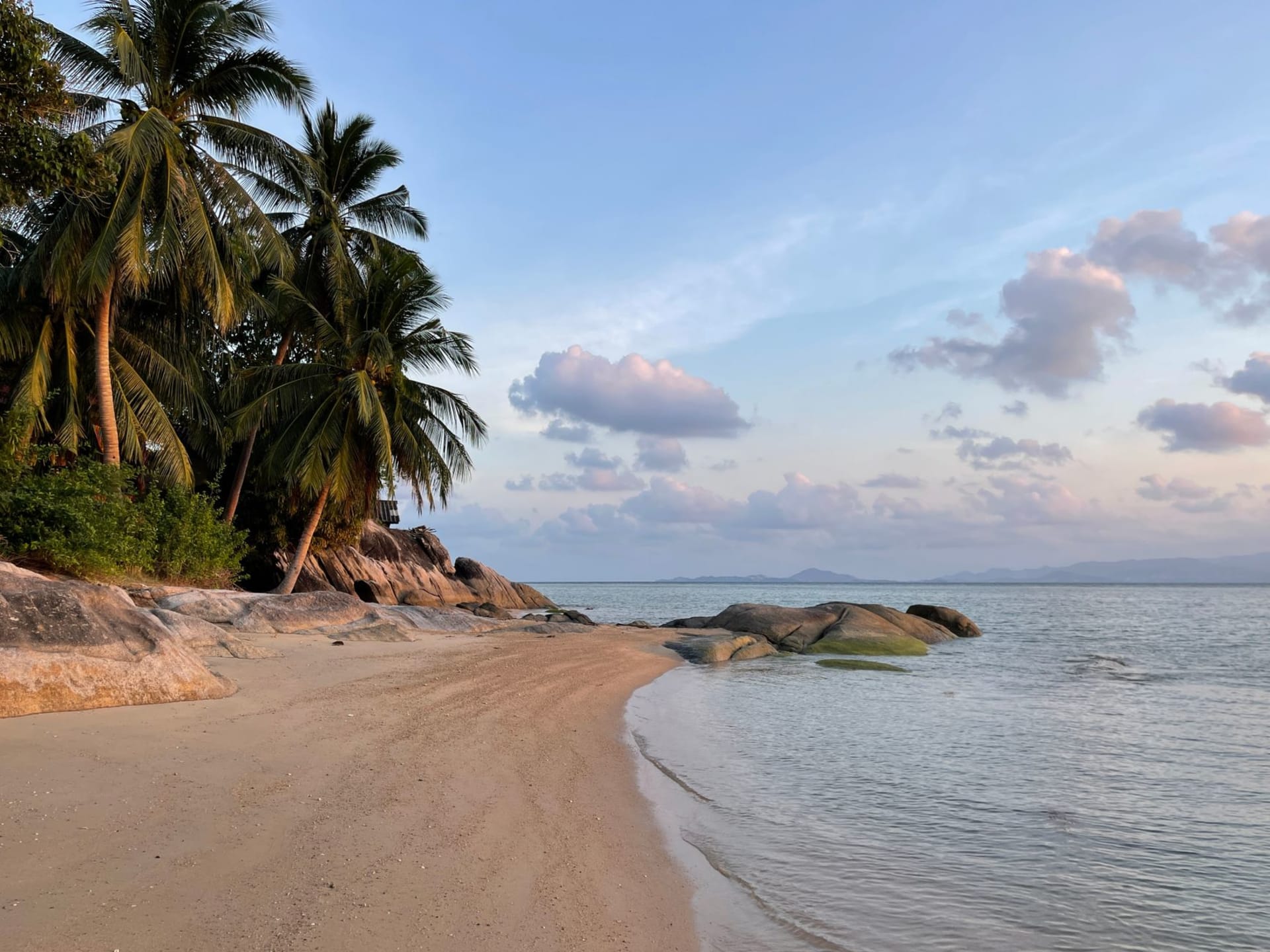
I came to Lamai on a Tuesday afternoon and found a spot on the sand well away from the clusters of chairs and umbrellas around the beach bars, in a stretch where the palm trunks lean far out over the water at low tide and you can lie in their shade and watch the small waves come in with the Gulf’s characteristic lack of hurry. The water was warm enough that getting in required no negotiation with yourself, just walking forward. I swam out to where the depth changed from pale green to blue and floated for twenty minutes looking back at the coconut palms against the clouds and thought: this is the version of Thailand that people come here imagining and often don’t find.

The town behind Lamai Beach — just called Lamai, unsurprisingly — runs along a main street with a concentration of restaurants and shops that is properly functional rather than exclusively tourist-oriented. There is a fresh market most mornings toward the north end where the actual local cooking happens: a woman making fresh roti with condensed milk that costs the equivalent of loose change, a man with a large clay pot of slow-cooked pork leg that has been going since four that morning, som tam stations where the mortar work starts before seven. I ate breakfast at Lamai market on four consecutive mornings and varied my route slightly each time to sample different vendors, which is not a strategy I usually employ but seemed the correct response to the density of options.
In the evenings the beach changes character. The large rocks at the south end of Lamai — where Hin Ta and Hin Yai sit — become a gathering point at sunset, and the beach bars fill at a pace that does not tip into the desperate energy of Chaweng’s nightlife. People eat on the sand at tables close enough to the water that the tide occasionally touches the chair legs. The seafood restaurants along the beach road operate with the logic that the best way to advertise is to put the fish on display in the open air and let the smell do the work, which it does.

There is a small temple at the north end of the beach — Wat Lamai — that is completely overlooked by most visitors and is therefore exactly the kind of place that deserves not to be. The grounds are shaded by large trees and the monks here seem to have a less interrupted relationship with their practice than those at the more famous sites. I wandered in one morning when they were finishing alms collection and a monk offered me water from a large ceramic jar, which I accepted and which was the single coldest and best water I had in three weeks on the island.
When to go: December through April is the standard recommendation for the east coast, when the Gulf side is in dry season. Lamai holds up better than Chaweng in the shoulder months of May and November because it has never been as dependent on peak-season tourism for its character. Avoid October if you can — the northeast monsoon arrives in force and the beach becomes unswinable.