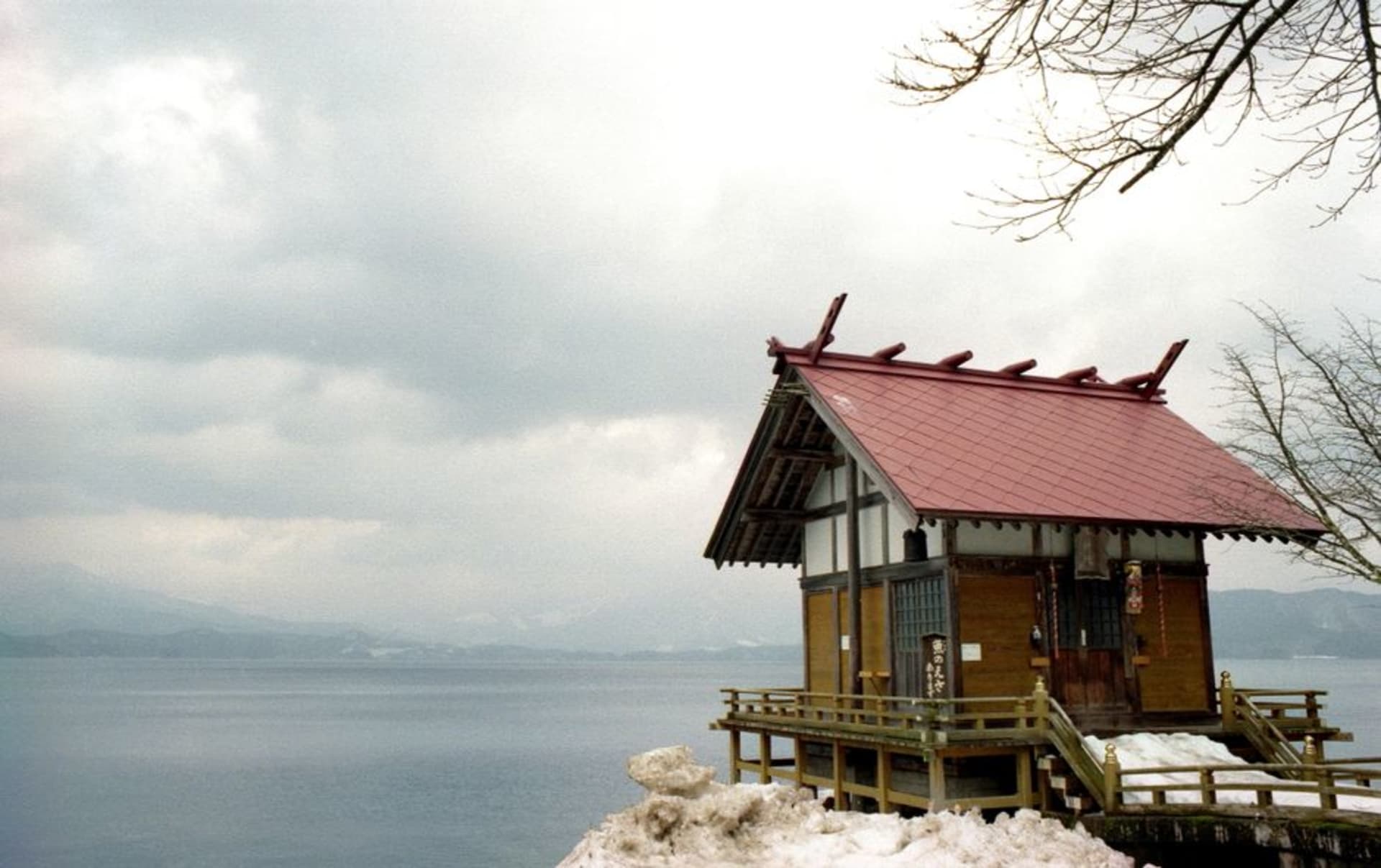
Lake Tazawa
"Lia dipped a hand in and pulled it back — the blue looked warm and was cold as a knife."
A startlingly blue crater lake in the mountains of Akita, the deepest in Japan, with the golden Tatsuko statue standing in its shallows. Serene, vivid, and close to the wild cedar baths of Nyūtō. A place that seems lit from below.
We came to Lake Tazawa expecting a lake and found a colour instead. It was the first thing either of us said, standing at the edge with our bags still on our shoulders — not look at the water but look at the blue, as if the two things had come apart. It is a crater lake, almost perfectly round, more than four hundred metres deep, the deepest in all of Japan, and that depth does something to the light so that on a clear morning the surface goes a cobalt so saturated it feels artificial, like a colour poured in from somewhere else. Lia dipped a hand in and pulled it straight back. The blue looked warm. It was cold as a knife.
The Golden Woman in the Water
A short way along the western shore stands the Tatsuko statue, a slender gilded figure who steps out into the shallows, catching the sun so hard she seems to burn. The legend is a sad one — a village girl named Tatsuko who prayed for eternal beauty and was turned instead into the dragon-spirit of the lake, condemned to live in its depths forever. Standing there, with the gold reflected in that impossible water, the story felt less like folklore than like an explanation. Something is in this lake. You feel it.
We ate lunch on a bench nearby, watching a swan-shaped pedal boat cross the bay, and I found I could not stop looking at her. Neither could Lia. There is a particular kind of beauty that is also a little unnerving, and Tatsuko has it.
Around the Rim
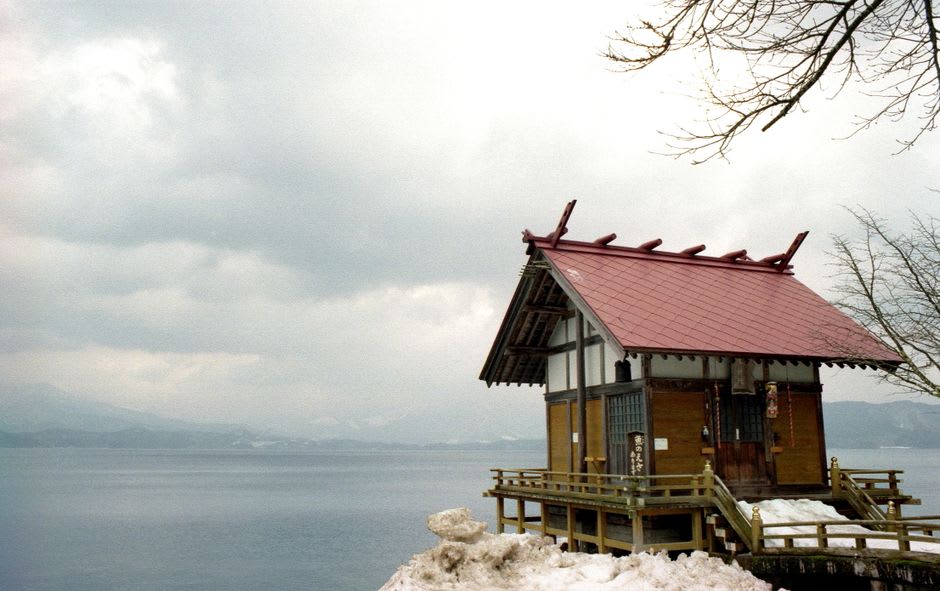
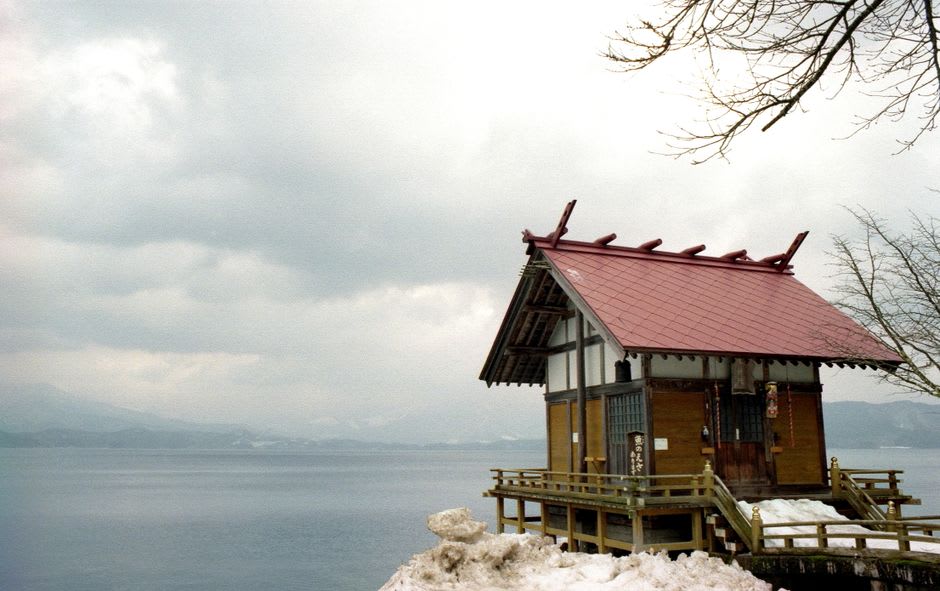
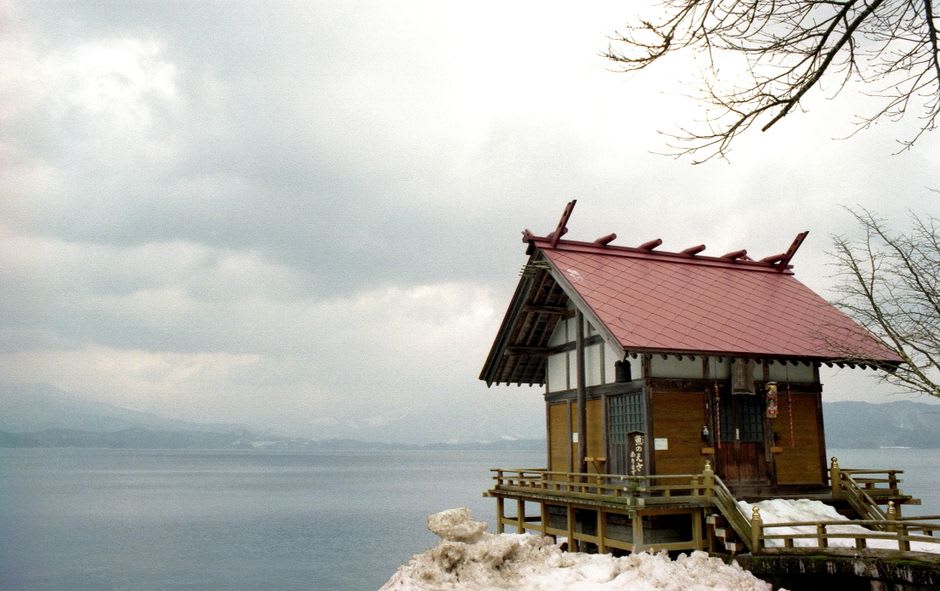
The lake is ringed by mountains and you can circle the whole thing by road in under an hour, but we did it slowly, stopping wherever the shoreline opened up. On the east side the trees come right down to the water; on the north the peak of Mount Akita-Komagatake rises behind, still streaked with snow when we visited in early summer. We rented bikes for part of it, which I recommend and also slightly regret, because the road has hills that a lake this calm does not prepare you for. At Ukiki-jinja, a small shrine, a red torii stands with the blue behind it, and the two colours together stopped us dead.
There are few big attractions here, and that is the point. The lake is the attraction. You come to look at it from as many angles as a day allows.
Up to Nyūtō Onsen
We had booked ahead, and I am glad, because the reason many people come to Tazawako is not only the lake but what lies in the hills above it: Nyūtō Onsen, a scatter of old hot-spring inns deep in the beech forest, some of them centuries old. We stayed a night at Tsurunoyu, the oldest, where the milky-white water rises through the gravel of the bath itself and the thatched buildings look unchanged since the feudal lords who once soaked here. Sitting in the open-air bath at dusk, snow-melt cold on our faces and volcanic heat below, was among the finest hours we spent in Tohoku.
In the morning the forest steamed. We drove back down to the lake for one last look at the blue before the train, and it had not faded overnight, which somehow surprised us both.
Getting There
Lake Tazawa is reached via Tazawako Station, a stop on the Akita Shinkansen between Morioka and Akita, which makes it far easier to reach than its remote feeling suggests. From the station, buses run to the lakeshore in about fifteen minutes and continue up the mountain to the Nyūtō Onsen inns, though the mountain buses are infrequent, so check times before you set out. Renting a car at the station is the freest way to circle the lake and reach the hot springs. Come in late spring or early summer for snow still on the peaks, or in autumn when the forested rim turns to fire above that unbelievable water.
Keep exploring
More of Tōhoku