Akita
"One man carried a whole swaying tower of light on the flat of his palm, and the crowd forgot to breathe."
A Tōhoku castle city on the Sea of Japan, home of the summer Kantō festival where performers balance towering poles hung with lanterns. Green Senshū Park on the old castle grounds, kiritanpo hotpot on cold nights, and some of the finest sake in the country.
We timed our stop in Akita for the first week of August, entirely on purpose, because Lia had set her heart on seeing the Kantō festival and would not be moved. Akita is the main city of a rural, snow-heavy prefecture on the Sea of Japan side of Tōhoku, and outside festival week it’s a calm, friendly, slightly overlooked place — which suited us fine for the days on either side. But we came for one summer night in particular, and it delivered something I still describe to people who ask what surprised me most in Japan. It’s the kind of festival that sounds mild when you read about it and then, in person, makes your jaw drop.
The Kantō Festival
The Kantō is, on paper, absurd: men balance long bamboo poles, some nearly ten meters tall and strung with dozens of lit paper lanterns, to pray for a good harvest. In practice it’s astonishing. We found a spot along the main avenue as dusk fell, and then hundreds of these swaying towers of light rose up together down the whole street, each one held aloft by a single performer who balanced it on his palm, then his forehead, then his shoulder, then his hip, shifting it from one point of his body to the next while the crowd chanted “dokkoisho, dokkoisho.” The poles bend and sway alarmingly in the breeze; every so often one topples in a shower of sparks and the crowd gasps and then roars. Lia had both hands over her mouth. Musicians drummed and piped behind it all, and the whole street glowed. I’ve rarely felt a crowd so completely held.
Senshū Park and the Old Castle
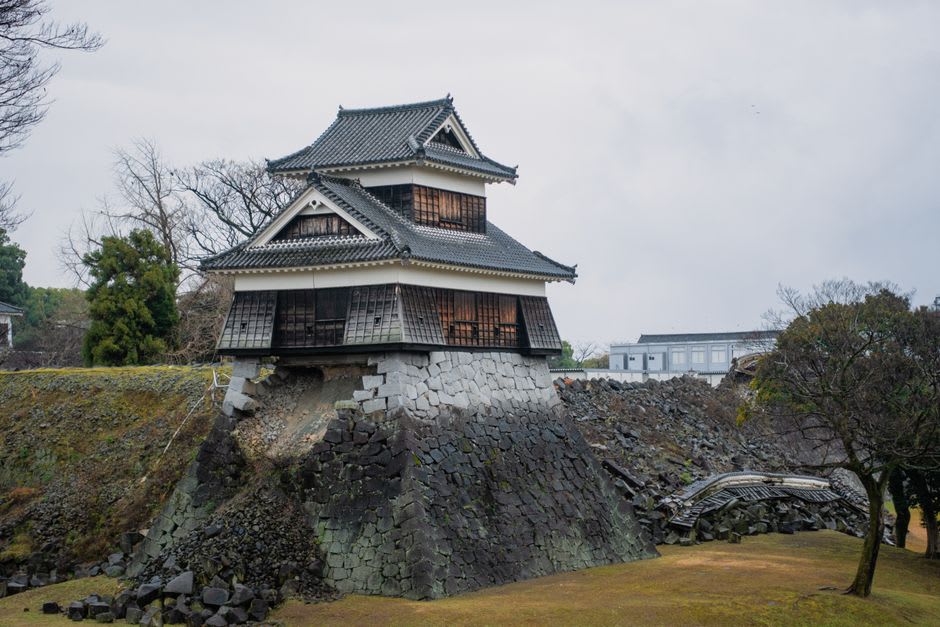
By day we spent our time in Senshū Park, the green heart of the city laid out over the grounds of the former Kubota Castle. The castle keep is long gone, but the moats, earthworks, and a reconstructed corner turret remain, and the whole hill is a tangle of shaded paths, ponds, and old trees. We climbed up to the turret for a view over the rooftops, then wandered down through the park as cicadas roared in the heat. There’s a lovely unhurried quality to Akita away from the festival — a shrine among the trees, an elderly couple feeding carp, students crossing the lawns. Lia found a quiet bench under a big zelkova and we sat out the hottest part of the afternoon with cold cans of tea, watching the city go slowly about its business. It felt like the real, everyday Akita underneath the one week of spectacle.
Kiritanpo and Akita’s Sake
Akita eats and drinks well, and we made a proper study of it. The local dish is kiritanpo — mashed rice pounded around a cedar skewer, grilled, then cut into a hotpot with chicken, burdock, mushrooms, and negi in a rich broth. It’s a winter dish really, but we found a place serving it year-round and ate it gladly even in August, the toasted rice soaking up the stock. And then there’s the sake: Akita is one of Japan’s great brewing prefectures, thanks to its rice, its snowmelt water, and its long cold winters, and the local breweries turn out sake that’s clean and soft and dangerously easy to drink. We worked through a tasting flight at a little bar near the station, the owner explaining each pour, and Lia — who claims not to like sake — quietly finished mine. It was the perfect close to a day, and a fine way to toast the poles of light we’d seen the night before.
Getting There
Akita is well connected for a city its size: the Akita Shinkansen runs directly from Tokyo, branching off the Tōhoku line, and reaches Akita Station in around four hours through some genuinely beautiful mountain country. There are also flights into Akita Airport, about a forty-minute bus ride from the center, from Tokyo and other cities. The station sits right in town, with Senshū Park a short walk away and the festival avenue close by. If you’re coming for the Kantō festival, it runs in early August — book accommodation months ahead, as the whole city fills up. Any other time of year you’ll have Akita mostly to yourself, which has its own quiet appeal, and the kiritanpo and sake are waiting regardless.
Keep exploring
More of Tōhoku