Sukumo
"We came to Sukumo to see one sunset and stayed three nights, which tells you everything."
A quiet bay town in the far southwestern corner of Kochi, where the days end in sunsets so famous they've been given a name. There is little to 'do' here, which is precisely the point — Sukumo is a place to slow down and watch the light leave the water.
By the time we reached Sukumo we were tired of moving. We had been zigzagging around Shikoku for two weeks, ticking off gorges and shrines, and somewhere on the long empty coast road down toward the southwestern tip Lia said, quietly, “Can we just stop somewhere for a while?” Sukumo is where we stopped. It is not on many itineraries, and I think that is why it worked.
A Town at the End of the Line
Sukumo sits at the bottom-left corner of Kochi, about as far from anywhere as you can get on Shikoku, curled around a wide calm bay. It is a working town more than a pretty one — fishing boats, a ferry pier, a supermarket, an old shopping street half-shuttered — and there is an honesty to it that I liked immediately. Nobody was performing for tourists because there were no tourists. We were, as far as I could tell, the only foreigners in town, and after two weeks of temple crowds that felt like a gift rather than a hardship.
Our innkeeper, a woman who spoke no English and communicated entirely through warmth and a translation app, drew us a little map of where to stand for the sunset. That was the whole tourist infrastructure. It was enough.
The Sunsets They Named
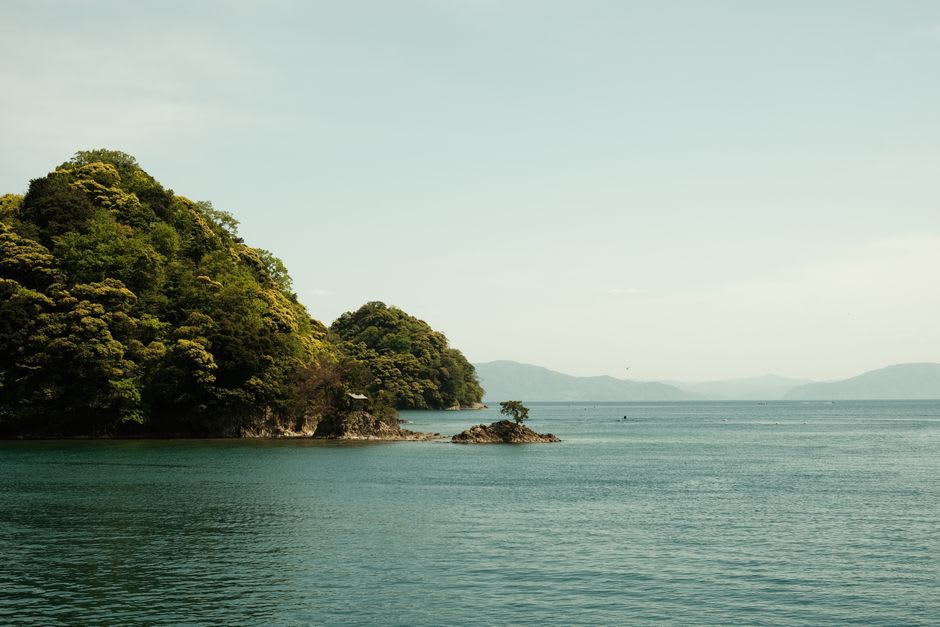
Sukumo Bay is known across Kochi for its sunsets, and specifically for a rare optical trick — on certain clear evenings the setting sun flattens and stretches into what locals call the “daruma sun,” an hourglass shape that seems to sit doubled on the horizon as it meets its own reflection in the sea haze. We did not get the full daruma; you need very particular winter conditions. But what we got was still the best hour of the trip.
We walked out to the seawall with cans of cold coffee and watched the whole bay turn to hammered copper, then rose, then a bruised violet, the mountains across the water going flat and black. A few locals were out doing the same, unhurried, unremarkable, as if the finest sunset I’d seen in years were simply Tuesday. For them it was.
Slow Days and Sea Bream
With nothing we were obliged to see, we invented small routines. Morning coffee at a tiny place run by a man who roasted his own beans and clearly could not believe his luck at having customers to talk at. A walk out to the pier where the Uwajima ferry loads. And dinner — the reason to linger — because this stretch of coast pulls extraordinary fish out of the water, and we ate sea bream and horse mackerel so fresh it barely needed the soy.
One evening Lia struck up a wordless friendship with an old fisherman mending nets who insisted on giving us two still-warm grilled fish from his own dinner. We tried to refuse; you cannot refuse. We ate them on the seawall watching the light go, and I remember thinking there was nowhere else I wanted to be.
Getting There
Sukumo is genuinely remote, and that remoteness is the whole appeal — set your expectations accordingly. From Kochi city we drove the coast road down through Shimanto, which took around two and a half hours of beautiful, empty tarmac; there’s also the Tosa Kuroshio Railway as far as Sukumo Station, though services are infrequent and slow. The town is also a ferry port — boats cross the strait to Yawatahama in Ehime — which makes it a natural pause if you’re threading between Shikoku and Kyushu. Come without a fixed plan. There is no headline sight, no must-do; there is a bay, a fishing town, and a sunset that has quietly outshone far grander places for us. Stay at least one night so you catch the light, and if the winter air is sharp and clear, ask a local whether the daruma sun might appear.
Keep exploring
More of Shikoku