
Matsuyama
"We came to Shikoku for the quiet. Matsuyama gave us that, plus the best bath of my life and a castle you reach by chairlift."
The largest city on Shikoku, built around Dōgo Onsen — one of the oldest hot springs in Japan and its grand wooden bathhouse. A hilltop castle, rattling streetcars, and a warm, literary, unhurried spirit all its own.
Shikoku is the island most travellers to Japan never quite get to, and that was exactly why Lia and I went. We crossed over from Honshū with no fixed plan beyond a vague intention to slow down, and Matsuyama — the island’s biggest city, though it wears the title lightly — turned out to be the perfect place to do it. It’s a town of rattling streetcars and covered arcades and a hot spring so old it appears in Japan’s earliest chronicles, and within a day of arriving we’d stopped checking the time.
Dōgo Onsen
The reason to come to Matsuyama, or at least the reason we came, is Dōgo Onsen, said to be one of the oldest hot springs in Japan — a place mentioned in the eighth-century Man’yōshū, bathed in by legendary emperors, still steaming a thousand-odd years later. The bathhouse at its heart, the Dōgo Onsen Honkan, is a magnificent three-storey warren of dark wood built in 1894, all gables and lattice and a little bronze heron on the roof, and it is rumoured to have helped inspire the bathhouse in Spirited Away. You pay at the entrance, are handed a thin cotton yukata, and disappear into a maze of stairs and corridors to soak in the mineral water before retreating upstairs to a tatami room where an attendant brings green tea and a small sweet. Lia and I bathed separately — the baths are divided by sex, as they always are — and met afterwards on the tatami, both of us flushed and loose-limbed and grinning at each other like fools.
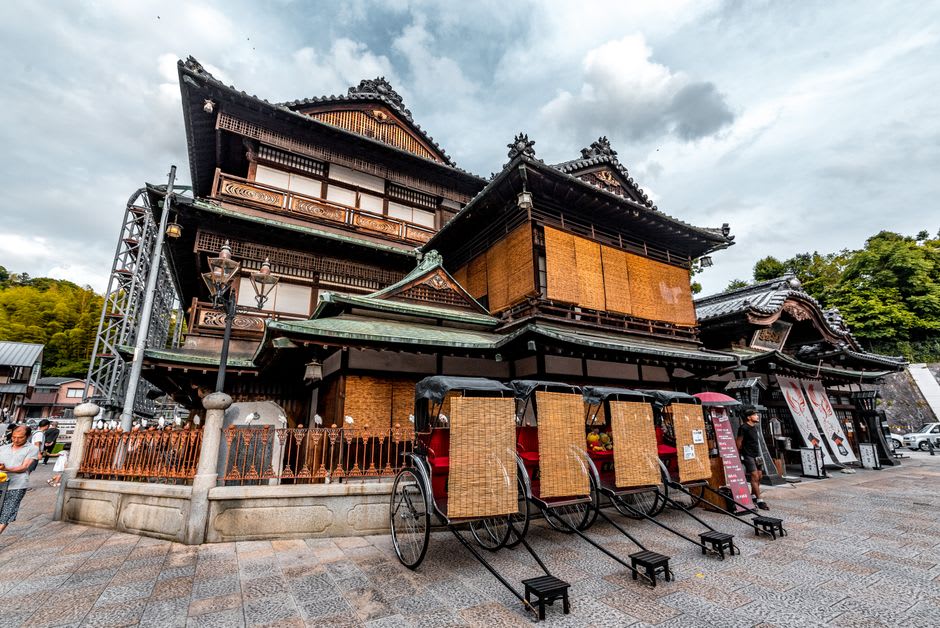
We stayed in the onsen quarter, and the ritual of it took over our evenings — bathe, change into the yukata the inn provided, and wander the little streets around the bathhouse in wooden geta, clacking past the arcade shops for a cold beer and a plate of the local jakoten, small deep-fried fishcakes. The town moves at the pace of people who have just had a bath.
The castle on the hill
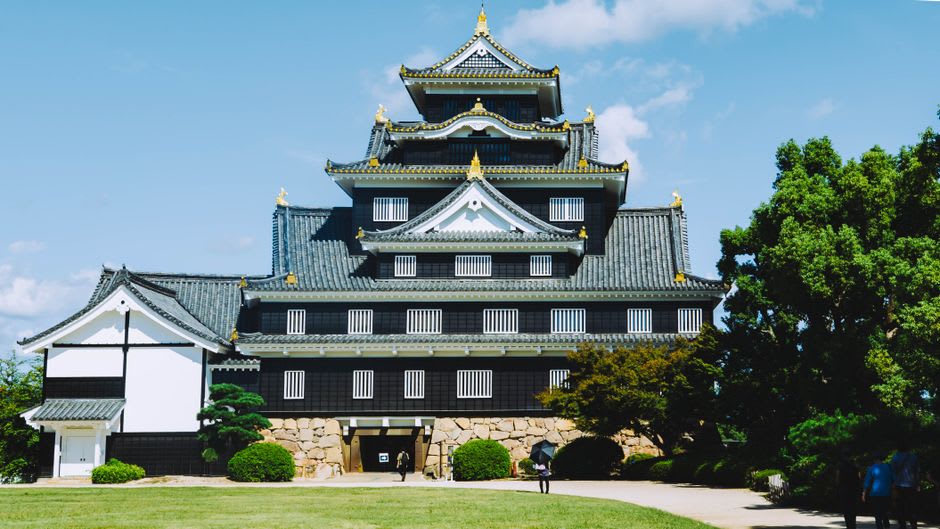
Matsuyama’s other landmark is its castle, one of the dozen or so in Japan that survive as genuine originals rather than concrete postwar reconstructions, standing on a steep hill right in the middle of the city. You can walk up through the wooded slopes, or — this being Matsuyama, which does not believe in unnecessary effort — ride a single-seat chairlift that carries you up over the treetops, feet dangling, the city spreading out behind you. We took the chairlift up and walked down, which felt like the correct order of things. The keep itself is a handsome complex of interlocking wooden towers and gates, and from the top the view runs across the whole city to the glinting waters of the Seto Inland Sea.
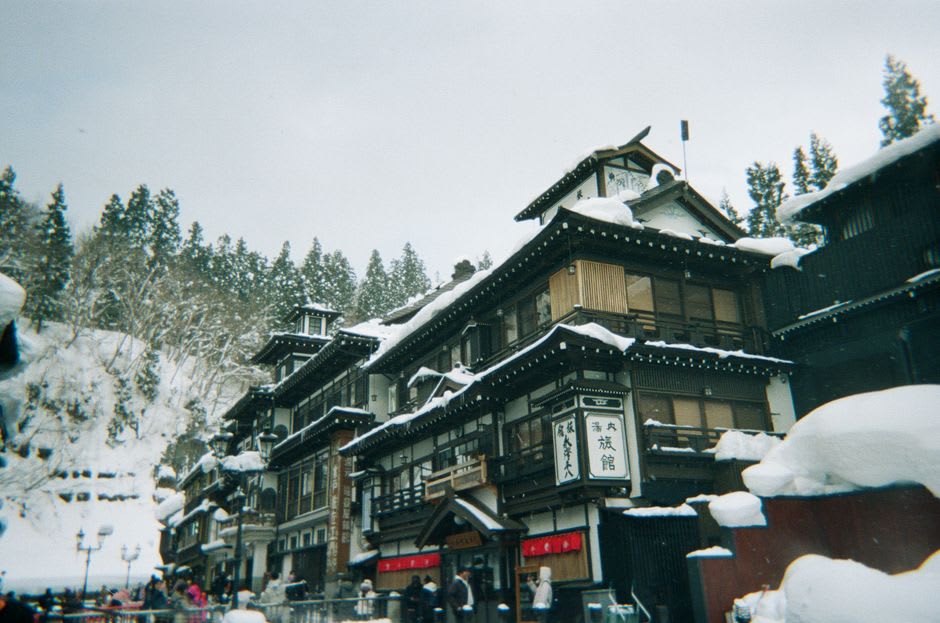
Matsuyama is proud of its literary connections — this is the city of the novelist Natsume Sōseki, whose comic novel Botchan is set here, and of the great haiku poet Masaoka Shiki, born in the town. There are haiku postboxes dotted around the place, where you can drop in a poem, and a streetcar done up as the old steam “Botchan train” that trundles through the centre. It’s the kind of civic pride that’s easy to be cynical about and hard to actually resist.
Streetcars and the slow days
What I’ll remember most, though, isn’t the castle or even the bath — it’s the texture of ordinary Matsuyama afternoons. The streetcars, which have run here for over a century, rattling around corners and clanging at crossings. The long covered shopping arcades where old ladies sold mikan oranges, the fruit Ehime is famous for, piled in fragrant orange pyramids. Sitting in a tiny standing bar near the station eating tai-meshi, sea bream cooked into rice, while the owner told us, unprompted and at length, about his son who’d moved to Osaka and never called.
Nobody hurried us anywhere. Nobody was performing the town for tourists, because there weren’t really any tourists — just a warm, slightly old-fashioned Japanese city getting on with its life, and letting us drift along in it for a few unreasonably happy days.
Getting There
Matsuyama sits on the northwest coast of Shikoku. The city has its own airport with flights from Tokyo and Osaka, which is the fastest way in. By land, limited express trains cross from Okayama over the Seto-Ōhashi bridge in around two and a half to three hours, a beautiful ride across the islands of the Inland Sea. In town, the streetcars take you almost everywhere you’ll want to go; the Dōgo Onsen line runs straight from the centre to the bathhouse quarter. Give it two nights — Dōgo is a place to settle into, not to rush.
Keep exploring
More of Shikoku