A deep, mist-wrapped gorge in the heart of Shikoku, laced with vine bridges and thatched houses and a strange population of straw scarecrows. Iya is the Japan we thought had disappeared — and hadn't.
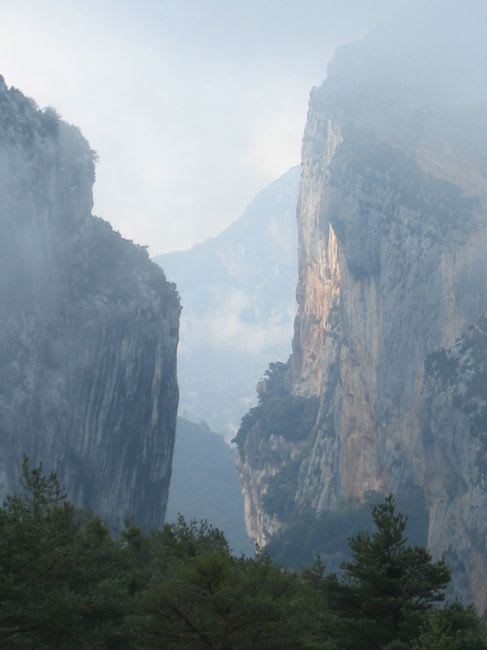
You feel Iya before you see it. The road from Tokushima’s plain climbs and narrows and starts clinging to the side of a gorge so deep the river at the bottom is just a rumor of sound. Then the guardrails thin out, the mist comes down, and you’re somewhere that feels genuinely hidden — the kind of fold in the mountains where defeated samurai were said to vanish and never be found. Lia navigated the switchbacks with white knuckles while I promised, dishonestly, that we were nearly there. We were not nearly there. That’s rather the point of Iya.
The vine bridges that still move
The kazurabashi are the reason most people come, and no photo prepares you for standing on one. The bridge is woven from living mountain vines, rebuilt every few years, and the “floor” is a lattice of logs with gaps wide enough to drop a boot through — so you walk looking straight down at the river churning green over rocks far below. It swings. It creaks. It moves when you move. I went first, gripping the vine rail, and heard Lia laughing nervously behind me the whole way across. Legend says the bridges were built from vines precisely so they could be cut down fast if enemies came. Crossing one, you understand the fear and the ingenuity both.
A village of scarecrows
Deeper into the valley, in the hamlet of Nagoro, we met the residents — and slowly realized most of them weren’t alive. A woman there, watching her village empty out as the young left and the old died, began making life-size straw dolls to replace the people who had gone. There are now far more scarecrows than humans: figures waiting at a bus stop, bent over in a field, sitting in the shuttered schoolhouse at little desks. It should be eerie, and it is, but it’s also unbearably tender — a whole community’s grief made visible and oddly warm. Lia sat down on a bench beside two of them and went quiet for a long time.
Thatched roofs and hidden hot springs
Iya rewards staying the night. We slept in an old farmhouse with a thatched roof and an irori hearth sunk into the floor, the smoke curling up through blackened beams that had held for two hundred years. In the morning fog sat in the valley like poured milk. The valley’s most famous bath, at a mountain hotel across the gorge, is reached by its own little cable car that lowers you down the cliff face to an open-air onsen beside the river — we soaked there as the mist shifted and a hawk turned overhead. There is a statue of a boy relieving himself off a cliff-edge rock, a local joke about the bravado these heights demand. We did not test our own nerve that far.
Getting There
Iya is remote on purpose, and reaching it is part of the experience. The usual approach is via Oboke, on the mountain train line between Okayama and Kōchi; from Oboke station, infrequent local buses wind up into the valley to the main vine bridge. Honestly, though, a rental car changes everything here — the deeper corners of Iya, the scarecrow village, and the second, twin set of vine bridges are barely reachable without one, and the driving, however nerve-testing, is magnificent. Come with time and low expectations of speed. Fuel up before you climb, watch for fog, and let the valley set the pace. It will anyway.
Keep exploring
More of Shikoku