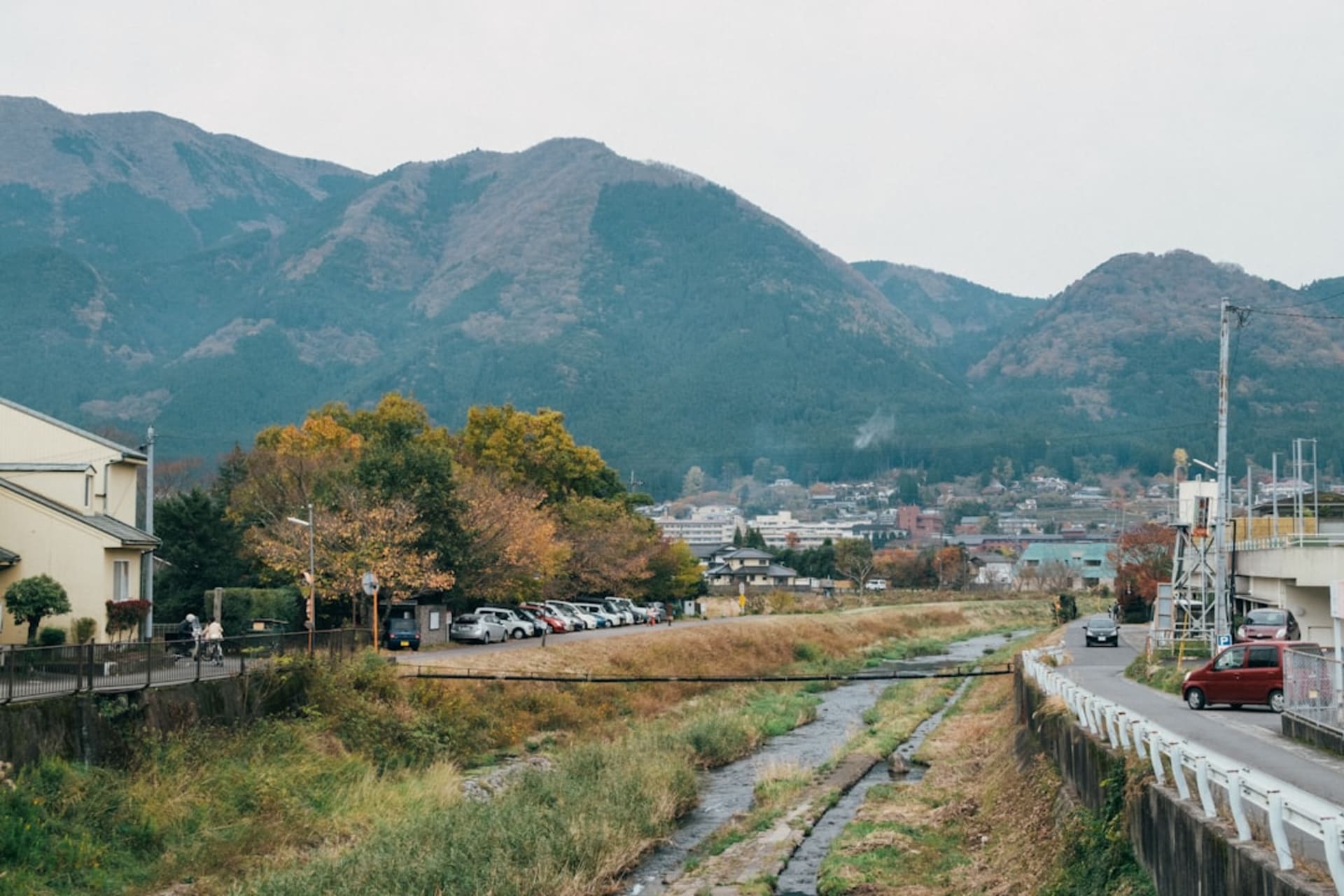
A genteel onsen and craft village in the Ōita hills beneath the twin peaks of Mount Yufu. Misty morning lakes, small galleries, quiet ryokan, and a slower kind of Japan.
We came to Yufuin straight from the roar and steam of Beppu, over the mountain pass in a little bus, and the change was almost comic in its completeness. Beppu had felt like a furnace; Yufuin felt like a held breath. The village sits in a green basin in the Ōita hills, and rising over the whole of it are the twin peaks of Mount Yufu, a mountain so precisely framed that the town seems to have arranged itself as a foreground for it. Lia and I stepped off the bus into a soft, cool morning with mist still burning off the fields, and I felt my shoulders come down from around my ears for the first time in days. There are onsen everywhere in Kyūshū, but Yufuin has cultivated something more particular — a refined, rural quiet, half farming village and half artists’ retreat, and we slipped into its pace within the hour.
Kinrin-ko at Dawn
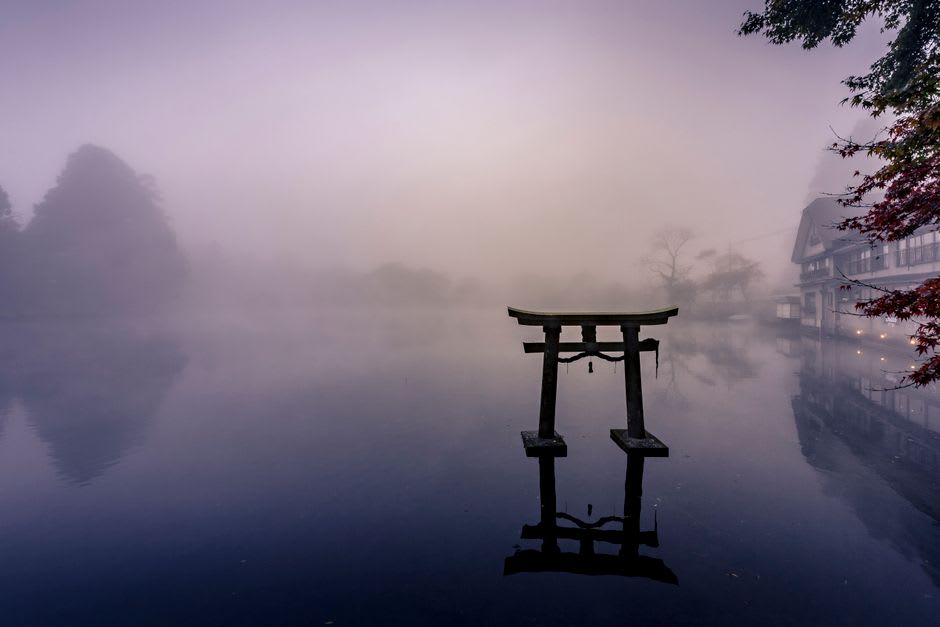
The heart of Yufuin, for me, was Kinrin-ko — the “golden scale lake,” a small pond fed by both hot and cold springs at the far end of the village. We made ourselves get up before the light was properly awake to see it, and it was worth every minute of lost sleep. Because warm spring water feeds into the cold lake, mist rises off its surface at dawn in slow, curling sheets, and the whole pond seemed to be breathing. The name comes from the way the early sun catches the fish scales and the ripples and turns them gold; we were a touch early for that, but the mist alone was enough.
We had the lakeside almost to ourselves — a few local walkers, an old man feeding the carp, a heron standing motionless in the shallows. A small shrine sits at the water’s edge, and a torii gate stands half in the pond itself. Lia sat on a stone and sketched the mountain doubled in the water, and I walked the short path around the lake twice, slowly, the way you do when you don’t want a place to end.
The Craft Village and Its Galleries
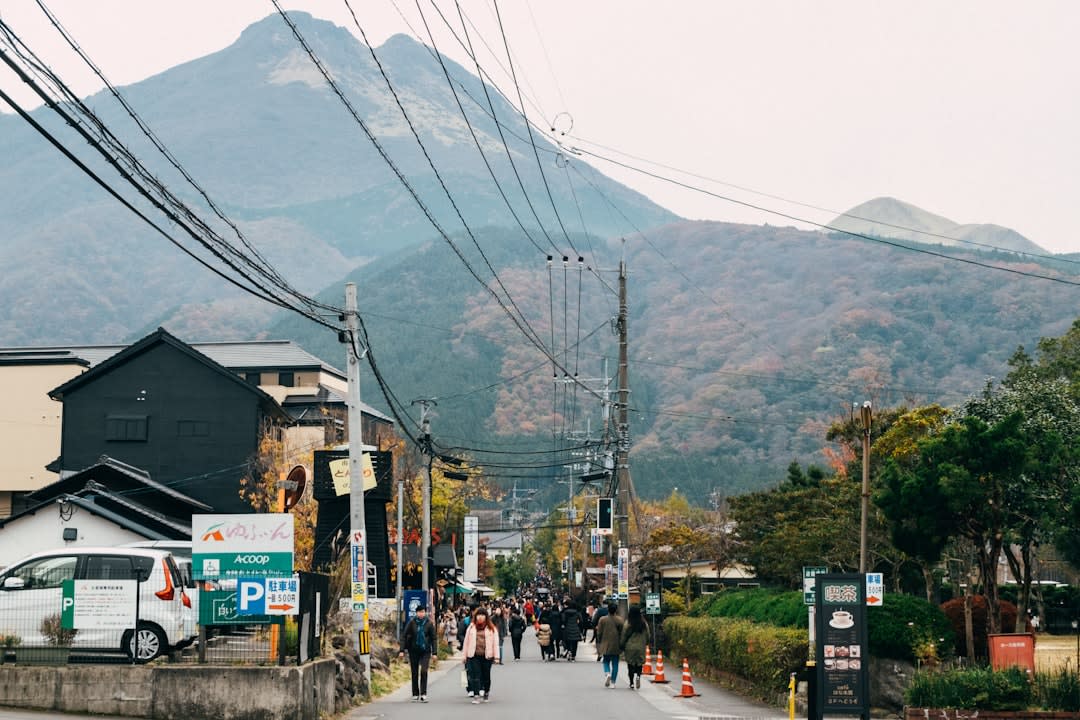
Later, as the village woke, we wandered the main lane that runs from the station toward the lake. Yufuin has drawn artists and craftspeople for decades, and the street is threaded with small galleries, ceramic studios, glassblowers, and cafés set in converted farmhouses. It can tip toward the touristy in the busiest hours — there are more soft-serve stands and souvenir shops than a purist might like — but step one lane back and you find the real thing: a potter at a wheel, a woman weaving, a tiny museum in a private house.
We spent the middle of the day drifting between these. Lia fell hard for a small blue-grey tea bowl in a ceramics studio, watched the maker for a while, and bought it directly from his hands — it now lives on our shelf in Mexico and holds, of all things, our house keys. I bought nothing and regret it slightly. That is Yufuin’s gentle trap: it makes you want to take a small, handmade piece of it home.
A Night in a Ryokan
We had booked a night in a small ryokan on the edge of the village, and this, really, is how Yufuin is meant to be done. The inn was old wood and paper screens, our room looking out onto a garden and, beyond it, Mount Yufu. In the late afternoon we soaked in the ryokan’s own onsen — an outdoor rotenburo bath ringed by stones, the water hot and faintly sulfurous, the mountain framed perfectly above the fence, as though the whole inn had been built around that one view.
Dinner was kaiseki — a long procession of small, seasonal dishes brought to our room, local Bungo beef and mountain vegetables and river fish, each plate more considered than the last. Afterward, wrapped in yukata, we walked out into the village, which by night empties of its day-trippers and belongs again to the people who live there. The lanes were dark and quiet, a few lantern-lit inns glowing, the mountain a black shape against the stars. Lia said Yufuin was the most restful place we stayed in all of Japan, and I didn’t argue. Some places you visit; this one we simply rested in.
Getting There
Yufuin is inland in Ōita Prefecture, an easy pairing with Beppu just over the mountains — local buses run between the two in under an hour through a scenic pass. From Fukuoka (Hakata) the handsome sightseeing limited express Yufuin no Mori runs directly to Yufuin in a little over two hours, and it is worth timing your trip to ride it; the train is half the pleasure. Once you arrive, the village is entirely walkable — the station, the craft lane, and Kinrin-ko lie in a gentle line about twenty minutes end to end. Stay overnight if you possibly can. Yufuin’s real character only shows itself once the day buses leave and the mist settles back over the lake.
Keep exploring
More of Kyūshū & Okinawa