
Hita
"The shopfronts leaned toward each other over the lane like old men sharing a secret."
An Ōita river town where a whole Edo-era merchant quarter still stands, its wooden shopfronts leaning over lanes that once made Hita rich enough to be governed directly by the shōgun. Come evening, the rivers fill with lantern-lit pleasure boats and the smell of grilled river fish.
Hita announced itself with the smell of soy and charcoal. We’d arrived in the late afternoon, tired from the train, and walked into the old Mameda-machi quarter half-expecting the usual tidied-up heritage street. Instead we found a living neighbourhood of dark wooden merchant houses, their shopfronts leaning toward each other over the lane like old men sharing a secret, with actual shops still in them — a soy-sauce brewer, a maker of wooden geta clogs, a sweet shop that had been in the same family for generations. An old woman was hosing down the stone in front of her store. Somewhere behind a lattice window a radio was playing enka. Lia, who has a nose for these things, immediately declared it her favourite town in Kyūshū, and we hadn’t even had dinner yet.
Mameda-machi, the merchant quarter
In the Edo period Hita was tenryō — land governed directly by the shōgun rather than a local lord — and the money that flowed through it built the merchant district that survives today. Walking Mameda-machi is walking through that prosperity, house by house. We ducked into a soy-sauce and miso brewery where enormous old cedar vats stood in the cool dark, the air thick and savoury, and the owner let us taste soy aged for years alongside the young stuff. Next door a craftsman was carving wooden clogs, curls of pale wood at his feet. There’s no admission gate to any of this; you simply wander, and the town lets you. We bought a small bottle of the dark aged soy that we’re still rationing at home.
The rivers and the cormorants
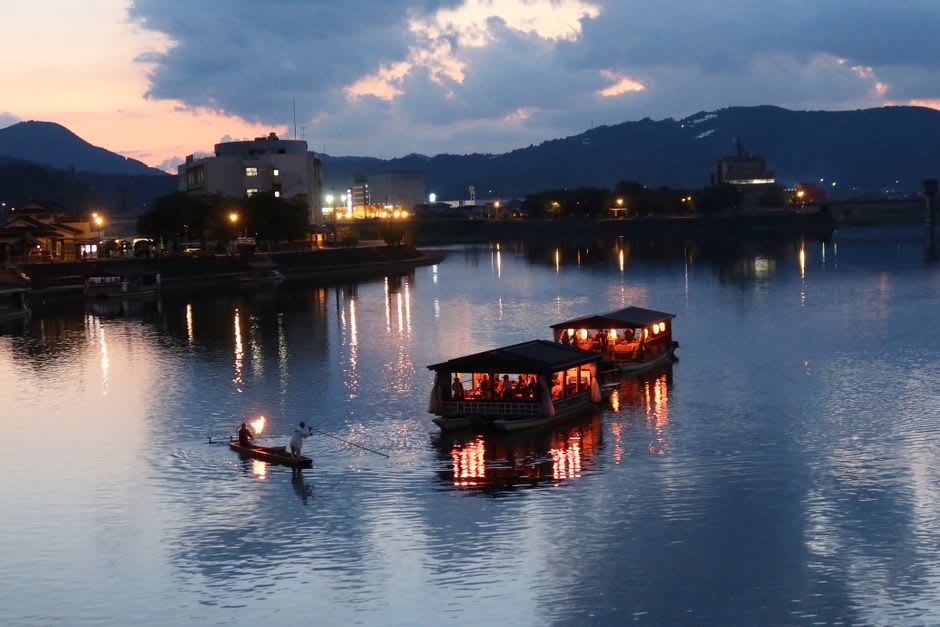
Hita is stitched together by rivers — the Mikuma chief among them — and in summer the town revives an old tradition of ukai, fishing with trained cormorants from boats at night. We took a small boat out at dusk, sharing it with a Japanese family and a cooler of beer, and watched a fisherman in a straw skirt manage a dozen cormorant birds on cords, the birds diving into the firelit water after sweetfish while a torch blazed at the bow. It is theatrical and strange and a little uncomfortable — the birds wear rings so they can’t swallow the larger catch — but there’s no denying the beauty of the flames on the black water. Afterwards we ate grilled ayu, the same river fish, salted and skewered whole, and the fireflies came out over the bank.
Hot springs and river breakfasts
Hita is also an onsen town, and our inn had baths fed by the local hot springs, set right against the river so you could soak while the current murmured past below. There is a particular pleasure to a morning bath with the mist still lifting off the water and a heron picking along the far bank. Breakfast came as a lacquered tray of small dishes — grilled fish, pickles, a raw egg to fold into hot rice — eaten cross-legged by a window open to the river sound. Lia said she could live like this, and I pointed out that we more or less already do, in a much less picturesque way, and she threw a pickle at me. A good morning.
Getting There
Hita lies inland in the west of Ōita Prefecture, on Kyūshū, roughly between Fukuoka and the coast. From Fukuoka’s Hakata station the Yufuin-no-Mori or a limited express train reaches Hita in about an hour and a quarter, making it an easy day trip — though it rewards an overnight stay far more. Drivers will find it a comfortable stop on the mountain roads between Fukuoka, Yufuin and Beppu. The old Mameda-machi quarter is a short walk from Hita station and best explored on foot; the summer cormorant fishing runs roughly May to October, so check dates and book a boat ahead if that’s what draws you.
Keep exploring
More of Kyūshū & Okinawa