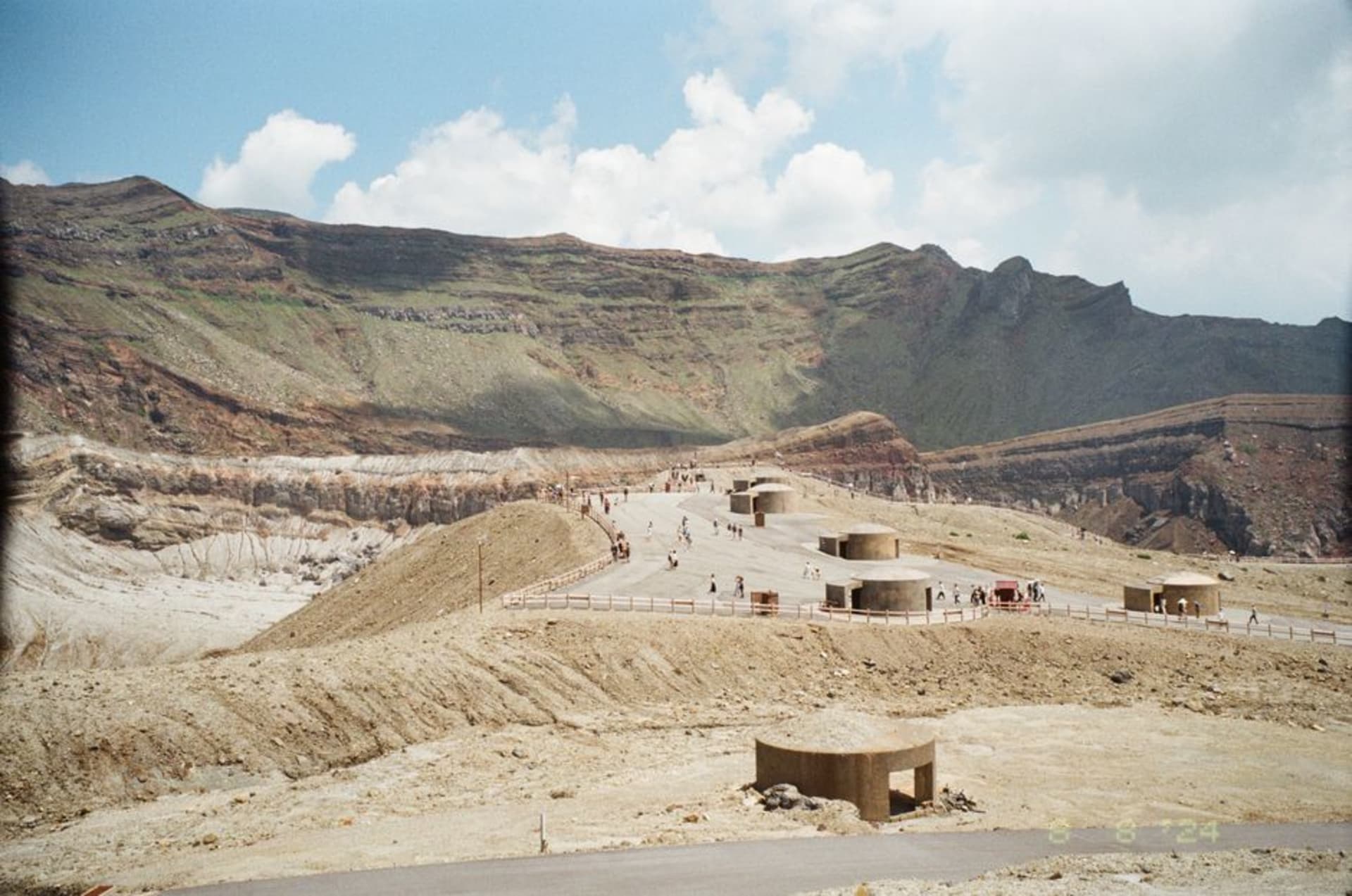
Aso
"We stood inside a volcano so large it took me an hour to understand we were already in it."
One of the largest volcanic calderas on Earth — a vast green bowl of grasslands and grazing horses in the heart of Kumamoto, with a steaming, restless crater still smoking at its center.
It took me a while to grasp the scale of Aso, and I think that’s the whole point of the place. We came up from Kumamoto expecting a mountain and a crater, and instead the road climbed over a rim and dropped us into a vast green bowl — farms, towns, rice fields, a train line, all of it cradled inside the walls of an ancient volcano so enormous you can’t take it in from the ground. This is the Aso caldera, one of the largest in the world, formed by eruptions unimaginably huge, and tens of thousands of people simply live inside it. Lia kept turning in slow circles trying to see the far walls at once. Cattle and horses grazed the slopes; a plume of white steam rose from somewhere in the middle distance. It was the strangest landscape we saw in all of Japan — pastoral and enormous and quietly, obviously alive.
The Grasslands and the Horses
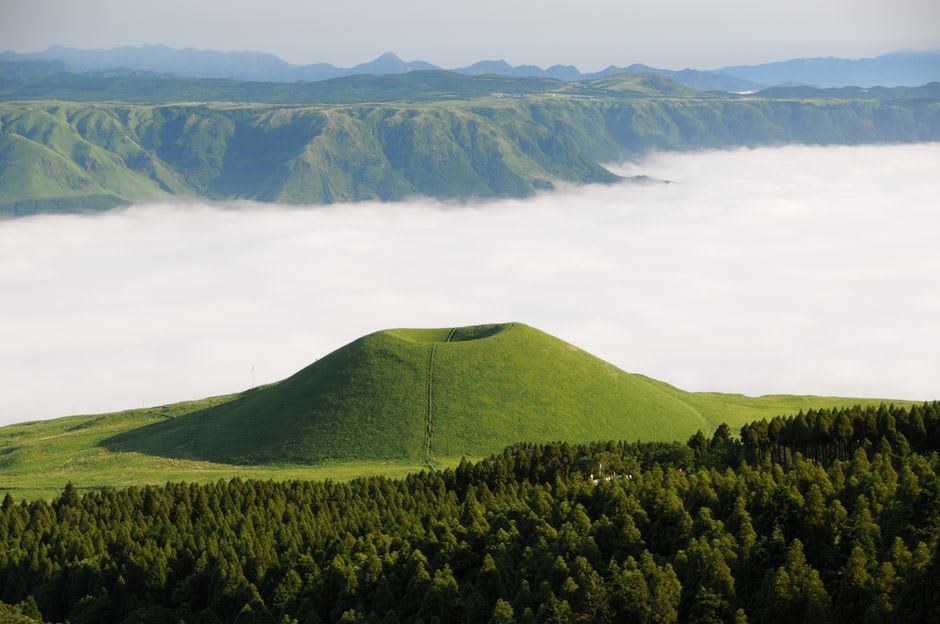
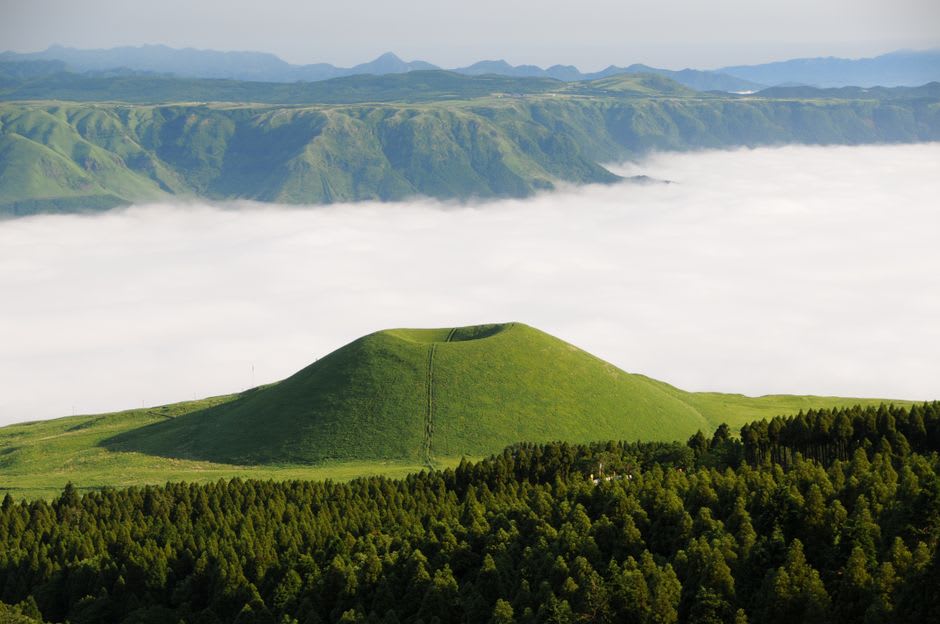
The floor and slopes of the caldera are open grassland — kept that way for centuries by grazing and controlled burning — and walking through them feels almost nothing like the Japan of temples and trains. We spent a morning up at Kusasenri, a rolling meadow with a couple of shallow crater ponds, where horses and cattle graze loose across the green.
You can ride the horses along marked paths, and Lia — braver than me around large animals — took a placid mare out across the meadow while I walked alongside feeling like the more sensible of us. The wind came steady and cool across the grass, the volcanic peaks rose all around, and the whole scene had a wide, high-country openness that I hadn’t known existed in this country. We ate a picnic on a slope watching the herds move, and it was hard to remember we were sitting inside an active volcano at all.
The Smoking Crater
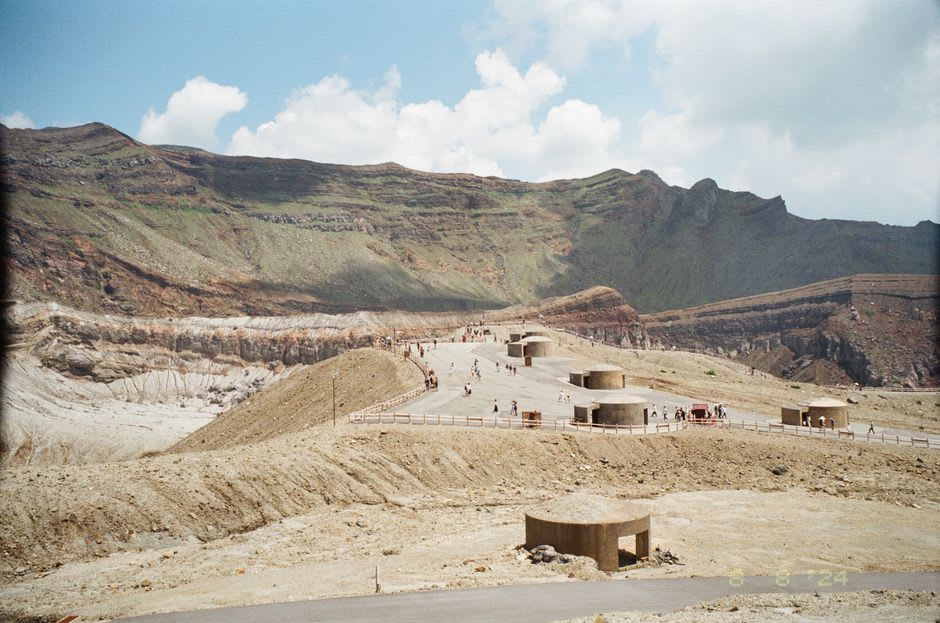
Until, that is, you go to the middle. At the caldera’s heart rises Mount Nakadake, still very much active, its crater holding a turquoise pool of boiling acidic water under a constant roll of sulphurous steam. When conditions allow — and they don’t always, since the volcano is genuinely dangerous and closes on high gas days — you can go right up to the rim and look in.
We were lucky; the day we went the gas readings were low and the road was open. Standing at the barrier, looking down into that churning blue-white cauldron with concrete blast shelters dotted along the rim behind us, I felt the raw fact of the place in a way the grasslands had softened. The steam shifted and for a moment we saw straight down to the boiling surface. Lia went quiet. It is not a pretty sight so much as an overwhelming one — a reminder, at close range, of the force the entire caldera is built on.
Shrines and Farm Villages
Down on the caldera floor, life goes on with the volcano as a neighbor. We spent our last afternoon in the farming towns, stopping at Aso Shrine, one of the oldest in Japan, whose great wooden gate was toppled in the 2016 earthquakes and has been painstakingly rebuilt — a reminder that this fertile bowl exacts a price for its richness.
Nearby, a lane of springs runs through the town of Aso, where locals draw clear volcanic water and where we ate a bowl of dango-jiru, the local flat-noodle miso stew, in a farmhouse restaurant run by an elderly couple. The husband told us, in slow careful English, how the ground had shaken and the shrine had fallen, and how they had rebuilt anyway, because where else would they go. Driving back out over the caldera rim at dusk, the grasslands going gold and the crater’s steam catching the last light, I thought Aso was the most quietly humbling place we’d been.
Getting There
Aso lies in the mountainous center of Kyūshū, in Kumamoto Prefecture. The usual base is Aso Station, reached by the Hōhi Line from Kumamoto in around an hour and a half — a scenic railway that itself climbs into the caldera. Coming from Fukuoka (Hakata) you can take the shinkansen to Kumamoto and change to the local line. A car makes the most of the area, since the grasslands, crater, and farm villages are spread across the huge caldera floor, but local buses run up toward Kusasenri and the crater ropeway. Always check the volcano’s status before heading to Nakadake — the crater closes without notice when gas levels rise.
Keep exploring
More of Kyūshū & Okinawa