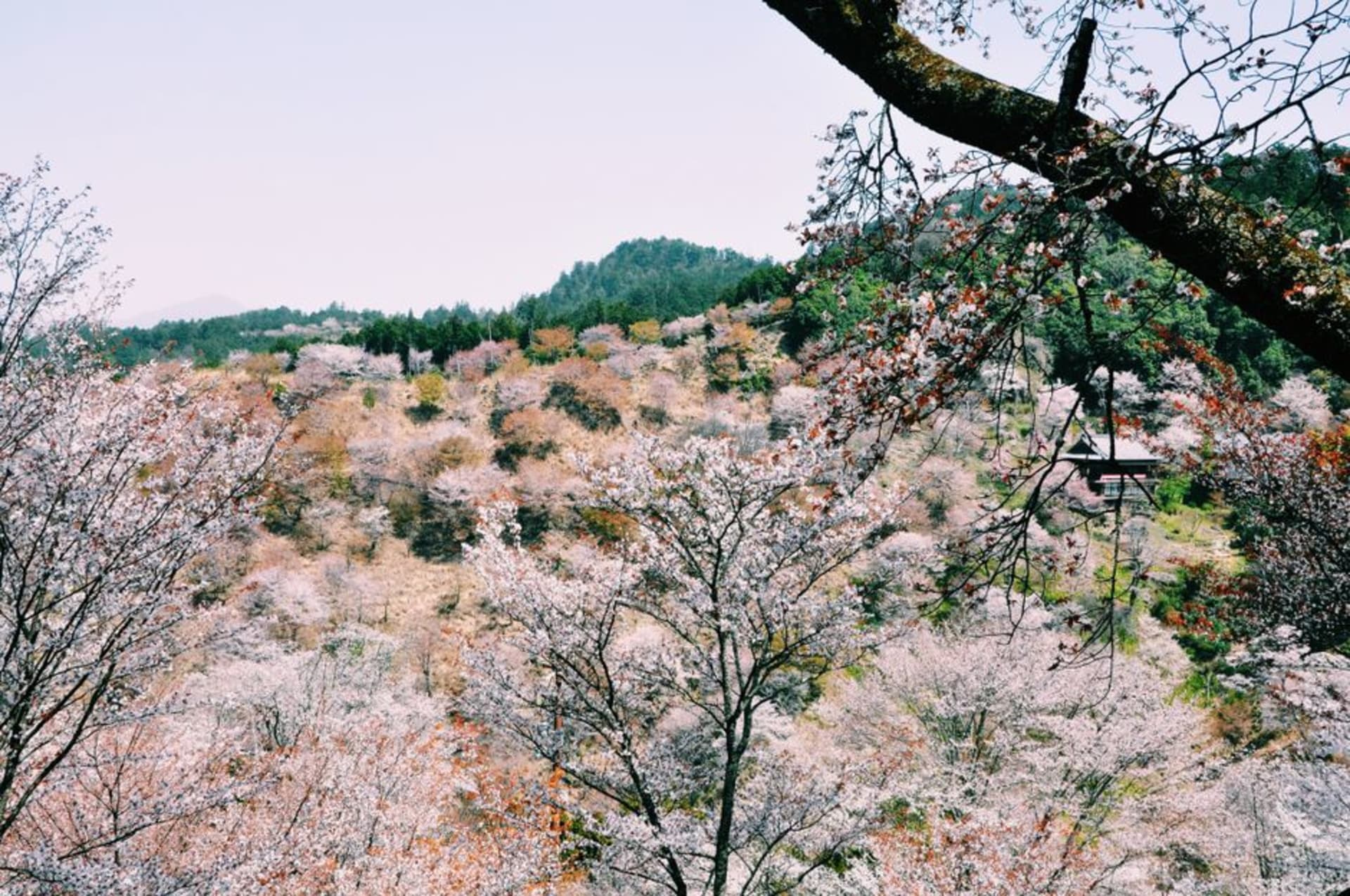
A whole mountainside that turns to cherry blossom in waves each spring, climbing from valley to summit over weeks. Beneath the flowers lie ancient temples and centuries of mountain-ascetic faith. We came for the sakura and found the older thing underneath.
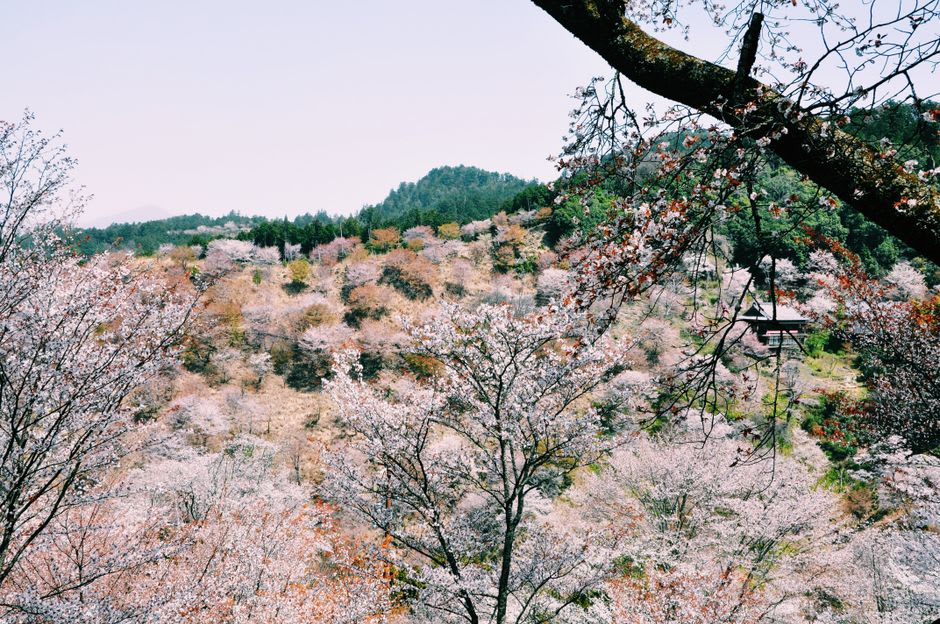
I’d seen cherry blossom in city parks before — a tree here, an avenue there, beautiful but contained. Nothing prepared me for the first view of Yoshino from the ridge, when Lia grabbed my arm and neither of us managed a word. It isn’t a garden or a park. It’s an entire mountain, tens of thousands of cherry trees planted over more than a thousand years, and in spring the bloom moves up the slopes in stages — the lower groves first, then the middle, then the upper and inner — so that the whole hillside is a slow tide of pink and white climbing toward the summit. We’d timed it half by luck, and stood on that ridge in the cool morning feeling very small and completely happy.
The Four Groves
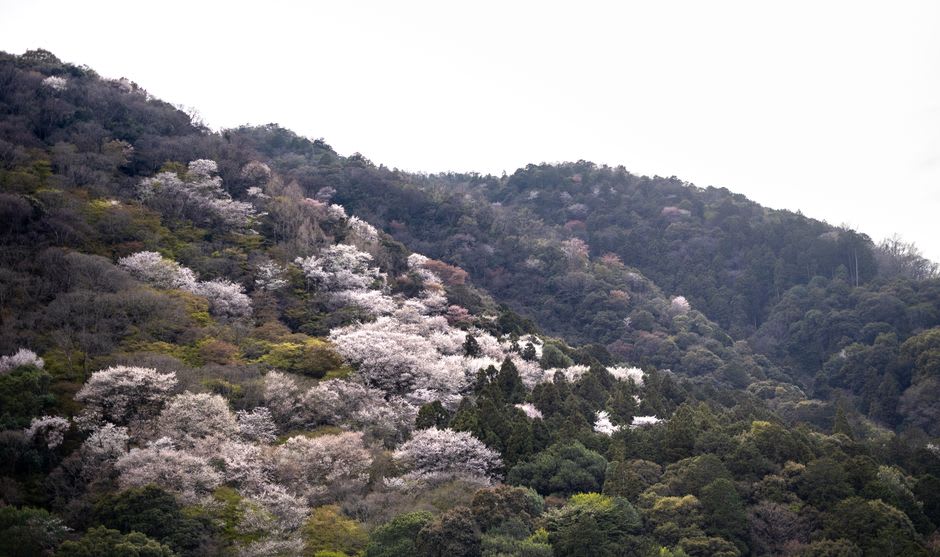
The trees are divided by elevation into four areas — Shimo (lower), Naka (middle), Kami (upper), and Oku (inner) — and because each blooms in turn, the cherry season here stretches far longer than in the cities below. We started low, where the crowds and the food stalls were thickest, sakura mochi wrapped in a salted cherry leaf sold from every other doorway, and walked upward through thinning company. By the time we reached the upper groves the path was quieter, the trees older and more gnarled, and the valley below was a bowl of blossom. An old man tending a small shrine told us, in patient gestures, that the trees had been planted as offerings, that each one was in some sense a prayer. I’ve never looked at a cherry tree the same way since.
Kinpusen-ji and the Mountain Faith
Yoshino isn’t only about flowers — it’s one of the great centres of Shugendō, the mountain-worshipping ascetic tradition, and its heart is Kinpusen-ji. The temple’s main hall, Zaōdō, is a colossal wooden structure, one of the largest in Japan, and stepping inside from the bright hillside into its dim, incense-thick interior was like stepping into a different century. Three fierce blue-skinned Zaō Gongen figures loom in the dark, revealed to the public only rarely. Pilgrims in white robes and straw sandals, some carrying conch-shell horns, still set out from here into the deeper mountains toward Ōmine. We lit incense, watched a monk chant in the gloom, and felt the weight of a faith that has drawn people up this mountain for over thirteen hundred years.
Staying After the Buses Leave
The secret to Yoshino is to sleep there. Most visitors come up for the day and pour back down by late afternoon, and when the last of them go the mountain exhales. We’d booked a night in a shukubo, a temple lodging, with a simple vegetarian dinner and futons on tatami, and after dark we walked out to find the lower groves lit up, blossom glowing against black sky, almost no one else around. In the morning there was frost on the path and mist in the valley, and we drank tea on the veranda watching it burn off the flowers. That quiet, book-ended hour before and after the crowds, was the best of the whole trip.
Getting There
Yoshino sits in Nara Prefecture at the end of the Kintetsu Yoshino line. From Osaka (Abenobashi) the Kintetsu limited express reaches Yoshino station in around an hour and fifteen; from Kyoto or Nara you’ll change trains, typically at Kashiharajingu-mae. A ropeway (or a steep walk) climbs from the station to the lower town, and from there paths and shuttle buses continue up the slopes. Cherry season, roughly early to mid-April, draws big crowds — book lodging far ahead and stay the night to have the mountain to yourselves at dawn.
Keep exploring
More of Kansai