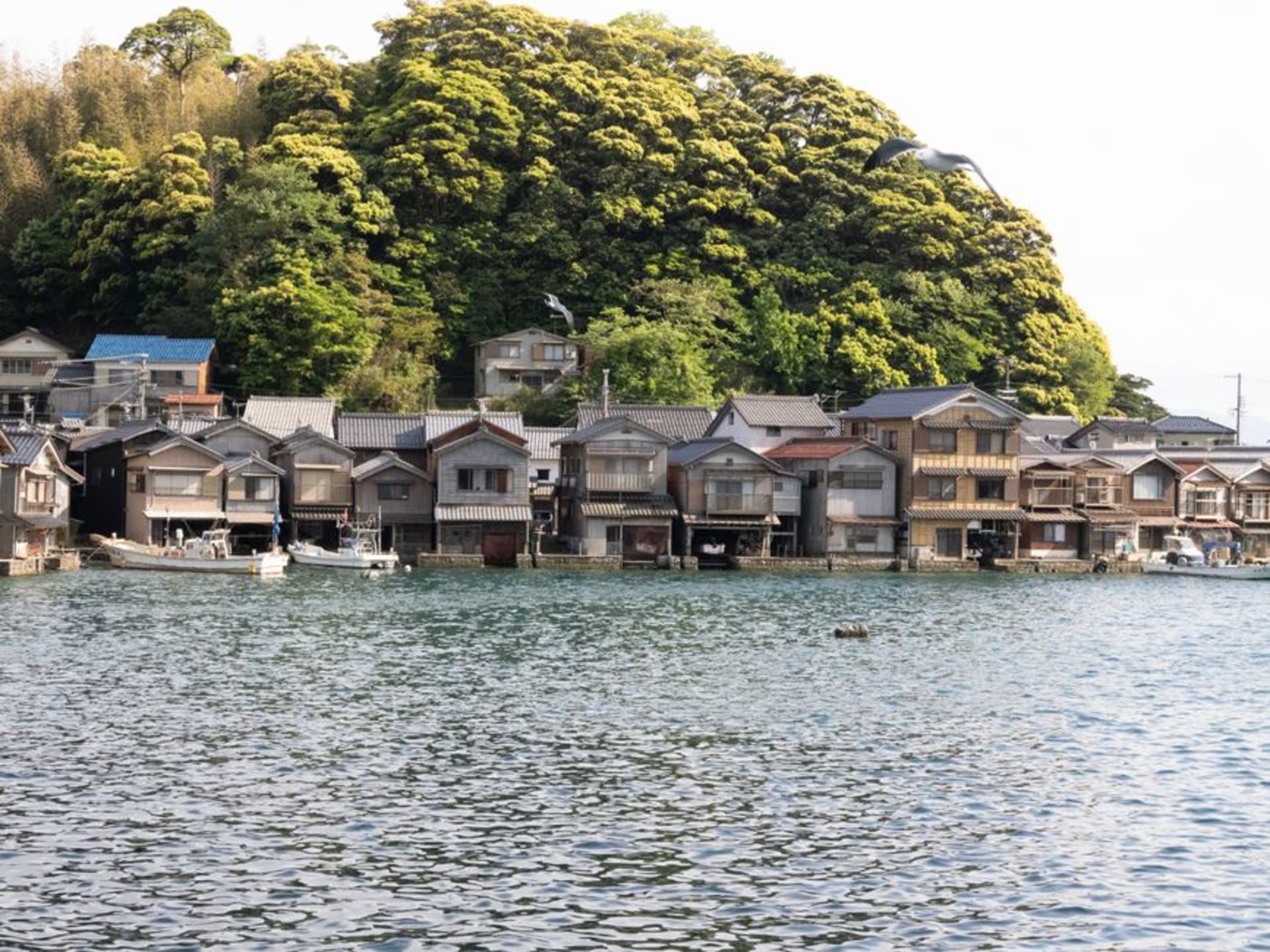
A crescent bay on the far north Kyoto coast where two hundred wooden funaya boat houses stand with their feet in the sea, garage below, home above. We took a boat out onto the still water and understood why nobody here seems in any hurry to leave.
We reached Ine at the end of a long coastal drive, both of us stiff and a little carsick from the switchbacks along the Tango Peninsula, and then the road dropped to the water and every complaint dissolved. The bay curved away in a perfect arc, and along its edge stood the funaya — wooden boat houses built right at the waterline, dark timber, the sea lapping directly into their ground floors. Lia said it looked like a village that had waded in up to its knees and decided to stay. There was no promenade, no ticket booth, just fishermen mending nets and cats asleep on warm stone. We hadn’t booked anything. We just stopped.
Life at the Waterline
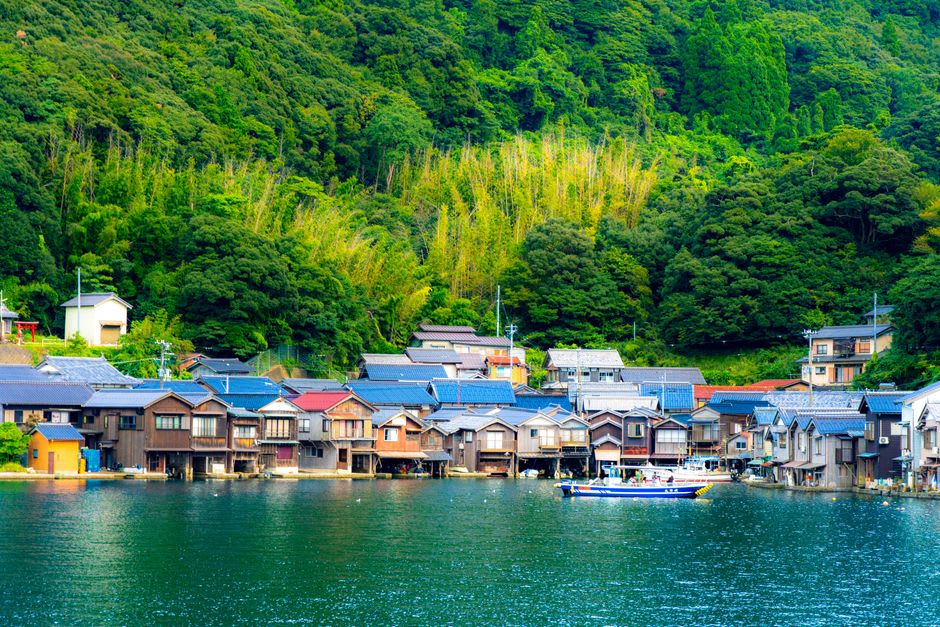
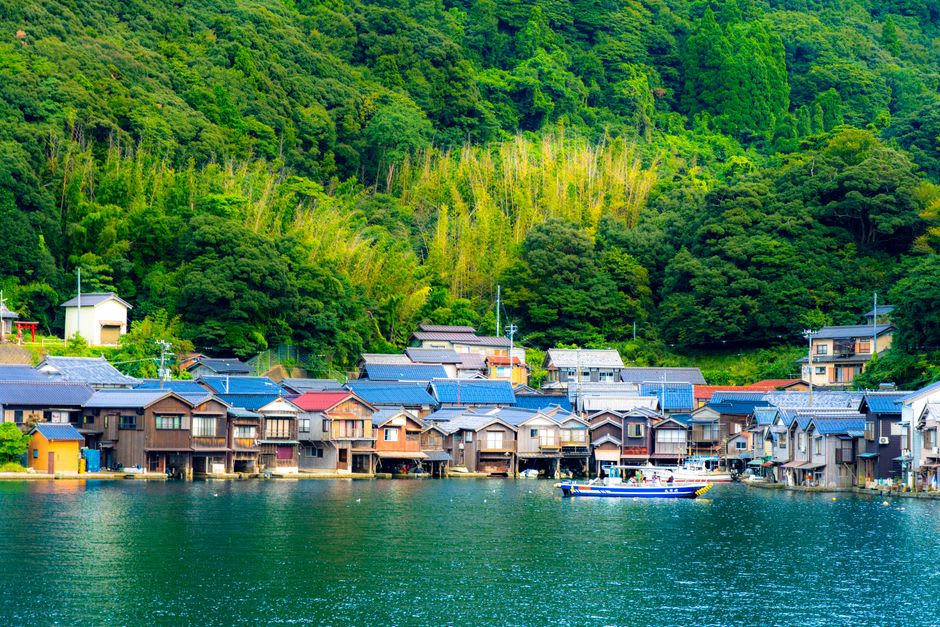
The genius of the funaya is stupidly simple. The ground floor is a boat garage open to the sea, where the family keeps its fishing vessel, its nets, its gear; the living quarters sit above. Roughly 230 of them ring the bay, and Ine is protected enough — the bay mouth screened by a small island — that the water barely stirs, which is the whole reason this works. We walked the single road that threads behind the houses, close enough to peer into open garages where wooden hulls hung on ropes and grandmothers gutted the morning’s catch. Nobody minded us. One old fisherman, seeing Lia admiring his boat, mimed the throwing of a net and grinned with about four teeth. This is a living working village, not a set, and that’s exactly what makes it disarming.
Out on the Bay
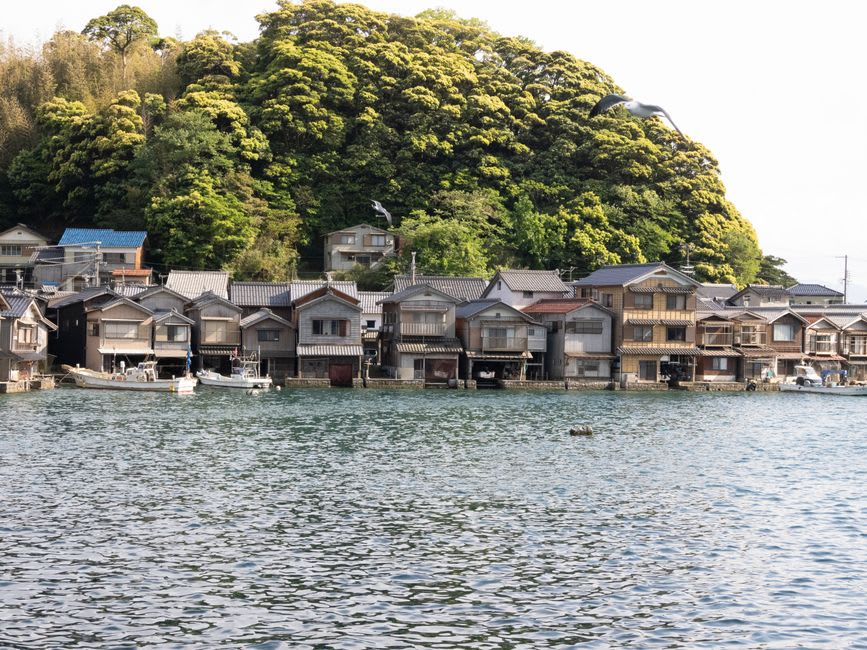
You cannot understand Ine from the land. We took the little sea-taxi — a fisherman’s boat that runs tours around the bay — and pushed off into water so calm it doubled the sky. From out there the funaya reveal themselves as a single unbroken wooden wall, house after house standing on their thin legs, reflected perfectly below. Black kites wheeled overhead, and the moment we opened a bag of the shrimp crackers the boatman handed us, they came screaming down to snatch them from our fingers mid-air. Lia shrieked and loved it. The water was that deep green-blue of a sheltered northern bay, cold-looking even in summer, and the boatman cut the engine partway so we could just drift and hear the village — a door, a radio, gulls — carry across the flat water.
Sake, Sashimi, and a Slow Night
Ine has one of Japan’s northernmost sake breweries, Mukai Shuzo, run by a celebrated female brewmaster, and we ducked in out of the heat to taste. Their Ine Mankai, brewed with an ancient red rice, comes out the color of rosé and tastes faintly of berries — we bought a bottle we absolutely did not need. Dinner was at a guesthouse where the owner served us that afternoon’s catch as sashimi, so fresh it was still faintly sweet, alongside grilled fish and a miso soup thick with clams from the bay below. We stayed the night in a converted funaya, sliding the window open to the sound of water directly under the floor. Lia fell asleep first. I lay listening to the tide knock against the timber and thought: some places you visit, and some you have to be pried out of.
Getting There
Ine is remote, and that’s its salvation. Coming from Kyoto, the smoothest way is the express train to Amanohashidate — itself one of Japan’s famous views — then a local bus (the Tankai bus toward Ine/Kyogamisaki) for about an hour along the coast to Ine. A car gives you the freedom to explore the Tango Peninsula and reach the hilltop Ine-no-Funaya viewpoint, which is worth every hairpin. Once in the village, go on foot or hire a bicycle; the sea taxis and larger tour boats leave from near the tourist information center and are the essential thing to do. Consider staying overnight in a funaya guesthouse — day-trippers leave by late afternoon, and the bay after dark, with the boat houses lit and the water black and still, is the memory you’ll actually keep.
Keep exploring
More of Kansai