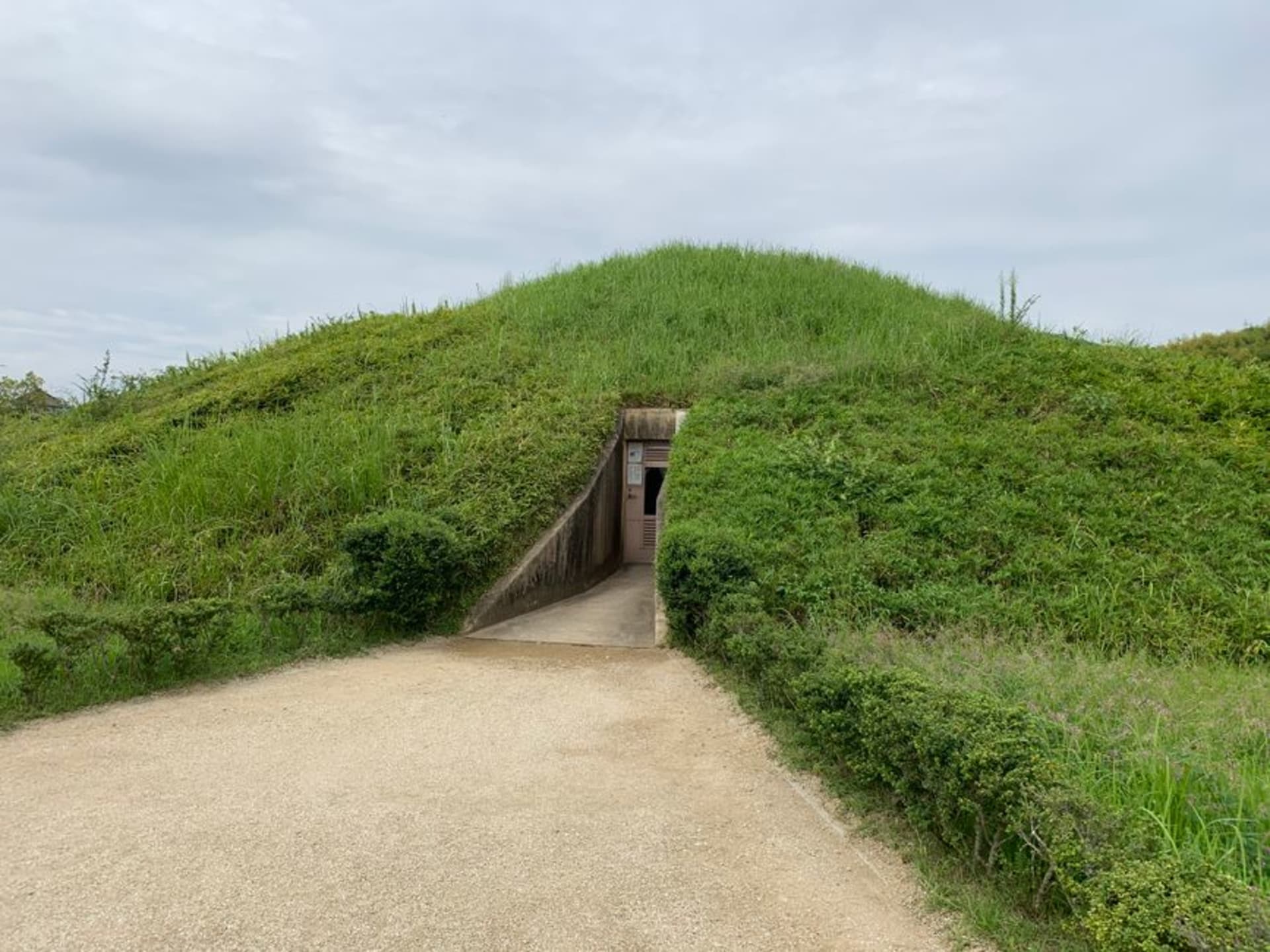
A rural Nara village that was, improbably, the cradle of the Japanese state — an ancient capital now dissolved back into rice terraces, burial mounds, and enigmatic carved stones. We rented bicycles and spent a day pedalling through fifteen centuries. Nothing here shouts; you have to slow down to hear it.
You would never guess, cycling into Asuka on a warm afternoon, that this drowsy village of rice paddies and vegetable plots was once the political heart of Japan. But it was — in the sixth and seventh centuries the imperial court sat here, Buddhism took root here, the first real machinery of a Japanese state was assembled among these hills. Lia and I rented a pair of creaky bicycles from a shop near the station, got a photocopied map with hand-drawn landmarks, and set off with no particular route. That turned out to be exactly the right way to do it. Asuka doesn’t have a single grand monument that organises everything. It’s scattered — a tomb here, a temple there, a strange stone in someone’s field — and the pleasure is in the finding.
Tombs and Painted Walls
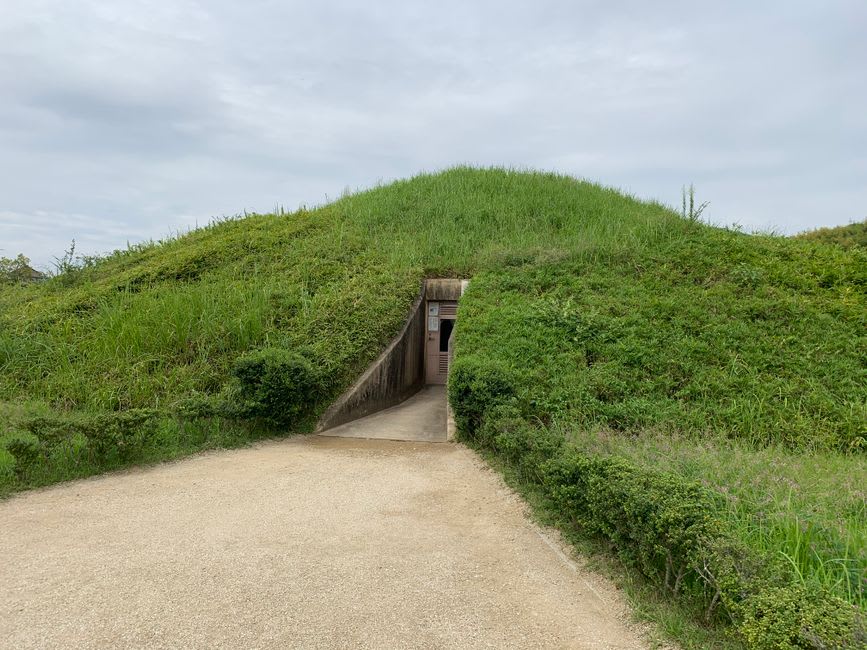
The countryside around Asuka is dotted with kofun, the ancient burial mounds of the early nobility, and pedalling between them you start to read the land differently — that low wooded hummock isn’t just a hill. We stopped at Ishibutai, the most famous: an enormous megalithic tomb whose earthen covering has long since eroded away, leaving the vast stone chamber exposed like a dolmen, the roof slabs weighing dozens of tonnes. You can walk right inside it, into the cool dark, and stand where a powerful clan leader — probably Soga no Umako — was laid some fourteen hundred years ago. Nearby, the Takamatsuzuka and Kitora tombs preserve delicate painted murals, guardians and constellations, protected now behind glass and climate control. Standing there I felt the odd vertigo of deep time in a very ordinary field.
The Enigmatic Stones
Asuka’s real eccentricity is its carved stones — weathered granite figures scattered through the fields and groves whose purpose nobody fully understands. We hunted them down one by one, half of the fun being the search. There’s the Saruishi, “monkey stones,” lumpen grinning faces near an imperial tomb; the Kameishi, a great stone carved to look like a resting turtle, wearing an expression somewhere between benign and smug; and the Nimenseki, a two-faced stone. Scholars argue about whether they were fountains, boundary markers, ritual objects, or something we’ve simply lost the meaning of. That uncertainty is the charm. In a country that documents everything, Asuka keeps a few genuine mysteries lying about in the grass, and Lia and I invented increasingly ridiculous theories for each one as we rode.
Temples and Rice Terraces
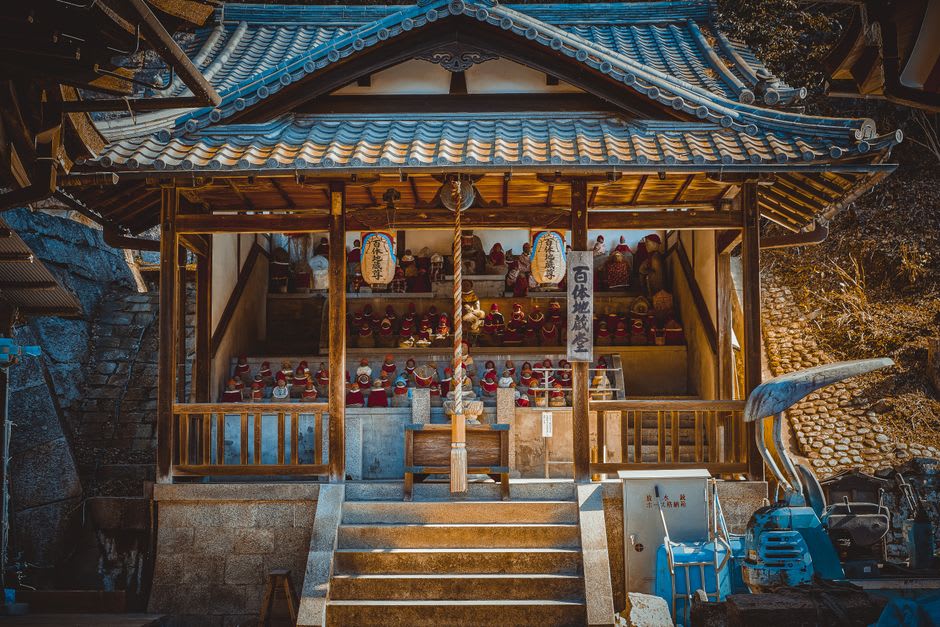
Asukadera claims to be one of the oldest Buddhist temples in Japan, founded around the year 596, and it still houses the Asuka Daibutsu — a bronze Buddha cast in the early seventh century, one of the oldest of its kind, sitting serenely in a modest hall where a caretaker will happily tell you its story. It’s a world away from the crowds of Nara or Kyoto; often we had these places almost to ourselves. Between the sites, the cycling itself was the thing — rice terraces stacked up the hillsides, farmers bent over their plots, the smell of warm earth and cut grass. We stopped at a roadside stand for cold tea and tomatoes, sat on a low wall, and watched the shadows lengthen over paddies that have been worked, more or less like this, since before the temple was built.
Getting There
Asuka is reached on the Kintetsu Yoshino line; Asuka station is about forty minutes to an hour from Nara or Kashiharajingumae, itself easily reached from Osaka (Abenobashi) or Kyoto. The village is spread out and made for two wheels — rent a bicycle at the shop by the station and take the whole day. Electric-assist bikes are worth the small extra for the hillier stretches toward Ishibutai. Come in late spring or autumn if you can, avoid the hottest part of summer, and don’t over-plan; Asuka rewards wandering more than any place we visited in Japan.
Keep exploring
More of Kansai