
Kaga Onsen
"We walked the gorge in the morning and soaked our aching feet by nightfall in the same water the poets praised."
A cluster of centuries-old hot-spring villages in southern Ishikawa, where a wooded gorge unspools beside a mountain stream, kilns still fire the bold colours of Kutani porcelain, and the ryokan know how to make an evening disappear.
Kaga Onsen is not one place but three, a loose family of hot-spring villages tucked into the hills of southern Ishikawa, and we made the mistake at first of treating it as a single dot on the map. It took us a full day to understand that Yamashiro, Yamanaka, and Katayamazu each have their own character, their own waters, their own way of holding the light. We’d come mainly to rest, honestly, worn out from weeks of trains, and Kaga turned out to be exactly the right kind of place to do nothing beautifully.
We based ourselves at Yamanaka, the most walkable of the three, and settled into the slow rhythm the villages seem to insist upon: a soak, a stroll, a long dinner, another soak, sleep.
The Kakusenkei gorge
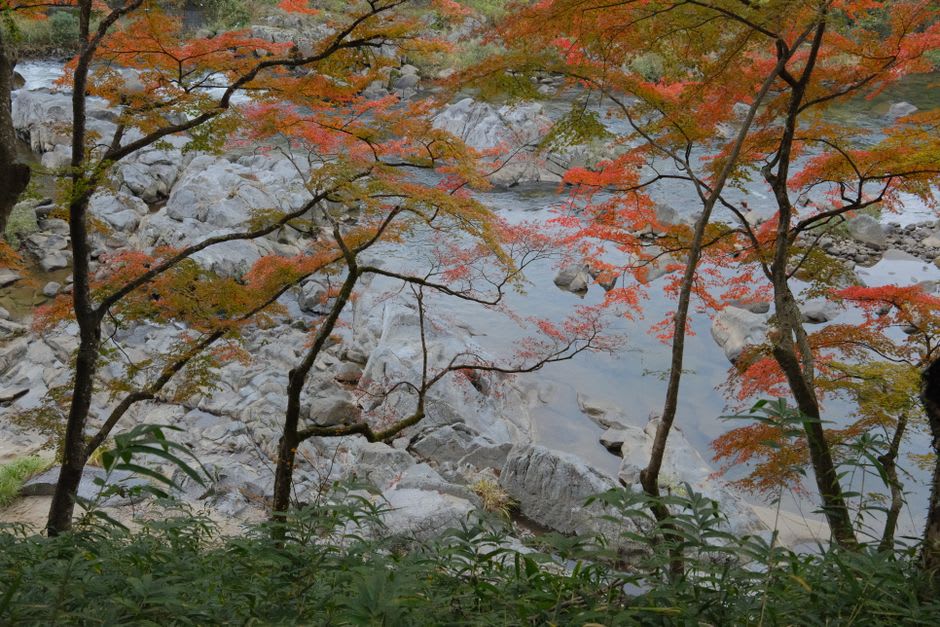
Yamanaka’s great gift is the Kakusenkei, a wooded gorge where the Daishoji river runs clear and quick over pale rock, and a footpath follows it for a kilometre or so between two bridges. We walked it the first morning, mist still lifting off the water, maples leaning in overhead. There’s a striking modern S-shaped bridge at one end and an older crimson one at the other, and between them the path drops close to the stream, past a little open-air teahouse where you can sit with a cup of matcha and watch the current.
The haiku master Basho passed through here centuries ago and praised the waters, and walking the gorge you understand the impulse to write something down. Lia filled a page of her notebook. I just stood on the rocks for a while listening to the river, which said everything I’d have wanted to.
Kutani colours
Kaga is the heartland of Kutani porcelain, and if you have any weakness for ceramics you are in trouble here. Kutani-yaki is unmistakable, bold overglaze painting in deep greens, yellows, reds and blues, motifs of birds and flowers and mountains laid on thick and confident. We spent an afternoon at a kiln and gallery near Yamashiro, watching a painter work a fine brush around the rim of a plate without a single hesitation.
He let us try, which was a humbling few minutes. My attempt at a simple leaf looked like something a child had abandoned; Lia’s was better but still, she admitted, nothing you’d want to eat off. We bought a pair of small cups instead, one green and one blue, and use them for tea at home, a bit of Kaga’s bright confidence smuggled back to our shelf.
The art of the ryokan evening
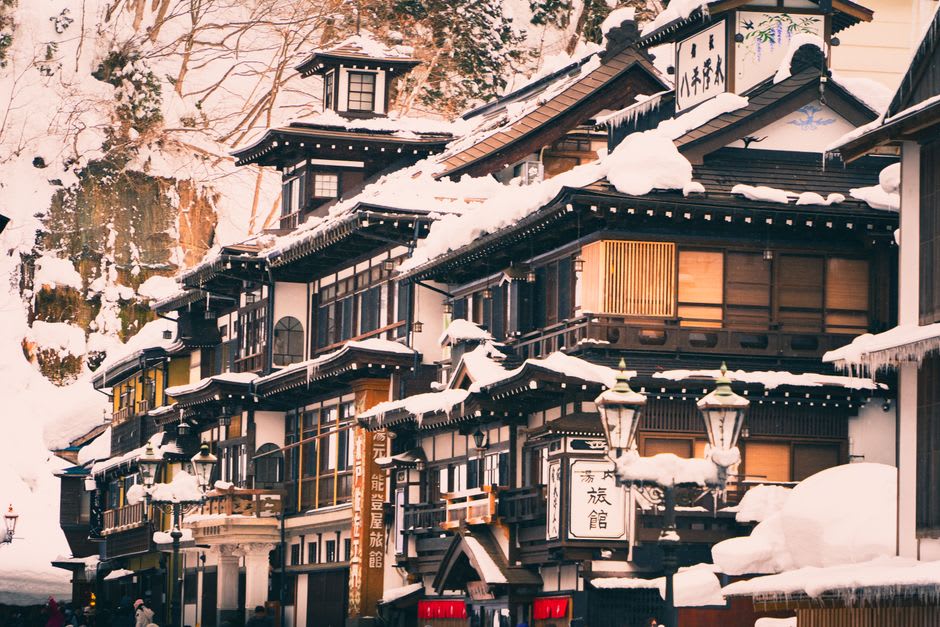
If there is a thing Kaga does better than almost anywhere, it is the ryokan evening. Yamashiro in particular has a lovely restored public bathhouse, the Ko-Soyu, built in the old style with painted glass and a wooden gallery above, and we soaked there in the afternoon among locals who nodded us a welcome.
But the real education was our own inn. We changed into yukata, padded down to the baths, and then were served a dinner that arrived course by patient course, each dish local and precise, until we lost track of time entirely. Afterward we walked the quiet lanes between the bathhouses, wooden clogs clacking on the stone, other yukata-clad guests drifting past in the lamplight. It is a small, complete world, an onsen village at night, and Kaga knows exactly how to run one.
Getting There
Kaga Onsen sits in southern Ishikawa, easily reached now that the Hokuriku Shinkansen has extended down the coast; trains stop at Kaga-Onsen station, from where local buses fan out to Yamashiro, Yamanaka, and Katayamazu, each a short ride away. From Kanazawa it’s under half an hour by train, and from Kyoto or Osaka the limited express and shinkansen connections make it a comfortable half-day’s travel. The villages are small and best explored on foot once you arrive, with the “Can Bus” loop line linking the main sights if you’d rather not walk between them. Autumn brings colour to the Kakusenkei gorge, but the onsen are a year-round pleasure.
Keep exploring
More of Chūbu