
A Gifu 'water town' laced with clear canals and streams beneath a small hilltop castle. Famous for its all-night summer Bon dance and for the craft of making startlingly realistic plastic food samples.
You hear Gujō-Hachiman before you see it. Lia and I walked in from the station on a hot August afternoon and the first thing that reached us, before any building, was the sound of running water — channels and canals and little streams threading through every street, gutters brimming, the whole town murmuring with it. It cools the air by a few real degrees. People were dipping vegetables in the clear flow to keep them fresh, and children were leaping off a low bridge into the deep green pool of the river below, shrieking, climbing out, doing it again. We had come for the famous dance, but I fell for the water first.
The Town of Water
Gujō-Hachiman sits where three rivers meet, and it has organized its entire life around clean, cold, abundant mountain water. The most famous spot is Sogi-sui, a spring at the heart of the old town so pure it was named one of Japan’s finest water sources, channeled through a tiered series of stone basins — the first for drinking, the next for washing rice and vegetables, the lower ones for dishes — a centuries-old etiquette of shared water that still holds. We filled our bottles there. It was startlingly cold and tasted, faintly, of stone.
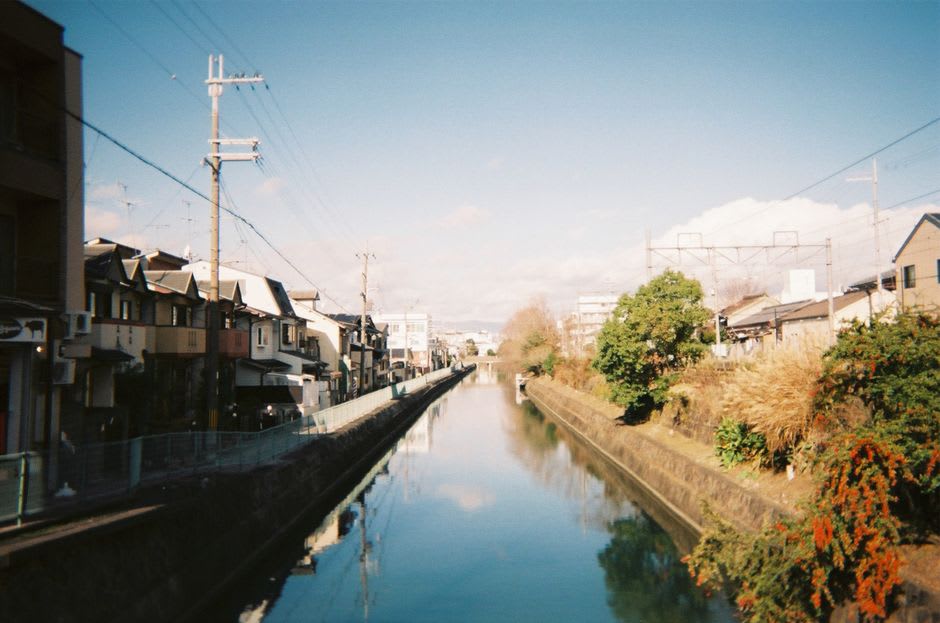
The narrow lanes of the old quarter — Igawa Komichi is the loveliest, a canal-side path where fat carp and river trout hang in the current beside people’s back doors — are made for slow wandering. We drifted for an hour with no aim, crossing and recrossing little bridges, trailing our fingers in the water. On a hot day it is the most refreshing town I know in Japan.
The Castle on the Hill
Above the rooftops, on a steep wooded hill, sits Gujō-Hachiman Castle — a small, handsome wooden reconstruction, said to be the oldest rebuilt wooden castle in the country, dating to the 1930s when most reconstructions were poured in concrete. The climb up is short but sharp, switchbacking through trees, and we did it in the heavy afternoon heat, arriving sweat-soaked at the little keep.
The reward is the view: the whole town laid out below in the river valley, its grey roofs and silver threads of water, the mountains stacked blue behind. In autumn the hill is meant to be extraordinary with maples, but even in green summer it was worth the climb. We had the top nearly to ourselves, a caretaker dozing in the shade, cicadas roaring in the trees.
The Dance and the Food Samples
Two things made Gujō-Hachiman famous, and they could not be more different. The first is Gujō Odori, one of Japan’s great folk dances — a summer-long Bon festival where, on several nights in mid-August, the town dances until dawn in the streets, anyone welcome to join the circle, the wooden clatter of geta keeping the beat. We caught an early-evening session, learned two of the simple looping steps badly, and shuffled around the lantern-lit square with grandmothers who had clearly been doing it for seventy years.
The second is stranger and just as beloved: this small town produces most of Japan’s plastic food samples — the uncannily realistic replica dishes in restaurant windows nationwide. There are workshops where you can try making your own, and Lia spent a happy hour producing a lump of wax “tempura” that genuinely fooled me across a table. It is the perfect Gujō souvenir: a little absurd, entirely local, and unlike anything you’d get anywhere else.
Getting There
Gujō-Hachiman is a little effort to reach, which keeps it uncrowded. From Nagoya, take the train to Mino-Ota and change to the single-track Nagaragawa Railway, a slow, scenic local line that follows the river up into the mountains to Gujō-Hachiman Station — the whole trip runs around two hours. There are also direct highway buses from Nagoya and Gifu that are often faster. From the station it’s a walk or short bus into the old town. If you can time it for a Gujō Odori night in July or August, do — but the water town is a cool, quiet delight in any season.
Keep exploring
More of Chūbu