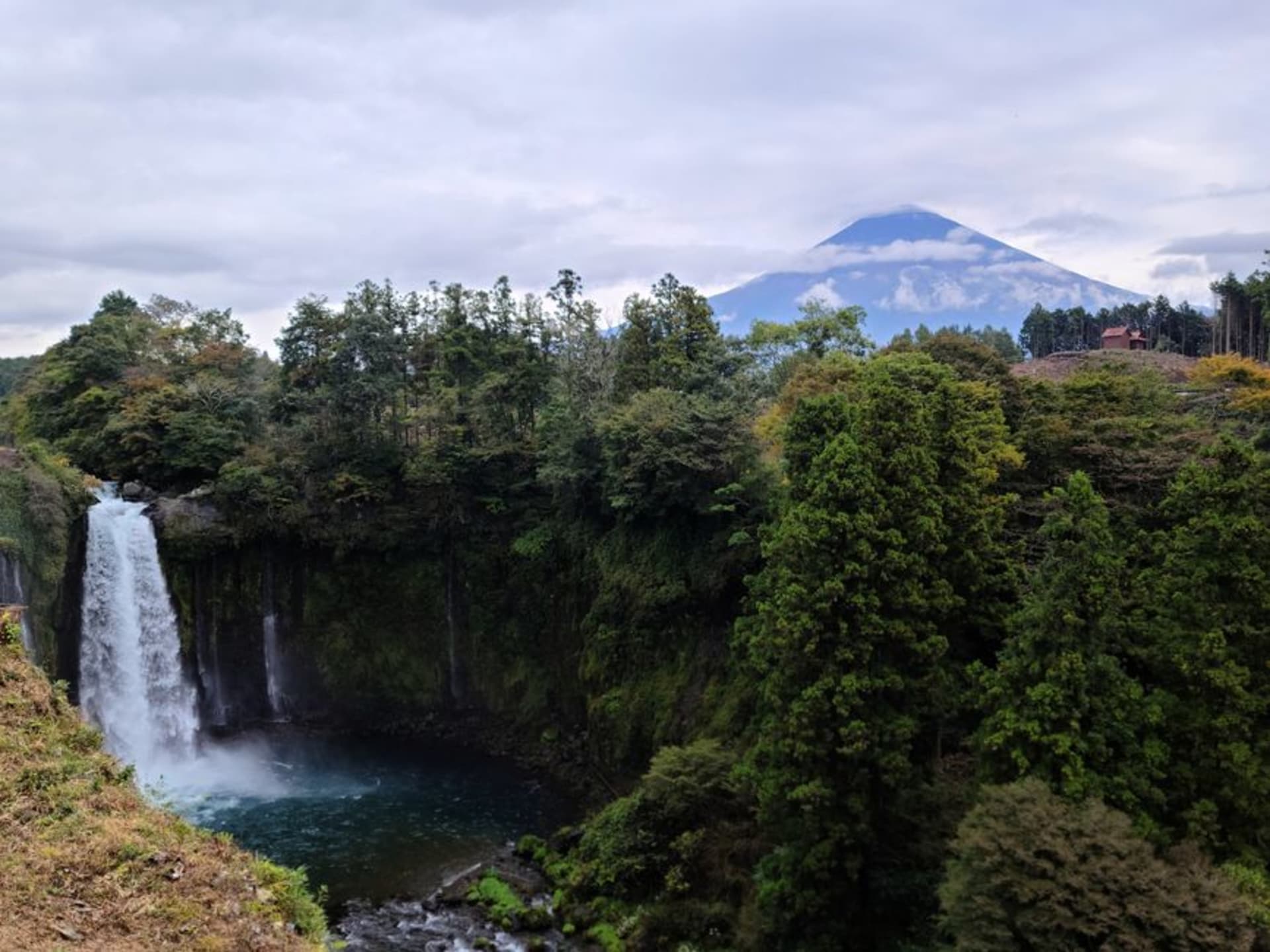
The town at Fuji's western foot, home to the mountain's head shrine and the wide silver curtain of Shiraito Falls. Lia and I came to stand at Fuji's feet instead of climbing its head, and found the mountain is best worshipped from below.
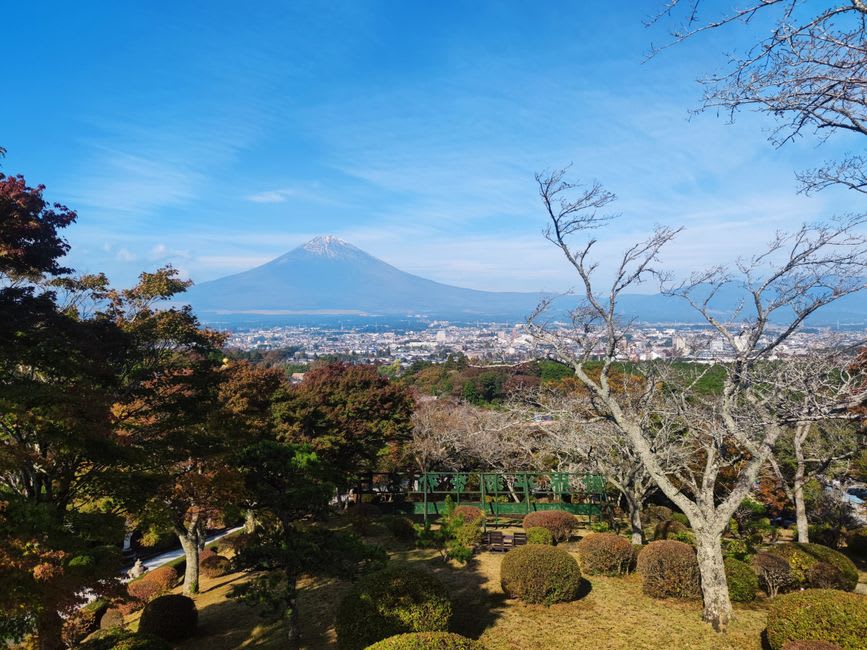
Most people meet Mount Fuji as a thing to conquer — a headlamp slog up scree to catch a summit sunrise. Lia and I decided, somewhere over breakfast, that we’d rather stand at its feet and look up, the way people did for a thousand years before it became a bucket-list line item. So we came to Fujinomiya, the old pilgrimage town on the mountain’s western flank, where the head shrine of all the Fuji shrines sits and where the mountain, on a clear morning, fills the entire northern sky. “Everyone climbs it,” Lia said as we walked out of the station and it just appeared, vast and impossibly close above the rooftops. “We came to look up at it instead.” It turned out to be the better view.
The Shrine at the Mountain’s Root
Fujisan Hongu Sengen Taisha is the grandest of the Fuji shrines, the spiritual root of the whole mountain cult, and its two-storey vermilion honden glows against the green hill behind it. But the thing that undid us was the spring. Fuji’s snowmelt, filtered down through decades of volcanic rock, surfaces here in a sacred pond called Wakutama, water so clear it barely registers as water — you see the pebbles and the drifting weed and only the trembling of the surface tells you there’s anything there at all. Pilgrims once purified themselves in it before climbing. Lia crouched at the edge for a long time. It comes up cold and endless, thousands of litres a minute, the mountain quietly bleeding its winter into the town, and you realise the shrine isn’t beside Fuji — it’s plumbed directly into it.
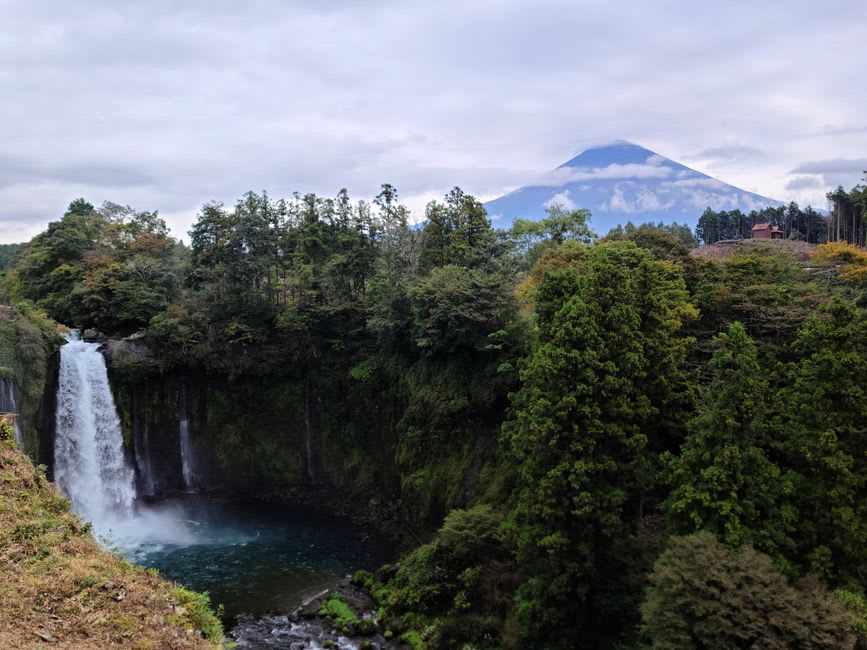
Shiraito, the Falls of White Threads
A bus took us up the lower slopes to Shiraito no Taki, “the waterfall of white threads,” and the name is exact. It isn’t one fall but a wide curved cliff, two hundred metres across, from which countless separate strands of water spill — most of it, again, Fuji’s filtered snowmelt seeping straight out of the rock face rather than flowing over a lip. The effect is a vast, gauzy silver curtain, threads of white against dark wet stone and green moss, with a proper thundering fall at one end for drama. We stood on the viewing platform in the cool mist thrown off the water, and Fuji itself showed briefly above the cliff before the cloud took it. Lia said it looked like the mountain was being wrung out. Nearby Otodome Falls crashes down in a single powerful drop, all noise where Shiraito is all whisper — worth the five extra minutes to feel the contrast.
Yakisoba and the Town Itself
Fujinomiya is not only Fuji — it is also, improbably and proudly, the yakisoba capital of Japan, and we were not going to argue. The local version uses a firmer, chewier noodle and a topping of powdered sardine, and the town has turned it into a minor religion, with a dedicated yakisoba alley and shops that have been frying it for generations. We ate two plates each at a cramped counter place where the cook worked a griddle the size of a door, sweat on his brow, and slid the steaming plates over without breaking rhythm. It was rich, smoky, faintly fishy, exactly right after a cold morning of waterfalls. Lia declared it the best thing she’d eaten in Izu-Fuji country, and I didn’t have the heart or the evidence to disagree.
Getting There
Fujinomiya sits on the Minobu Line in western Shizuoka. From Tokyo, the cleanest route is the Tokaido Shinkansen to Shin-Fuji or Fuji, then a change to a local train up to Fujinomiya — around two to two and a half hours all told. The Sengen shrine is a short walk from Fujinomiya Station; Shiraito Falls is reached by bus from the station in about thirty minutes, and the same buses continue toward the Fuji trailheads if you decide to climb after all. Go early and pray for a clear morning — Fuji is famously shy, veils itself in cloud by midday, and rewards only the people who show up at dawn.
Keep exploring
More of Chūbu