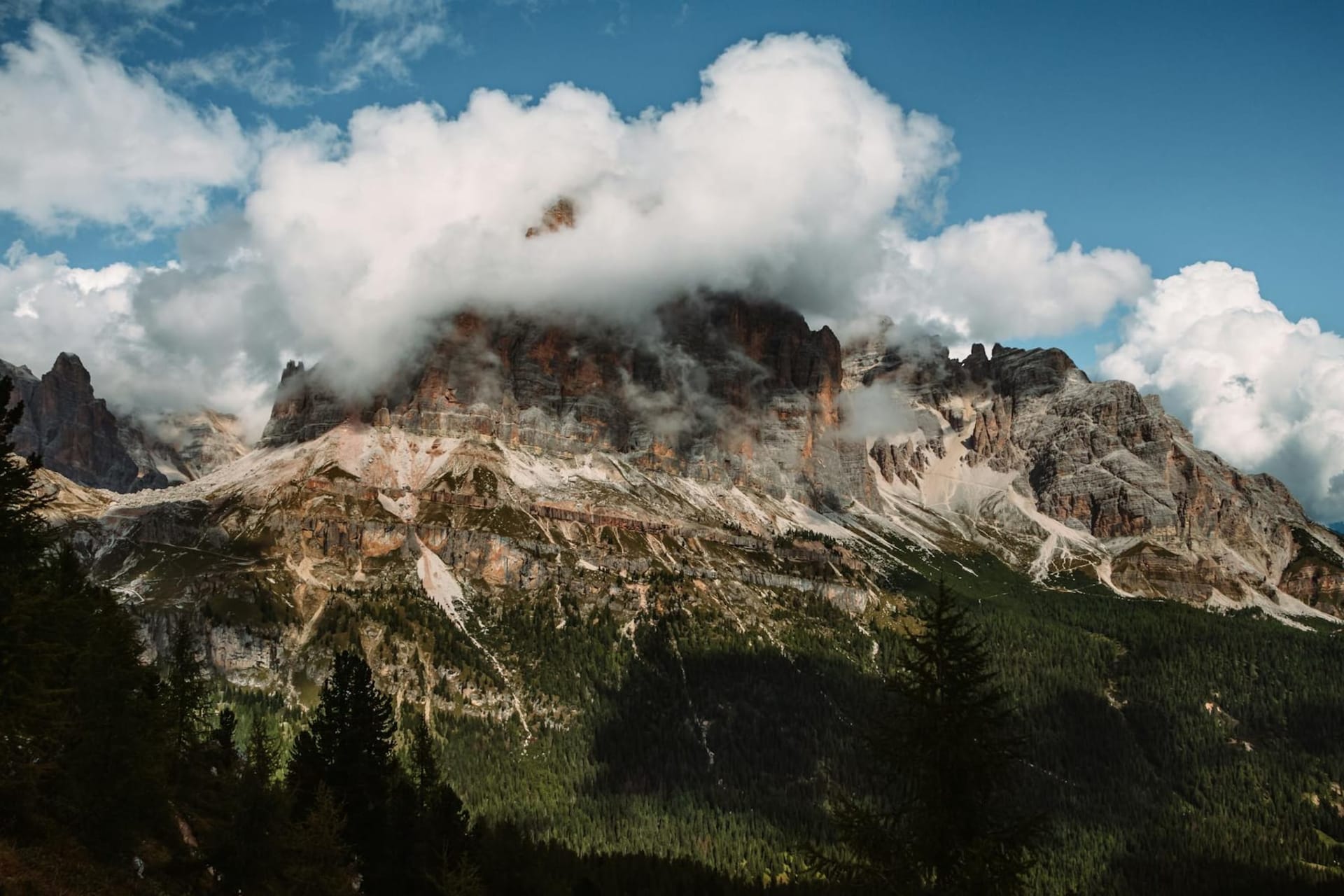
The most dramatic mountain range in the Alps — pink-glowing vertical walls of rock that turn the sky surreal at sunrise and sunset.
I have stood in front of dramatic landscapes before. I have told myself: this is too beautiful to be real. But the Dolomites were the first place that made me feel I had wandered onto a planet that had simply decided to be more extravagant than Earth. The rock is wrong, in the best possible way — pale, almost ivory in flat light, then burning orange and pink as the sun drops. Enrico, the man who ran the guesthouse in Cortina d’Ampezzo, told us without irony that the light at 6 a.m. was worth setting an alarm for. He was not exaggerating.
The Pink Hour Before Anyone Else Is Awake
We drove up to the Passo Giau before sunrise on our second morning, Lia asleep against the window for most of the ascent. At the top, we stepped out into cold that smelled of pine resin and wet stone. The valley below was still pooled in blue shadow. Then the light hit the Nuvolau massif — slowly, like something being remembered — and the walls went from grey to the color of embers. I stood there long enough that my coffee went cold. Lia took my hand without saying anything. Some moments do not require commentary.
Eating Well at Altitude
The food in the Dolomites surprised me more than the scenery. I had expected ski-lodge generics. Instead, in a small rifugio above Lago di Braies, I ate a plate of canederli — bread dumplings in a deep beef broth scented with speck and chive — that was among the most satisfying things I have tasted anywhere. The bread was stale before it was cooked, the broth reduced to near-umami, the speck slightly smoky and cured. It tasted like altitude and effort. I went back for a second bowl. The cook, a woman in her sixties with flour on her apron, looked pleased in the way of someone who has been cooking the same dish for forty years and sees no reason to stop.
The Ladin culture here — neither quite Italian nor Austrian but something older than both — shows up in the menus as much as in the architecture. Strudel made with walnuts, polenta layered with local cheese, wine from the Alto Adige vineyards lower down the valley. It is border food, which is always the most interesting kind.
Along the Alta Via
The Alta Via 1, the high trail that runs south from Lago di Braies to Belluno, covers terrain that alternates between meadow so green it looks synthetic and exposed ridgelines where the wind leans into you. I did not walk all of it — we had five days, not three weeks — but a single afternoon section from Rifugio Scotoni toward the Fanis group was enough to understand why people return every summer for a decade.
The unexpected thing: the silence. For all the tourism infrastructure, for all the cable cars and the hiking poles clinking on the stone paths, there were stretches of trail where the only sound was wind and my own breathing. In the distance, the Tofane group just stood there, indifferent and enormous, doing nothing except being extraordinary.
When to go: Late June through September for hiking, when the passes are clear and the rifugi are open. Come in early July or late August to avoid peak August crowds — or surrender to them entirely and arrive at sunrise anyway, when the light belongs only to the people willing to lose a few hours of sleep.