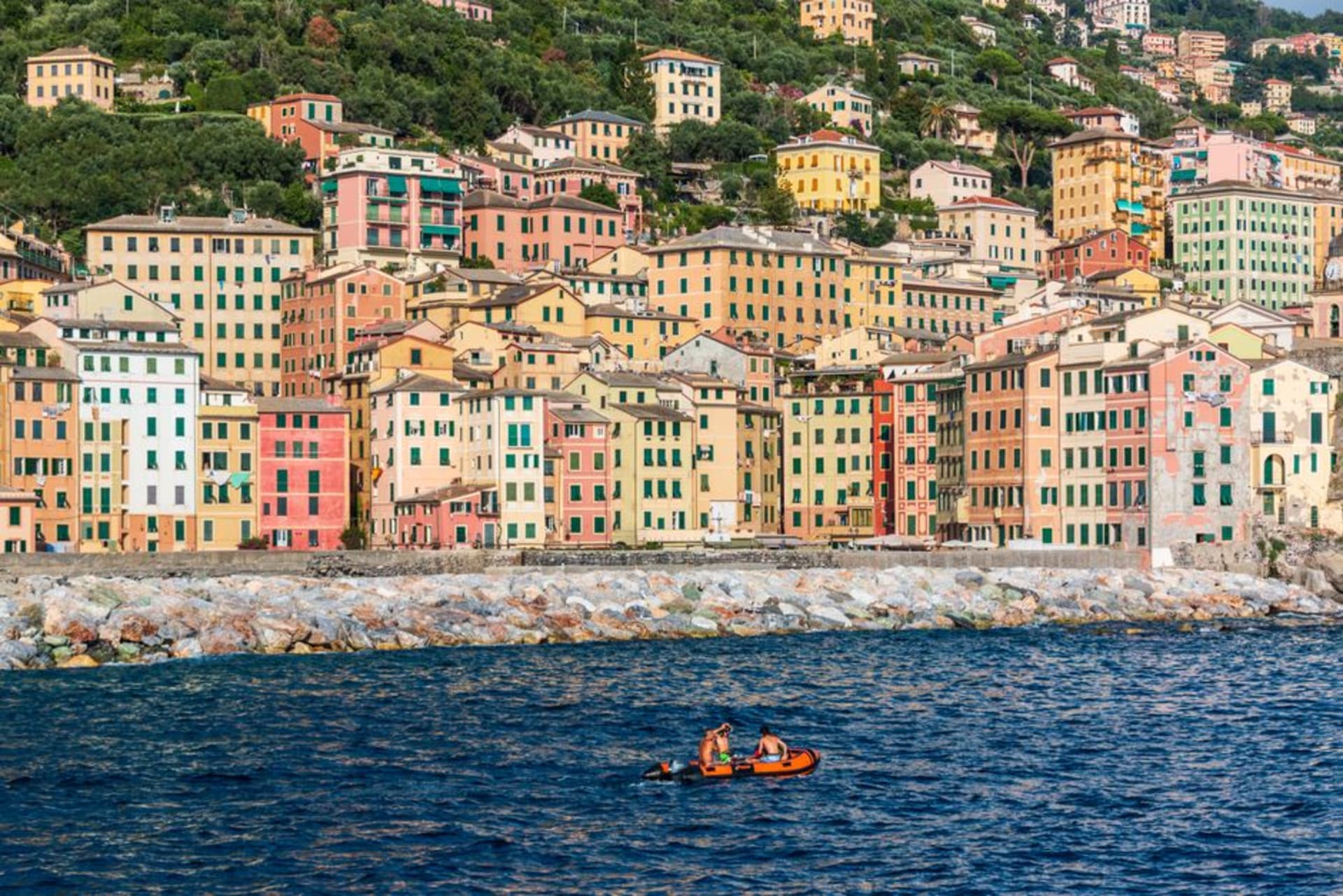
Camogli
"Camogli never bothered dressing up for tourists. It was already wearing its best colors for the sailors."
The fishing town Portofino used to be, where trompe-l'oeil houses tower over a working harbor and the smell of fried anchovies drifts down every alley.
If Portofino is the coast dressed for a photograph, Camogli is the coast in its working clothes, and I say that as high praise. This is a proper fishing town on the eastern flank of the Portofino promontory, its name supposedly derived from Ca’ a Möggi — “house of wives” — a nod to the era when the men were away at sea for months at a time and the town was, functionally, run by women. Whether the etymology is entirely accurate or partly legend, it fits: Camogli has always felt like a place shaped by people who had actual work to do.
The houses are the town’s signature and its strangest feature. They rise seven or eight stories directly from the harbor, packed tight in that classic Ligurian wall of color, but look closer and you notice the windows have shutters painted on, the balconies have wrought iron painted on, entire architectural features rendered in trompe-l’oeil rather than built. This wasn’t decoration for its own sake — it was a way for sailors’ families to signal wealth and status without the expense of actual stonework, and centuries later the illusion still holds up remarkably well from the water.
The Harbor and the Boats
I arrived in Camogli on a weekday morning and found the harbor already busy — not with tourists, but with actual fishermen mending nets and unloading the day’s catch, the kind of scene that has mostly vanished from the more famous towns along this coast. Camogli has one of the oldest fishing traditions in Liguria, and every May the town holds the Sagra del Pesce, a festival where fish is fried in a genuinely enormous pan — several meters across — set up right on the harbor front, a tradition going back to the 1950s. I wasn’t there for the festival, but the smell of frying anchovies and fresh acciughe seemed to follow me down every narrow caruggio, the typical dark, tight alleyways that run perpendicular from the water back into the hillside.

San Fruttuoso and the Coastal Trail
Camogli is also the easier, more local gateway to San Fruttuoso — you can catch a small ferry from the harbor directly to the abbey, skipping the longer hike from Portofino, or do what I did and walk part of the trail up toward Punta Chiappa, a flat rocky outcrop locals treat as an informal swimming spot, where the water turns a shade of blue-green that made me stop mid-sentence in a conversation with another traveler. The path threads through pine and olive groves with the sea constantly flashing through the trees, and I passed more residents out for a morning walk than tourists with cameras, which felt like the whole point.

I ate lunch at a tiny place just off the harbor — focaccia col formaggio, the Ligurian specialty of two impossibly thin layers of dough sandwiching molten stracchino cheese, torn apart with your hands while still too hot to hold comfortably. It is, unscientifically, one of the best things I have eaten on this entire coast.
When to go: Late spring, especially around the fish festival in mid-May, or September for warm water without the August crowds that pack the harbor front.