Lombardy's second city hides Roman ruins under its skin and a Renaissance armory in its heart — nobody outside Italy seems to know, which is exactly why I loved it.
I came to Brescia by accident, really — a gap in a train schedule between Milan and Verona that I decided to fill rather than waste in a station café. I left three days later wondering why nobody had told me. Brescia sits at the foot of the Alps in eastern Lombardy, halfway between Lake Garda and Lake Iseo, and it has been inhabited so continuously since Roman times that the ruins of the ancient forum simply sit there, mid-city, half-excavated, as if the town shrugged and built around them rather than make a fuss.
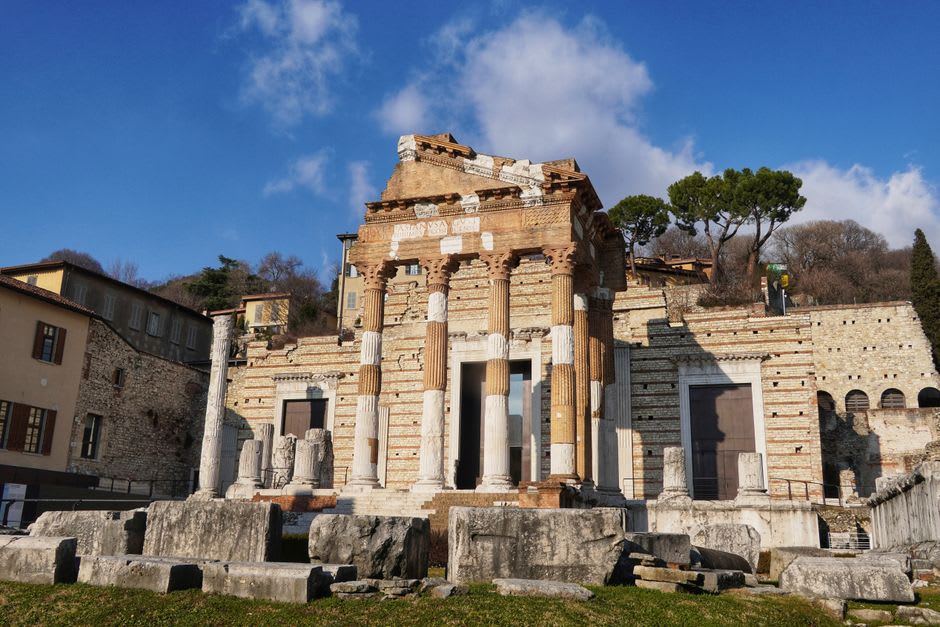
The Capitolium, a Roman temple commissioned by Vespasian in 73 AD, still stands at the edge of what was the Roman forum, its columns rebuilt from fragments found on site. Behind it, the archaeological area stretches back to include a Roman theater and the foundations of houses with mosaic floors still visible under glass walkways. UNESCO recognized the whole complex — along with the adjoining monastery of San Salvatore-Santa Giulia — as a World Heritage Site in 2011, part of a network of Lombard sites across Italy. I spent an entire grey afternoon in the Santa Giulia museum, which occupies the old convent, and kept losing track of time in rooms that moved from Roman bronzes to Lombard goldwork to Renaissance frescoes without ever feeling like a forced march through history.
Iron and Piazzas
Brescia’s other identity is metalwork. This has been a city of blacksmiths and gunsmiths since the Middle Ages — Beretta, the firearms company, was founded here in 1526 and still operates from the valley just north of town, making it one of the oldest continuously operating manufacturers on earth. That industrial backbone gives Brescia a different texture than the postcard hill towns nearby: it feels lived-in, slightly gruff, unconcerned with performing “Italy” for visitors.
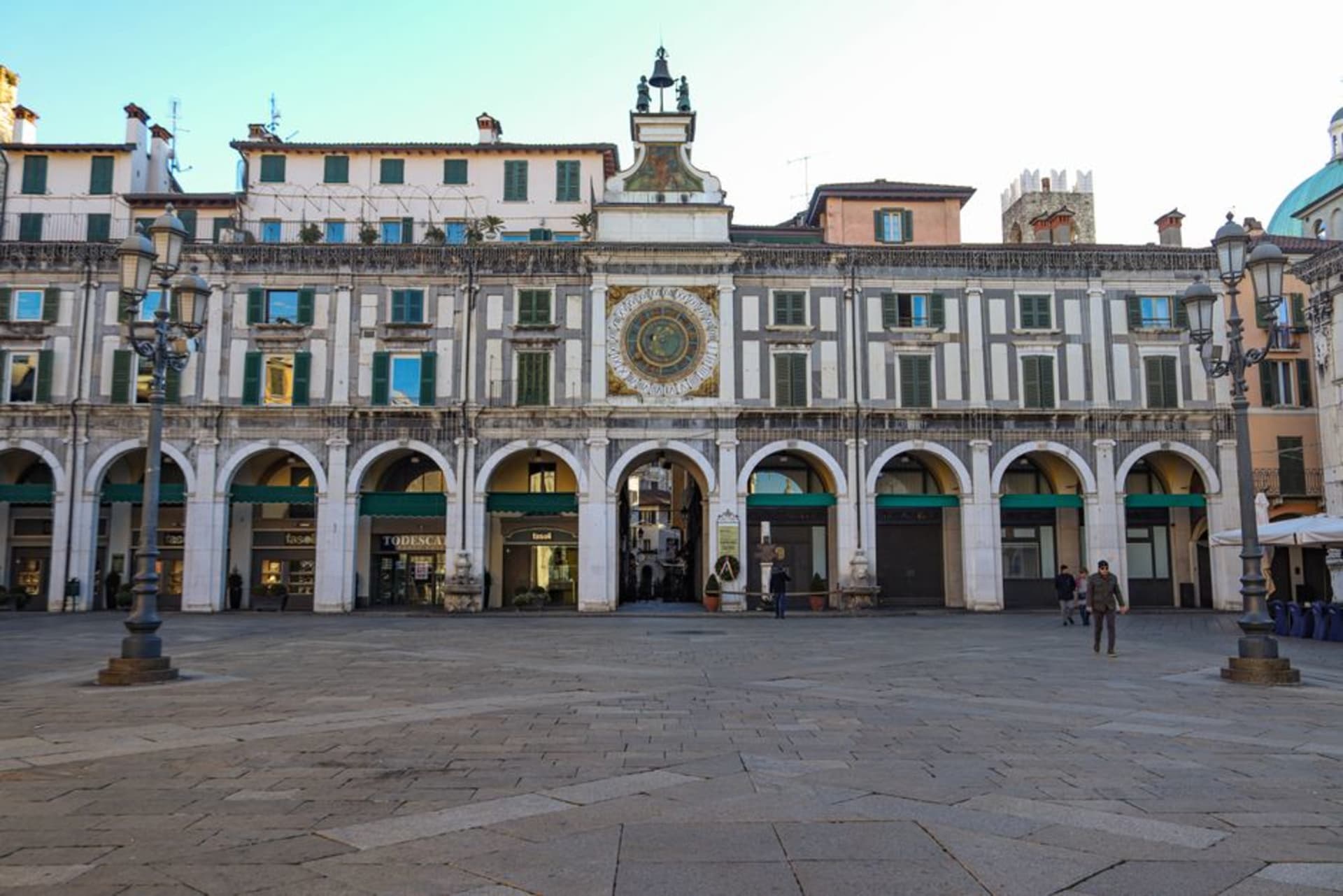
The two central piazzas tell the city’s split personality well. Piazza della Loggia is pure Venetian Renaissance — Brescia spent nearly four centuries under Venetian rule, and the loggia itself, with its astronomical clock tower modeled after the one in Piazza San Marco, could have been lifted from the lagoon and dropped in the Alpine foothills. A few hundred meters away, Piazza del Duomo stacks two cathedrals against each other: the round, squat Duomo Vecchio, a rare surviving example of a rotunda church built over an earlier basilica, and the much larger Baroque Duomo Nuovo beside it. Standing between them, you’re looking at roughly a thousand years of architectural argument compressed into one small square.

The Castle Above
Climb up to the Castello di Brescia, sprawled across the Cidneo hill, and the whole plan of the city opens up below — Roman grid, medieval knot, Venetian piazzas, industrial edges, and beyond it all the first folds of the Alps that eventually become the Val Camonica, home to some of the oldest rock carvings in Europe. It’s not a dramatic climb, more of a steep neighborhood walk past ivy-covered walls, and it’s the kind of thing I do in every city now — get above it, get quiet, let it make sense as a shape rather than a list of sights.
When to go: Late spring or early autumn, when the weather is mild enough for the hilltop walk and Lake Garda is a manageable forty-minute detour if you want to extend the trip.