Middle East
Iraq
"I came for history and found a country mid-sentence, still writing itself."
I landed in Baghdad on a Wednesday afternoon and the first thing that struck me was not the heat — though it was forty degrees and the air had that particular weight of a city that has absorbed too much — it was the date palms. Millions of them lining the road from the airport, swaying without urgency, indifferent to everything that had happened beneath them. Iraq has been carrying civilization for six thousand years. It has learned patience.
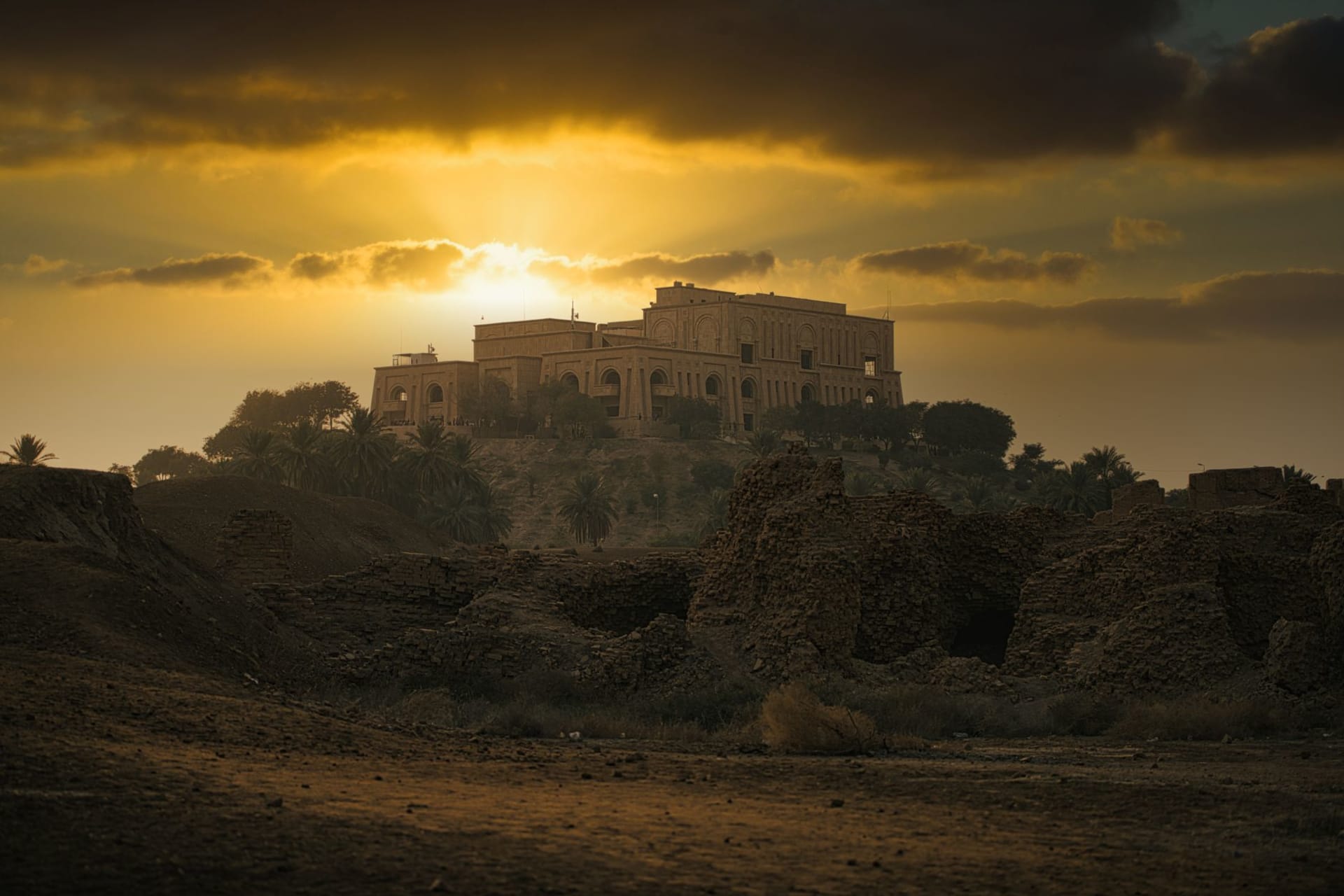
The south is where history becomes almost hallucinatory. Driving toward Babylon from Baghdad, the flat Mesopotamian plain stretches in every direction, impossibly vast, interrupted only by irrigation channels and the occasional minaret catching the late sun. The ruins themselves are a complicated encounter. Saddam had much of ancient Babylon reconstructed in the 1980s, his name stamped into the new bricks alongside Nebuchadnezzar’s — a gesture of megalomania so brazen it has become its own layer of history. You walk through that palimpsest of civilizations and feel something disorienting: the original ziggurat foundations beneath your feet, the dictator’s pastiche walls around you, and above everything, that relentless sky. Farther south, the marshes of the Mesopotamian Delta — the Biblical Garden of Eden, drained by Saddam and then partially restored after 2003 — are one of the most quietly astonishing landscapes I have ever seen. Marsh Arabs still pole wooden boats through channels of papyrus and reed islands that float like they were designed for another era entirely.
In the north, Iraqi Kurdistan is a different country in almost every sense. Erbil’s ancient citadel rises forty meters above the surrounding city on an artificial mound of compressed human habitation going back seven thousand years — the oldest continuously inhabited site on earth, according to some archaeologists. The bazaar below it smells of cardamom and roasting meat, and the Kurdish tea houses stay full past midnight. The mountains beyond Sulaymaniyah have pine forests and waterfalls and small villages where the hospitality is the kind that makes you feel like an imposition until someone takes you by the arm and sits you down in front of a meal you did not ask for and absolutely needed.
When to go: October to April is the practical window. Spring (March to May) is the sweet spot — mild temperatures, some green in the landscape, and the religious calendar is manageable. Avoid June through September entirely: summer in Mesopotamia is punishing, with Baghdad regularly hitting forty-five degrees and above. The Kurdish north is more forgiving in summer but still hot.
What most guides get wrong: They treat Iraq as a war zone with ruins attached, which gets the proportion exactly backwards. The trauma is real and the logistics require planning — visa procedures, travel insurance, staying current on conditions by region — but the country that receives you is ancient, generous, and in the process of something that feels genuinely hopeful. Baghdad’s restaurant scene has exploded in the last few years. Young Iraqis are opening cafes and galleries in neighborhoods that were rubble a decade ago. The country is not frozen in 2003 or 2006 or 2014. It is moving, complicated, and far more alive than the version that exists in most Western imaginations.