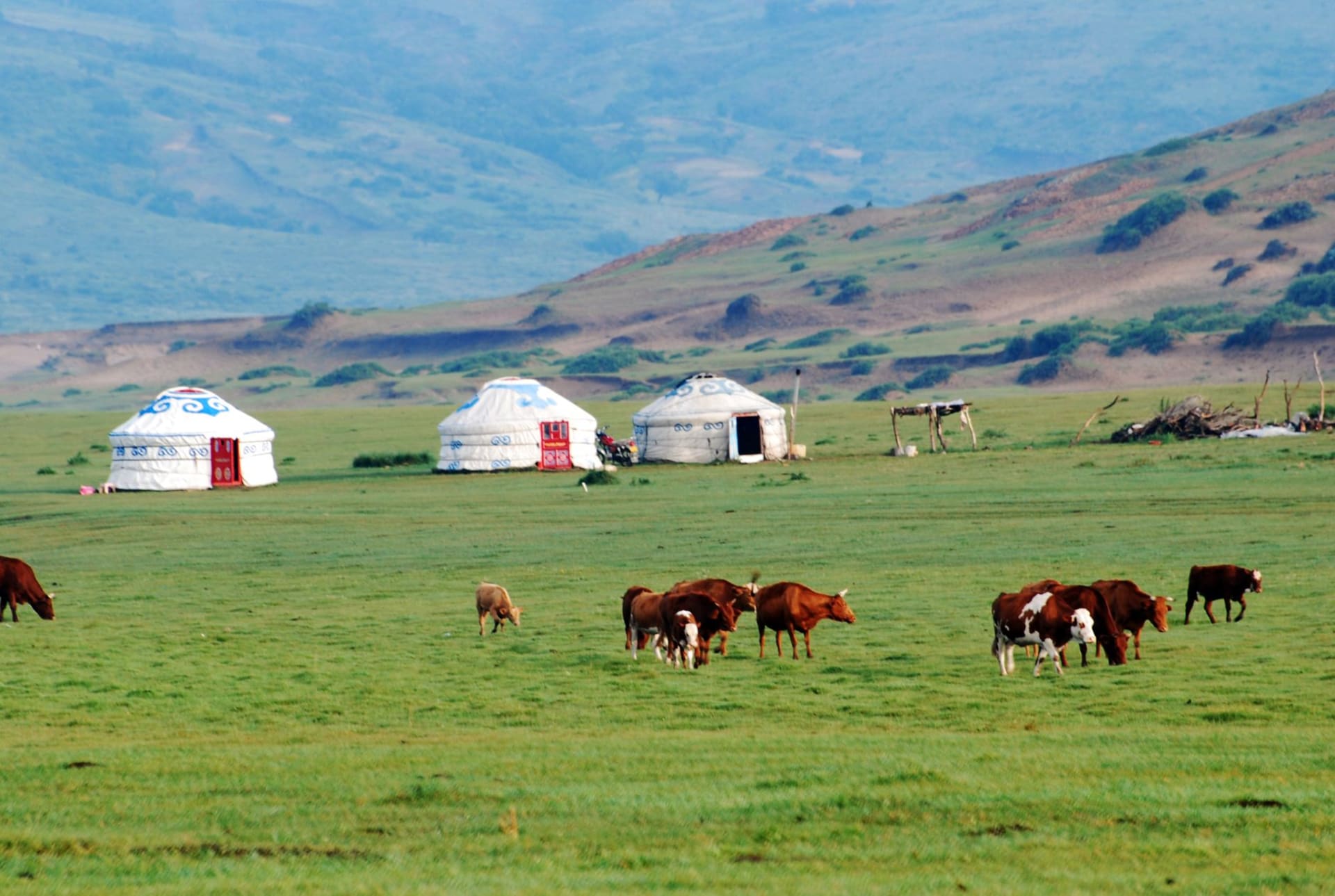
Hulunbuir Steppe
"I rode until the camp disappeared. For twenty minutes I was the only person in every direction."
The summer I came to Hulunbuir, the grass was so green it looked like a lie. I kept stopping, standing outside the jeep while the driver waited with the engine running, trying to decide if a landscape could genuinely be oversaturated or if that was something that only happened to photographs. It is something that happens to this landscape. The Hulunbuir steppe in July is an almost aggressive green, the kind that seems lit from below as much as above, the light flattening and widening everything until your sense of distance stops working the way it usually does. I had been in Inner Mongolia for four days at that point and the steppe had already begun doing something to my nervous system that I can only describe as a slow unwinding.
We reached the yurt camp in the early afternoon. My host was a Mongolian man named Bataar whose family had been grazing cattle on this stretch of land for three generations, and whose opinion of tourism was ambivalent in a way I found completely reasonable. He showed me to my ger — a proper working yurt, not the glamping version, with a coal stove in the center and a felt ceiling that would need to be pulled open to let the smoke out — and explained dinner in halting Mandarin while I responded in halting Mandarin and we arrived at a mutual understanding through gestures and goodwill.

The horse they assigned me was small, dark brown, and unimpressed by me. I spent the first twenty minutes convincing it I was a reasonable person and then we rode out together across a fold of land that seemed to go on without logic or end. Bataar rode beside me for a while and then peeled off toward a herd of his cattle, and I continued until the camp had sunk below the long grass line and disappeared. The sound when I stopped was not silence — there is no silence on the steppe — but a layered moving sound, the wind combing the grass at different speeds, a bird somewhere with a call I didn’t recognize, the horse breathing. I stayed very still for what I later estimated was close to half an hour. The horse grazed. The sky was the blue that happens at high altitude and wide latitude simultaneously.
That evening Bataar’s mother cooked shǎo kǎo over an open fire, mutton skewers spiced with cumin and Sichuan pepper, the edges charred hard, the interior still pink. We drank süütei tsai — salt milk tea — from wooden bowls and later, when the dark came down fast the way it does on flat land, someone produced a bottle of baijiu and a stringed instrument I couldn’t name and played a song that seemed to be about horses or loss or both.

The northeastern corner of Hulunbuir, near the borders with Mongolia and Russia, is also where the Mörön River winds through willows in wide meanders, and the landscape briefly becomes something else — softer, birch-lined, almost Siberian. The city of Hailar functions as the main base; it is a serviceable Chinese city with a good market and a history that includes WWII Japanese fortifications now preserved as a somewhat melancholy museum.
When to go: Late June through early August is peak season — the grass is at its highest and most intensely green, the festivals run, and the yurt camps are fully operational. September is quieter and the light in the late afternoon turns golden across the steppe in a way that photographers will understand. Avoid the corridor between November and April: -30°C is not a rounding error up here.