Hohhot
"The monks start chanting before six. I stayed until the incense turned my jacket into a memory."
I arrived in Hohhot on an overnight train and stepped onto the platform expecting to feel the steppe immediately, the way you expect sea air the moment you step off a train in a coastal town. What I got instead was a bus depot smell and a taxi driver who wanted to know if I’d ever eaten Mongolian hot pot. That was the beginning of Hohhot teaching me that it doesn’t try to impress you. It just goes about its business and waits for you to notice the things worth noticing.
The Dazhao temple complex is the place that rearranged my morning. I’d walked over from the guesthouse at half past five because I couldn’t sleep and the streets were still dark and slightly cold the way northern Chinese cities are in early autumn, that clean chill before the day burns it away. The main gate was open. Inside, two monks in saffron robes were sweeping the courtyard with wide brooms, moving in long unhurried arcs, and the incense sticks in the great bronze burner had already been lit, the smoke rising perfectly vertical in the windless air. I sat on a low stone wall and did not move for an hour. There is a silver Buddha inside the main hall — one of the few original silver Buddhas to survive the twentieth century intact — and when the morning light finally came through the eastern gate, it caught the silver in a way that seemed deliberately arranged.

Zhongshan Road is where Hohhot keeps its appetite. The street runs through what remains of the old Muslim quarter — Hui-run restaurants shoulder to shoulder, their shopfronts hung with red lanterns and handwritten menu boards — and by seven in the morning the lamb-based cooking had already begun. I ate at a place with no English signage and three tables, ordering by pointing at what the family at the next table was having. What arrived was a bowl of hand-pulled noodles in a dark lamb broth with a slick of chili oil and a plate of lamb ribs so fatty that by the second bone my fingers were coated in something between oil and silk. I ate every rib. I ordered more noodles. The woman who owned the place refilled my tea without being asked and never looked at me like I was unusual for being there. That quality of welcome — unremarkable, matter-of-fact — is what I remember most about Hohhot.

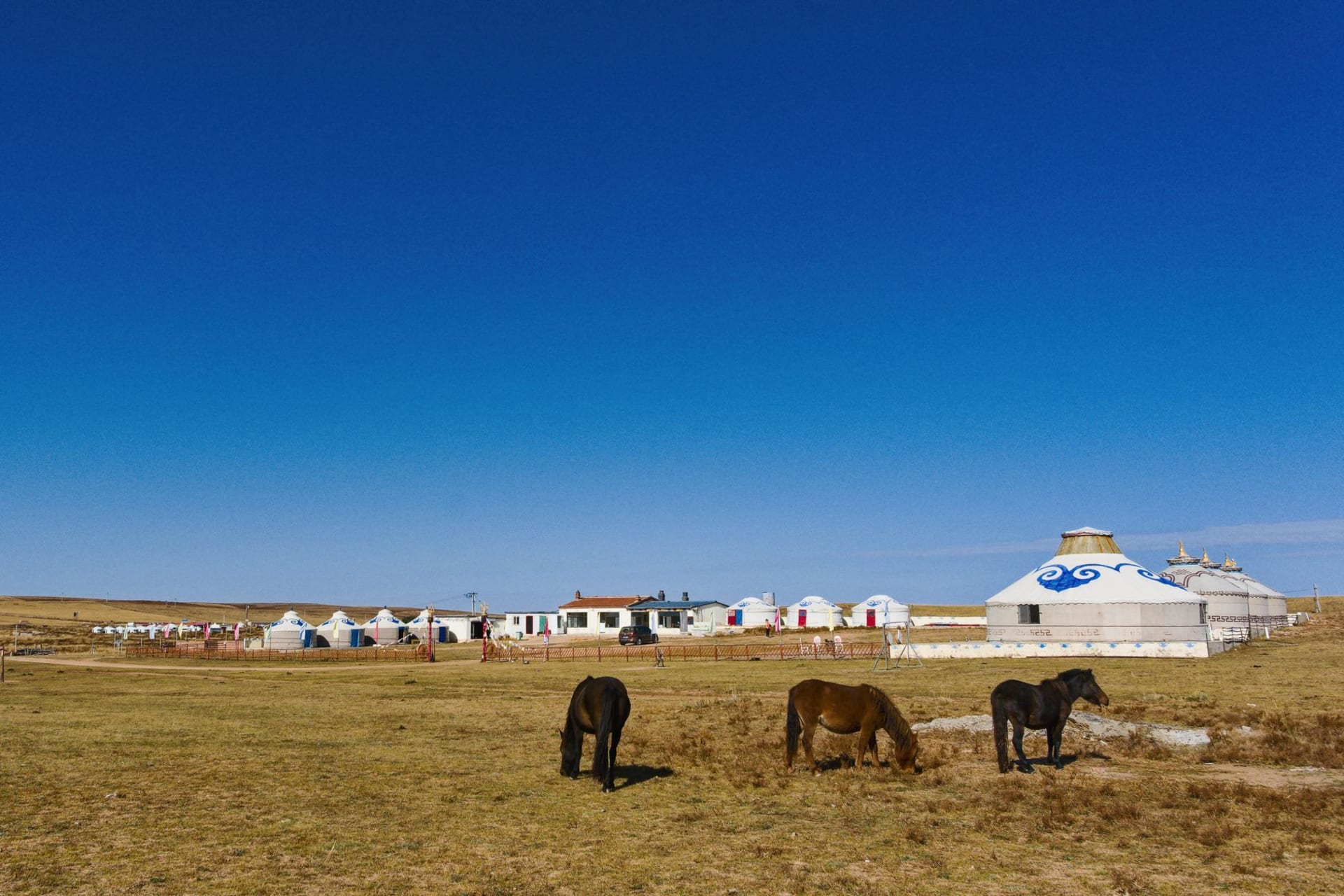
The Inner Mongolia Museum on Xinhua Square deserves the afternoon. It is a genuinely good museum, not the dutiful regional institution I was bracing for, but a place that takes the steppe civilization seriously — bronze artifacts from the Xiongnu nomads, reconstructed yurts, a diorama of Genghis Khan’s mobile capital that makes you understand how portable an empire can be. Outside the museum, the city presents its Soviet-block face: wide boulevards, administrative buildings in grey concrete, a fountain that runs only certain hours. But push a few streets off the main grid and you’re back in a Hohhot that moves at its own speed, old women selling dried curds from folding tables, a shop that seems to sell nothing but horse saddles.
When to go: September is the sweet spot — the summer grassland traffic has thinned but the weather stays warm and dry, ideal for day trips out to the surrounding steppe. Late October brings cold evenings but the sky turns a particular shade of blue that makes the Dazhao rooflines look painted. Avoid February and March entirely unless you enjoy empty cities and temperatures that feel like a personal insult.