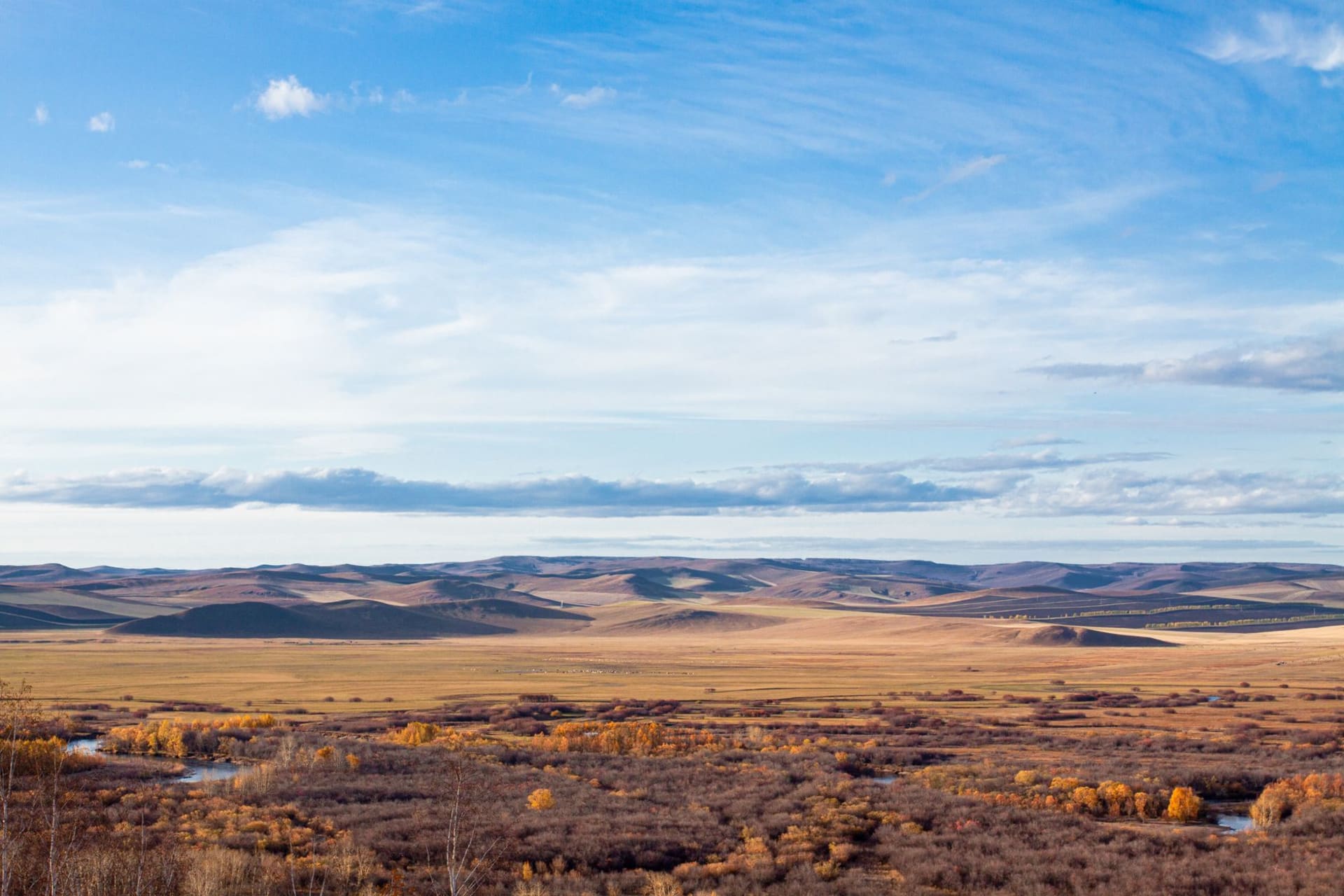
Badain Jaran Desert
"The dune was tall enough that climbing it felt like altitude sickness. The lake at the bottom should not exist. Both of these things are true."
Nobody prepared me for the scale. I had seen photographs of the Badain Jaran — the dunes, the lakes — and photographs had done what photographs do, which is flatten and domesticate. Standing at the edge of the desert in the early morning, looking north from the small encampment where I’d spent the night, the dunes were not what I had expected from photographs. They were taller. They were darker at their bases and whiter at their summits than I had assembled in my mind. The tallest ones — Bilutu Peak among them — rise to around 500 meters, which makes them among the tallest stationary dunes on the planet, and in the morning light they had the solidity and mass of mountains, not the delicacy I associate with sand.
Getting to Badain Jaran requires commitment. The desert sits in the Alxa League in far western Inner Mongolia, a long day’s drive from anywhere that has an airport, and the last stretch is on desert tracks where the vehicle does most of the navigating by sense of direction and the driver does the rest by experience. The Mongolian driver who brought me from Alxa Zuoqi knew the desert the way people know things they’ve spent their lives inside — without thinking about it, without explaining it, occasionally pointing at something that looked like every other thing and saying a name that placed it precisely in a geography only he could read.

The lakes are what make the Badain Jaran singular. There are more than a hundred of them scattered among the dune corridors — freshwater and saltwater both, fed by an underground aquifer system that draws snowmelt from the Qilian Mountains hundreds of kilometers south. They sit at the bases of the highest dunes in depressions so improbably placed that seeing the first one from above — walking up a dune face and cresting the ridge to find a glassy lake directly below, blue-green and still, a cluster of Mongolian yurts at its shore — produces something close to vertigo. The lakes are real. The physics of their existence is settled science. And yet they look like an error, like the desert made a mistake and the mistake turned beautiful.
I climbed the dune called Bilutu on my second morning. The climb took close to an hour, the sand firm near the ridgelines from the wind but loose and exhausting on the broad faces, and I stopped four times on the way up not from weakness but from the compulsion to turn and look at what was behind me, which was the rest of the Badain Jaran spreading south and west in corrugated gold waves with the small blue and green ovals of the lakes visible among them. At the summit the wind was steady and cold even in August and the silence that lives inside wind was complete. Far below, a camel train was moving across the sand floor between two dune corridors, six camels in single file, leaving a line of shadows that made me understand I was looking at something that had been happening here for centuries.

There is a monastery near the Badain Lake — a small Tibetan Buddhist temple built in 1868 by a monk who apparently decided this was the place — and it has been maintained since then by a continuous community of monks who have chosen to live in one of the more remote and inhospitable locations in China. The abbot I met was elderly and entirely unimpressed by the journey I had made to arrive, which seemed appropriate.
When to go: May and September are the months that make sense — temperatures in the 20s, no summer dust storms, the dune light extraordinary in the low sun of shoulder season. July and August are popular with Chinese domestic tourists but the heat is serious and the midday sun makes the sand surfaces almost impossibly hot to walk on without protection. The desert is theoretically accessible year-round but winter access requires serious preparation and the right vehicle.