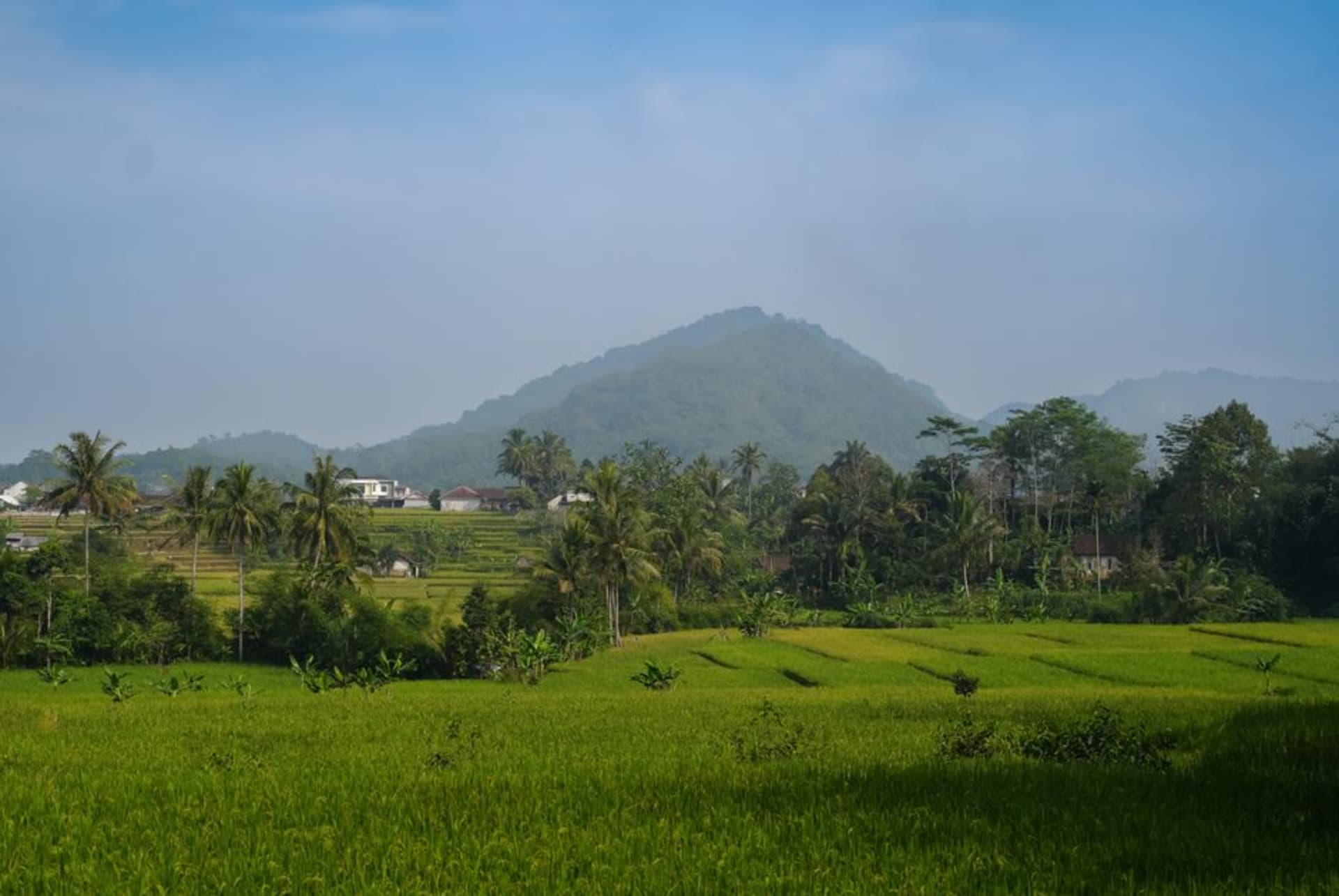
Rice paddies swallowed the capital of Southeast Asia's greatest empire, and it took archaeologists a century to find it again.
There is no single ruin at Trowulan that stops you in your tracks the way Borobudur or Prambanan does, and that, I’ve come to think, is exactly the point. This scattered plain in East Java, halfway between Surabaya and Mojokerto, was once the beating heart of Majapahit, the empire that at its height in the 14th century under Hayam Wuruk and his legendary prime minister Gajah Mada claimed influence over much of what is now Indonesia, Malaysia, and the southern Philippines. And almost none of it is left standing whole. What survives is fragments — brick gateways, bathing pools, temple foundations — pushed up out of rice paddies by farmers’ plows over the past hundred and fifty years, one broken piece of empire at a time.
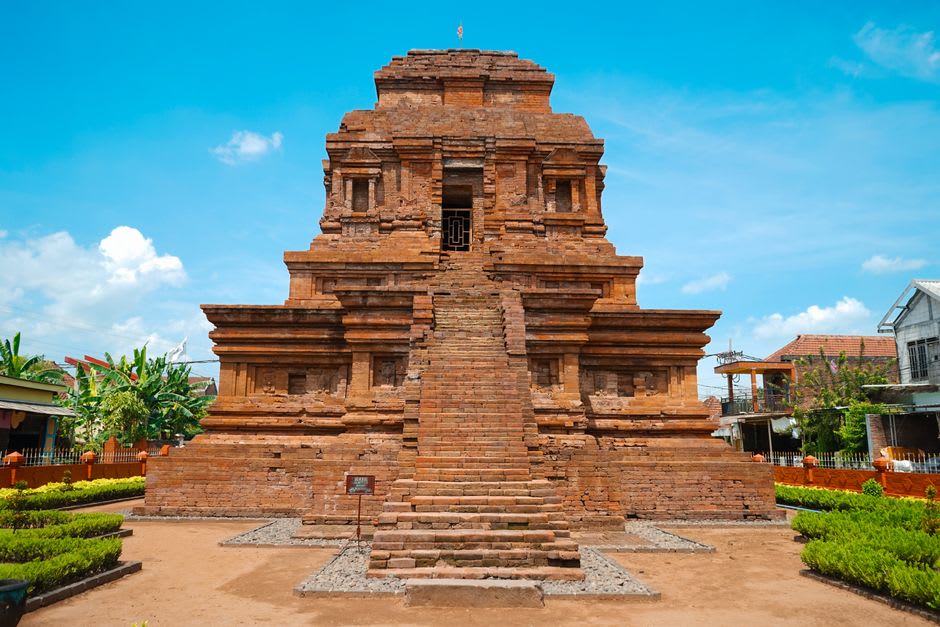
The most complete structure is Candi Bajang Ratu, a soaring red-brick paduraksa gate whose narrow silhouette against the sky gives you the only real sense of scale the site offers. Majapahit architecture used brick rather than the volcanic stone of central Java’s Hindu-Buddhist temples, and brick doesn’t survive the tropics the way andesite does — it crumbles, gets pillaged for later construction, gets reclaimed by root systems. That fragility is part of why Trowulan feels less like a monument and more like an excavation still in progress, which, in fairness, it is: archaeologists are still turning up new foundations under village land.
Water and empire
The site that got me thinking hardest was Kolam Segaran, a vast rectangular bathing pool nearly 700 by 500 feet, lined in fired brick, that most historians believe served ceremonial or diplomatic functions — possibly a place where the court entertained foreign envoys, a deliberate flex of hydraulic engineering meant to impress. Standing at its edge in the late afternoon, water going gold, egrets picking through the shallows, it wasn’t hard to imagine what it might have communicated about the empire that built it: mastery over water in a landscape where water meant rice, and rice meant power.
The Majapahit Information Center, a modest museum near the site, houses terracotta figures, coins, and ceramic fragments excavated from the surrounding fields, alongside a scale model that tries to reconstruct what the capital might have looked like at its peak — a sprawling city of canals and wooden pavilions that, being built mostly of timber and thatch, left almost nothing behind except the brick religious structures and this scatter of temple foundations. It’s a useful corrective: the ruins you can walk to are a tiny fraction of what was once here.
What lingers is the mismatch between the scale of what Majapahit was — the empire whose memory Indonesian nationalists later invoked as proof the archipelago had once been unified before colonialism carved it apart — and the sleepy, agricultural quiet of Trowulan today. Motorbikes puttering past temple gates, ducks herded along paddy dikes that sit directly atop the footprint of a vanished palace. Empires end up as farmland more often than we like to admit.
When to go: April to October, dry season, keeps the unpaved paths between sites passable and the rice paddies around the ruins a vivid green rather than a muddy brown.