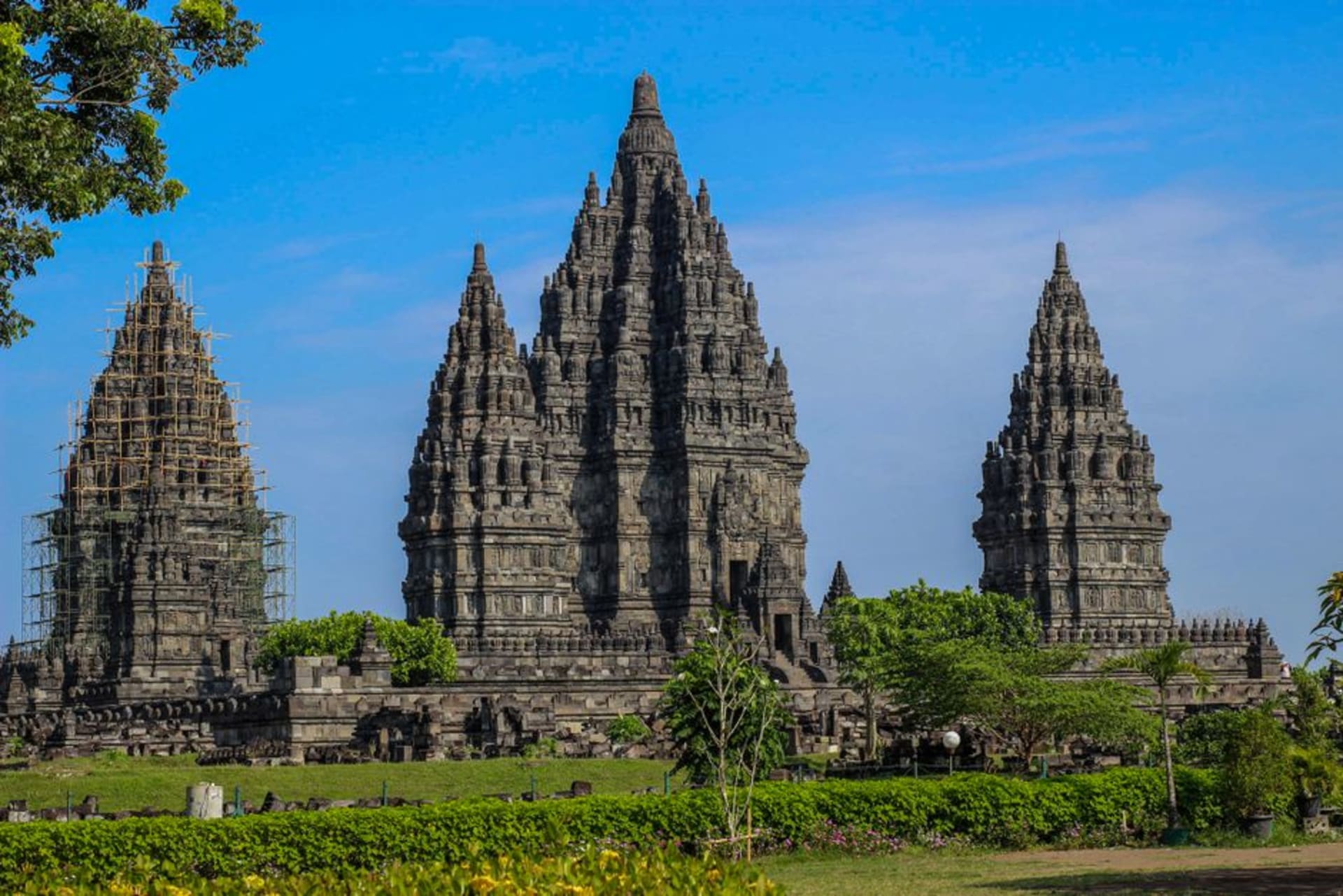
Prambanan
"Nine hundred temples, one furious princess, and a stone skyline that outlasted the kingdom that built it."
A ninth-century Hindu temple complex outside Yogyakarta whose stone spires still pierce the sky the way its builders intended — until an earthquake, and eight centuries of silence, said otherwise.
There’s a version of the Prambanan story that every guide in the parking lot will tell you before you’ve even bought a ticket: Bandung Bondowoso, a prince, demanded marriage from Roro Jonggrang, who tried to refuse him by setting an impossible condition — a thousand temples built in a single night. He nearly managed it with the help of supernatural spirits, so she had the villagers light fires and pound rice to fake the dawn, tricking the spirits into fleeing before the last temple was finished. Furious at being outwitted, the prince cursed her into stone, becoming, in local telling, the towering statue of Durga housed in the complex’s northern chamber to this day. It’s a folk tale layered over the real history, which is that the Sanjaya dynasty built this Shivaite temple complex in the mid-ninth century, roughly contemporary with the Buddhist monument at Borobudur less than an hour away — two enormous religious statements rising out of the same fertile Kedu plain within a generation of each other, one Hindu, one Buddhist, coexisting on Javanese soil in a way that says more about the period’s religious pluralism than any textbook summary could.
I arrived at opening time specifically to beat both the heat and the tour buses, and for maybe forty minutes had something close to the full complex to myself — the three main shrines to Shiva, Brahma, and Vishnu rising in a straight line inside the innermost courtyard, their reliefs telling the Ramayana in stone panels that circle the base of the Shiva temple in sequence, meant to be read clockwise as you walk. The scale surprised me more than the age did; the central Shiva shrine climbs over 47 meters, and standing directly beneath it, craning back to see the top, I understood why UNESCO calls this the largest Hindu temple site in Indonesia.
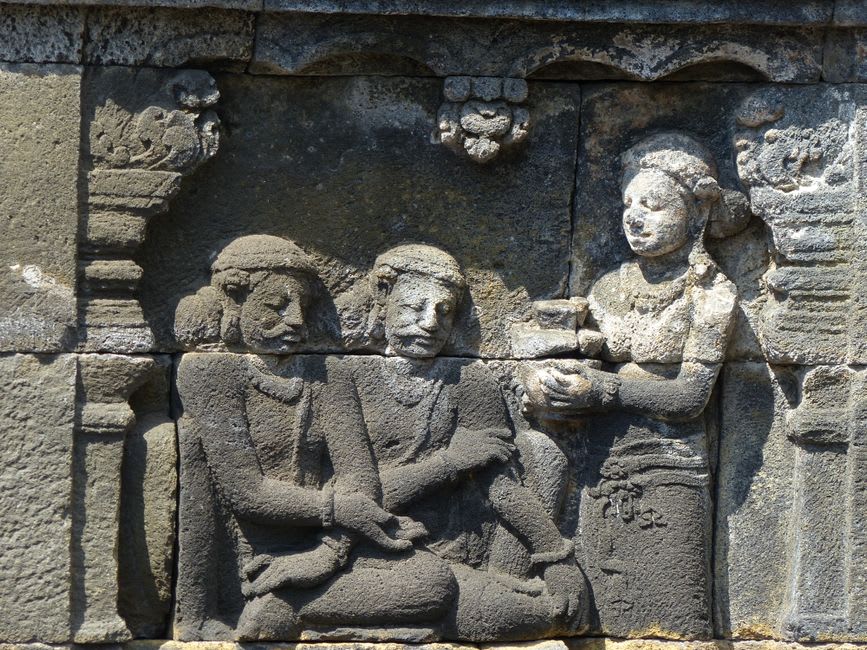
Rubble, restoration, and Ramayana by moonlight
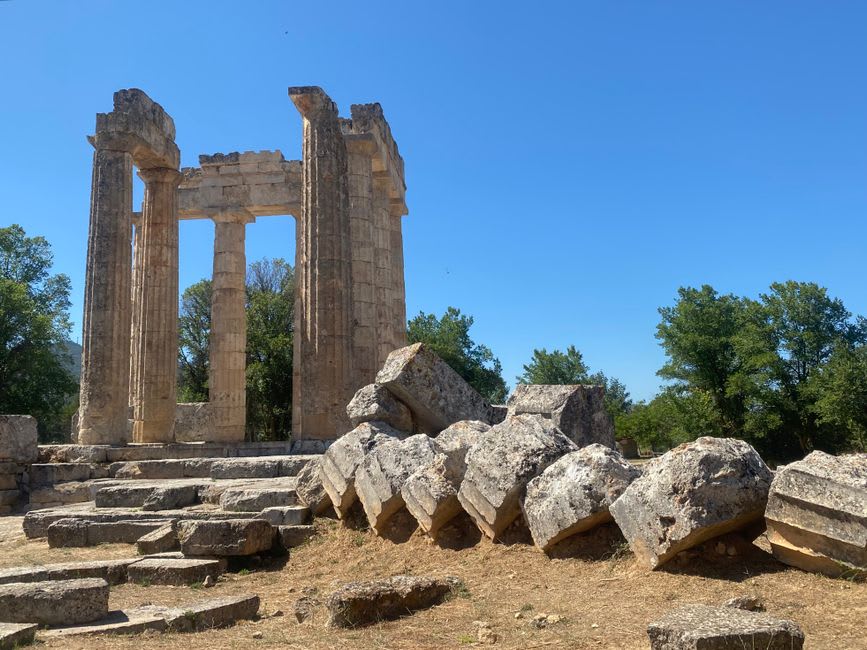
What the guides don’t lead with, but which I found more moving than the mythology, is the complex’s long ruin. Prambanan was likely abandoned not long after a major eruption of Mount Merapi and a possible earthquake in the tenth century, when the center of Javanese power shifted east, and it spent centuries buried under volcanic ash and jungle growth, rediscovered by colonial surveyors only in the early 1800s. A 2006 earthquake damaged it further, closing sections for repair well into the years after. Walking past the fields of loose stone blocks still stacked around the complex’s edges — numbered, cataloged, waiting for archaeologists to determine which temple they belong to — you get a rare, honest look at restoration as an ongoing, unfinished process rather than a completed museum piece.
I came back that same evening for the outdoor Ramayana Ballet, performed on a stage set against the floodlit silhouette of the temples themselves — a tradition that’s been running since the 1960s, gamelan orchestra included, dancers in gold and red telling the same epic depicted in the ninth-century reliefs a few hundred meters away. Watching Hanuman’s monkey army set the stage fire ablaze with the temple spires glowing behind them, I thought that no museum plaque could have made the connection between story and stone as directly as that performance did.
When to go: May to September for the dry season and clearest views of the spires; the outdoor Ramayana Ballet runs on select evenings around the full moon, worth timing a visit around if you can.