
Pontianak
"The only city I've stood in with one foot in each hemisphere, and it barely registered as a novelty to anyone but me."
A city split by the equator itself, built at the meeting of two rivers by a sultan who was, depending on which story you believe, running from ghosts.
Pontianak takes its name from the pontianak or kuntilanak, the vengeful female ghost of Malay folklore, and the origin story locals still tell is that Sultan Syarif Abdurrahman Alkadrie, founding the city in 1771, chose this exact spot — the confluence of the Kapuas and Landak rivers — because he’d fired his cannon here and the ghosts that had been troubling the area supposedly fled. Whether or not you believe it, it’s a better founding myth than most cities get, and it sets the tone for a place that has always felt a little apart from the rest of Indonesia: built almost entirely on stilts and pontoons in its old quarters, straddling the equator so precisely that the city has erected a literal monument, the Tugu Khatulistiwa, marking the line where you can stand with one foot in the northern hemisphere and one in the southern.
I went to the equator monument expecting a tourist trap and found something almost sweetly low-key — a squat white obelisk inside a modest pavilion a few kilometers north of downtown, with a scale model version out front for photos and, twice a year around the equinoxes, a genuine astronomical event where the sun passes directly overhead and objects momentarily cast no shadow at all, drawing crowds who come specifically to watch their own shadows vanish. I wasn’t there for the equinox, so I settled for the more everyday version of the phenomenon: standing on the line, feeling nothing whatsoever, and still finding it strange that nothing was the correct reaction.
Life on the water
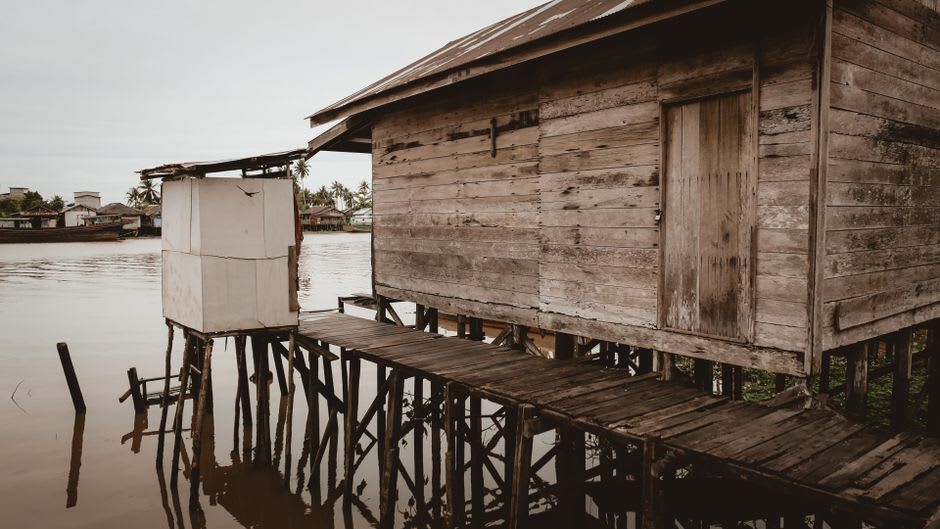
The city’s real character is in the Kapuas River itself, one of the longest rivers in Indonesia, which functions as Pontianak’s main street the way canals function in Venice. Wooden houses on stilts line the banks in the old Malay and Chinese quarters, and small motorized boats called sampan still ferry people across the water faster than the bridges can manage it during rush hour. I crossed at dusk on one of these, the boatman navigating between water taxis and floating vendor stalls, the muezzin’s call overlapping with the smell of grilled fish from a floating warung, the whole river turning gold and then quickly dark the way it does close to the equator, where twilight barely lingers.
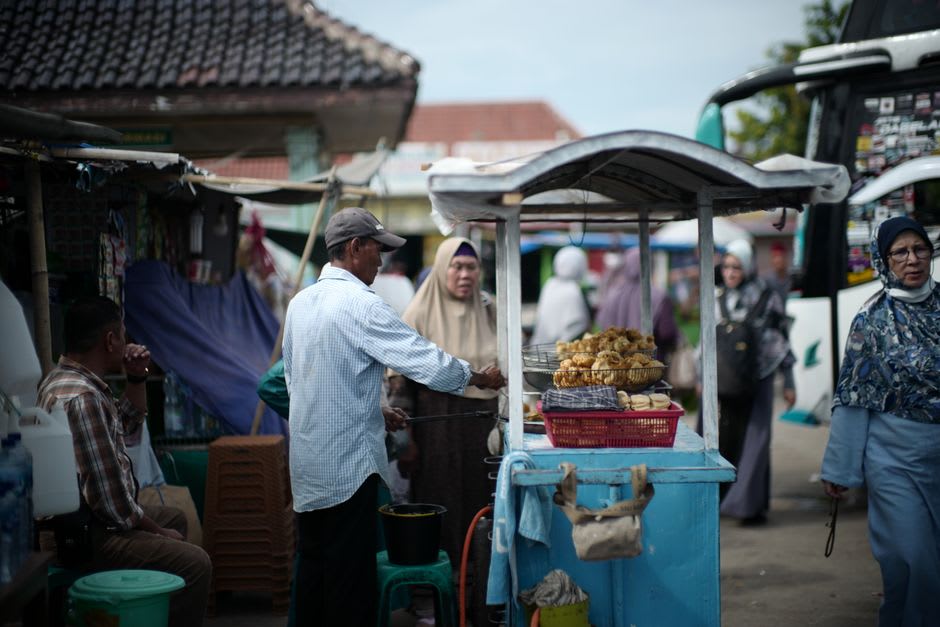
Pontianak’s population is heavily Chinese-Indonesian, descendants of gold miners and traders who settled West Kalimantan generations before Dutch colonization formalized borders, and that heritage shows up everywhere in the food — this is one of the best places in Indonesia to eat Chinese-Malay fusion cooking, and the local specialty, choipan, a pan-fried dumpling filled with jicama and chives, is sold from carts on nearly every block. I also made a point of tracking down bubur pedas, a savory rice porridge thick with vegetables and toasted coconut that’s distinctly a Kalimantan dish, nothing like the sweet rice porridges further west.
Just across the river from downtown sits the Kadriah Mosque and the wooden Kadriah Palace, the sultanate’s original seat, still maintained by descendants of the royal family and open for visits — modest compared to the grand palaces of Java, but with the same sense of a living lineage rather than a museum piece. I stood on the palace’s covered veranda as a light rain moved across the river, watching the same water that had carried the sultan’s founding fleet upstream two and a half centuries earlier, and thought that Pontianak, whatever else it is, has never stopped being a river city first and a capital second.
When to go: March and September, closest to the equinoxes, if you want a shot at the “zero shadow” phenomenon at the equator monument; otherwise the dry season from June to September brings the most reliable weather for river trips.