
Besakih
"Twenty-three temples, one mountain, and lava flows that stopped meters short of the holiest shrine in Bali."
Bali's mother temple, spread across a volcano's flank in twenty-three separate sanctuaries — the one place on the island that made me lower my voice without being told to.
Pura Besakih isn’t a temple so much as a small city of temples, terraced up the southwestern slope of Gunung Agung between roughly 900 and 1,200 meters of elevation. There are twenty-three separate temple complexes here, arranged along a single rising axis, with Pura Penataran Agung — the central sanctuary — at the heart of the arrangement and the others belonging to specific clans, villages, or castes who have maintained them, in some cases, since before written Balinese history reliably begins. Estimates put the origins of worship at this site well over a thousand years old, predating the arrival of the Hindu-Javanese Majapahit influence that shaped so much of Bali’s religious architecture, which means Besakih is likely older than “Balinese Hinduism” as most people would define it — a place where an indigenous mountain-and-ancestor cult got layered over, gradually, by Hindu cosmology, rather than replaced by it.
Every clan temple has its own meru — the distinctive tiered, thatched-roof shrine tower that’s become almost a visual shorthand for Bali itself — and the number of tiers, always odd, from one up to eleven, signals the shrine’s rank and the deity it honors. Standing at the base of Pura Penataran Agung’s main courtyard, looking up a stone staircase flanked by a long processional axis toward a cluster of eleven-tiered meru silhouetted against Agung’s summit, is one of the only moments in Bali where I actually understood scale as a religious argument. This was built to make you feel small on purpose.
The eruption that almost took it
The single detail everyone brings up about Besakih, and for good reason, is the 1963 eruption of Gunung Agung — the same catastrophic eruption that leveled Tirta Gangga down in the valley. Lava flows and pyroclastic material devastated villages across eastern Bali and killed well over a thousand people, and the flow came close enough to Besakih that ash and debris damaged some of the outer structures. But it stopped short of the mother temple’s core sanctuaries. Balinese Hindus widely interpreted this as a sign of the temple’s protection — its sanctity affirmed rather than disproven by proximity to disaster — and the moment has become part of Besakih’s living mythology, retold by guides and priests as evidence of the site’s spiritual authority rather than treated as a historical footnote.

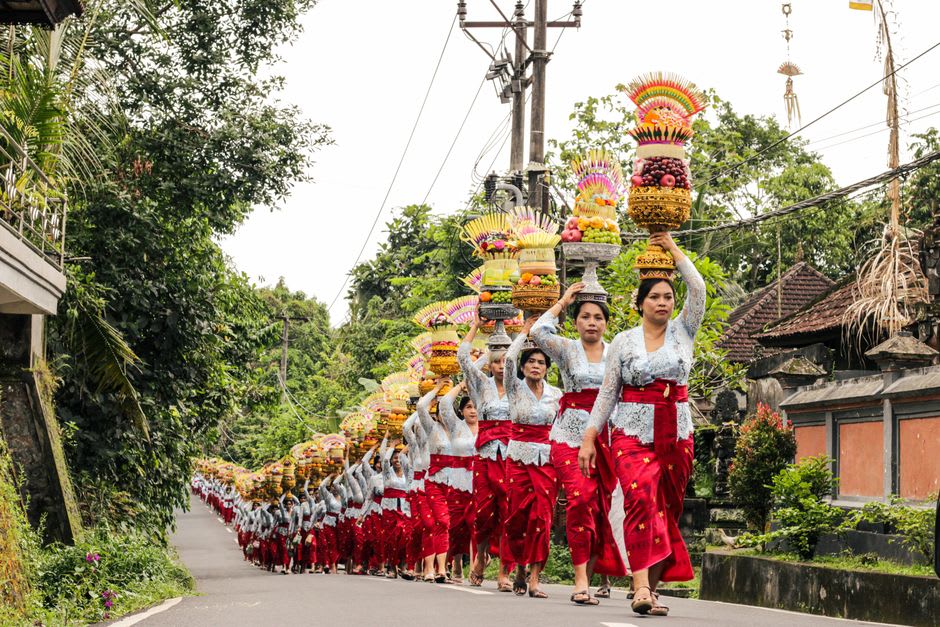
Besakih is still an active, functioning temple complex, not a ruin preserved for visitors, and that changes how you’re meant to move through it. Ceremonies happen constantly — Odalan anniversary festivals, purification rites, individual clan observances — and non-Hindu visitors are generally kept to designated paths and courtyards rather than allowed into the innermost sanctums, which felt right to me rather than restrictive. I went during a smaller, non-major ceremony and watched women carry towering fruit-and-flower offerings, gebogan, balanced on their heads up the same stone stairs pilgrims have climbed for a millennium, incense smoke drifting sideways in the mountain wind.
When to go: Dry season, April through October, for clearer views of Agung and easier road access; if you can time a visit around an Odalan ceremony, the complex comes alive in a way no ordinary visit will show you, though dress modestly and stay on designated paths regardless.